
MXene materials represent one of the most significant discoveries in two-dimensional materials science since graphene. First synthesized in 2011 at Drexel University, MXenes have rapidly emerged as a leading material for energy storage, electromagnetic shielding, sensing, and flexible electronics — combining electrical conductivity, hydrophilicity, and solution processability in a single material family that no prior 2D material could match.
What Are MXene Materials?
MXenes are a family of two-dimensional transition metal carbides, nitrides, and carbonitrides produced by selectively etching the “A” layer from MAX phase precursors. MAX phases are layered ternary carbides or nitrides with the general formula Mn+1AXn, where M is an early transition metal (titanium, vanadium, niobium, molybdenum), A is an A-group element (typically aluminium or silicon), and X is carbon or nitrogen.
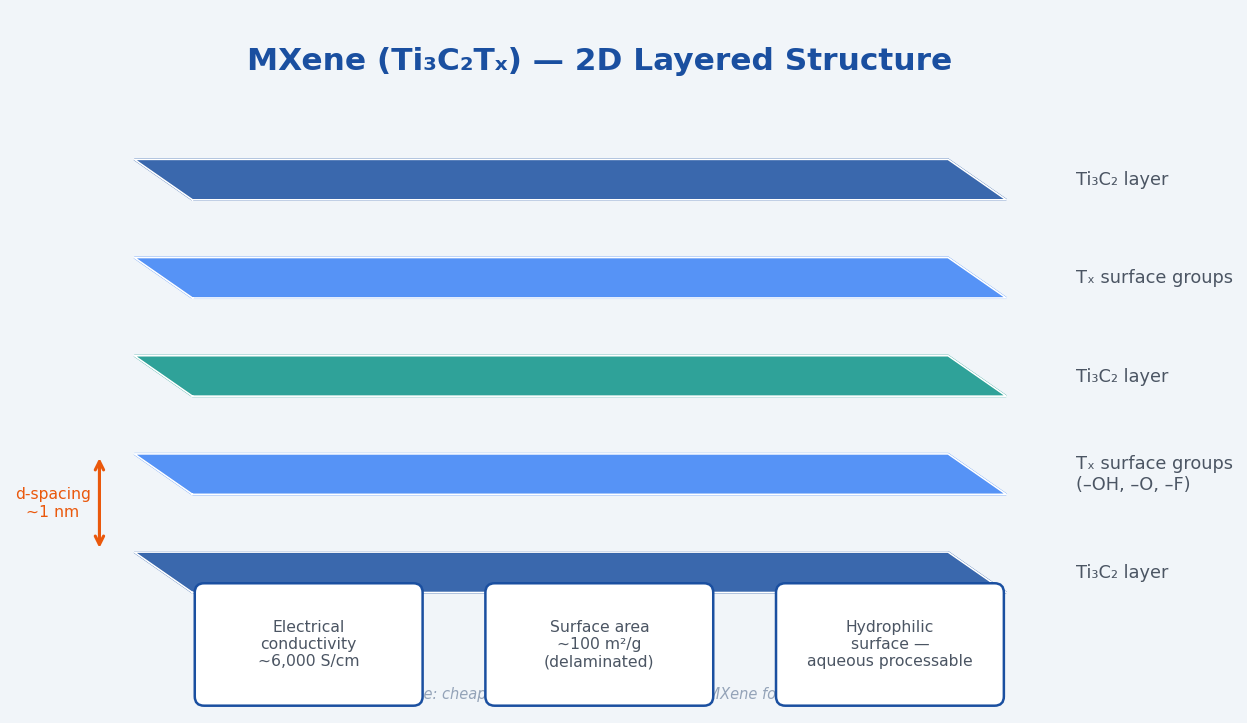
When the A layer is removed — most commonly using hydrofluoric acid or fluoride salt etchants — the result is a stack of MX layers with surface terminations of –OH, –F, and –O groups. These surface groups are critical: they make MXene surfaces hydrophilic and negatively charged, allowing MXene flakes to disperse readily in water without surfactants, form stable colloidal solutions, and be processed into films, coatings, and composites using standard solution-processing techniques.
The most widely studied MXene is Ti₃C₂Tₓ (titanium carbide MXene), derived from Ti₃AlC₂ MAX phase. It combines metallic electrical conductivity (~6,000 S/cm in thin films, exceeding most other 2D materials), high volumetric capacitance, and solution processability that makes it far easier to work with than graphene or transition metal dichalcogenides.
Key Properties of Ti₃C₂Tₓ MXene
The properties that make Ti₃C₂Tₓ MXene exceptional for device applications stem from its unique combination of metallic conduction in a hydrophilic, solution-processable 2D material:
- Electrical conductivity — thin films of Ti₃C₂Tₓ reach conductivities of 2,000–6,000 S/cm, comparable to metallic thin films and orders of magnitude above graphene oxide or reduced graphene oxide films of similar thickness
- Volumetric capacitance — Ti₃C₂Tₓ electrodes demonstrate volumetric capacitances of 900–1,500 F/cm³, among the highest reported for any electrode material, making it ideal for compact energy storage devices
- Electromagnetic shielding — a 45 µm thick Ti₃C₂Tₓ film achieves electromagnetic interference shielding effectiveness of over 90 dB — exceeding copper foil of the same thickness — due to the combination of high conductivity and multiple internal reflection at the 2D flake interfaces
- Solution processability — MXene flakes disperse in water at concentrations up to 30 mg/mL without surfactants, enabling spray coating, spin coating, vacuum filtration, and inkjet printing without organic solvents
- Mechanical flexibility — free-standing MXene films (MXene paper) can be bent and flexed without loss of electrical properties, enabling integration into flexible and wearable devices
- Tuneable surface chemistry — the ratio of –F, –OH, and =O surface terminations can be controlled through synthesis conditions and post-processing, modifying electrochemical behaviour and interlayer spacing
MXene for Energy Storage
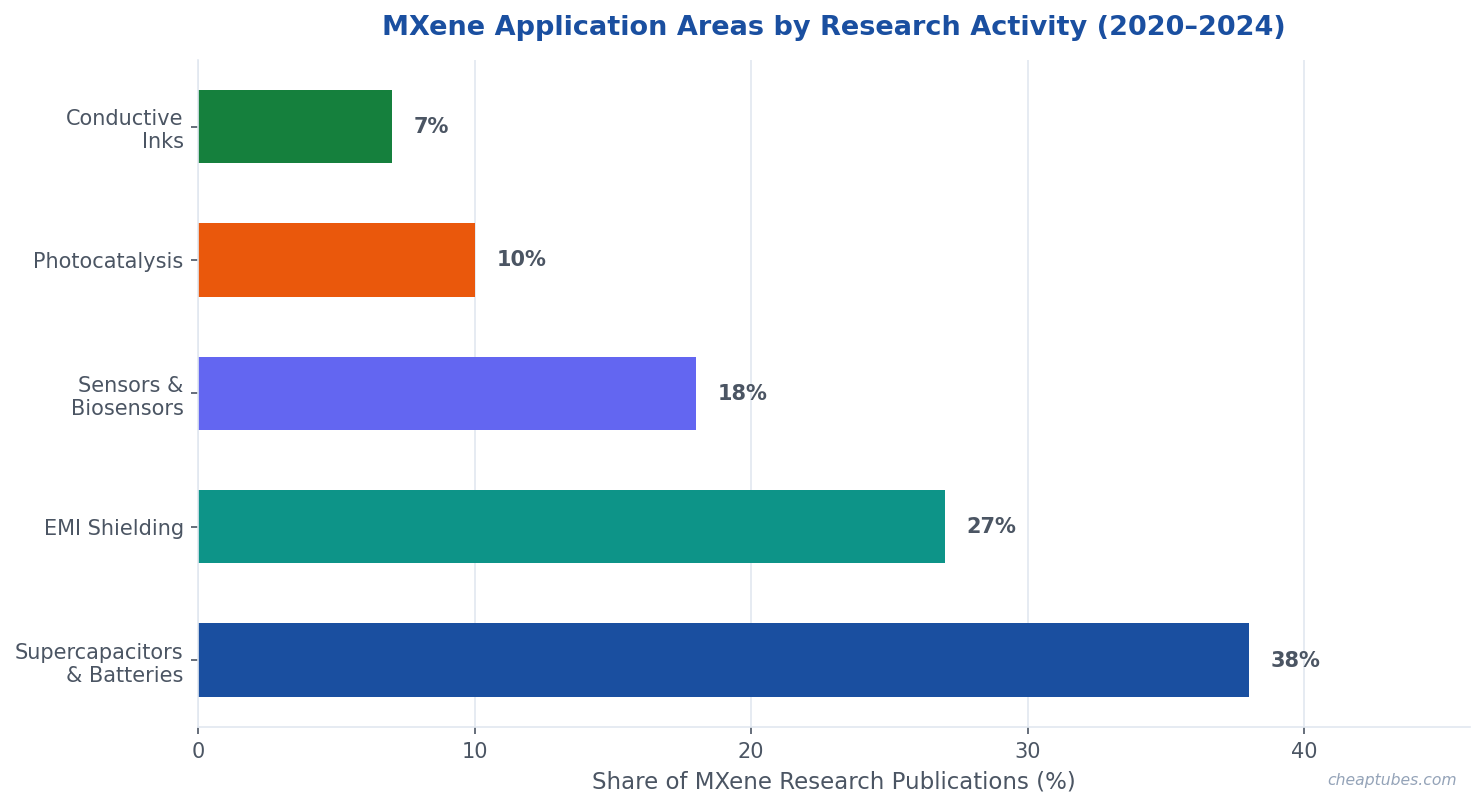
Energy storage represents the most extensively studied application for MXene materials. Ti₃C₂Tₓ functions as an exceptional pseudocapacitive electrode material — charge storage occurs not only through double-layer capacitance at the surface but through fast, reversible redox reactions involving the surface termination groups and titanium oxidation states. This pseudocapacitive mechanism gives volumetric capacitances far exceeding conventional activated carbon electrodes while maintaining the fast charge/discharge kinetics of a supercapacitor rather than the slow diffusion-limited behaviour of a battery.
MXene electrodes have been demonstrated in both aqueous and organic electrolyte supercapacitors, as well as in hybrid devices combining MXene pseudocapacitance with battery-type electrode materials. In lithium-ion batteries, Ti₃C₂Tₓ has been explored as an anode material, delivering capacities around 400 mAh/g with excellent rate capability. For sodium-ion and potassium-ion batteries — where graphite anodes perform poorly — MXene anodes show promise due to the larger interlayer spacing that accommodates the bigger Na⁺ and K⁺ ions.
Composite electrodes combining MXene with graphene oxide or reduced graphene oxide address MXene’s tendency to restack — the graphene sheets act as spacers between MXene flakes, preserving the accessible surface area and maintaining high capacitance even after repeated cycling.
MXene for Electromagnetic Interference Shielding
The electromagnetic shielding performance of Ti₃C₂Tₓ MXene has generated significant commercial interest. Traditional EMI shielding materials — copper, aluminium, carbon fibre composites — are heavy, rigid, or require high loadings in polymer matrices. MXene films achieve exceptional shielding at thicknesses and weights that no prior material could match.
The shielding mechanism in MXene differs from purely absorptive materials: the primary mechanism is reflection from the highly conductive surface, supplemented by multiple internal reflections as the electromagnetic wave passes through the layered MXene structure. This makes MXene effective across a broad frequency range from kHz to GHz.
For flexible electronics and wearable devices where weight and conformability matter, MXene coatings applied by spray or dip coating can impart EMI shielding to fabric, polymer films, and foam substrates at loadings well below those required for carbon nanotube or graphene-based coatings to achieve comparable shielding effectiveness.
MXene for Sensing Applications
The sensitivity of MXene’s electrical properties to surface interactions makes it a natural sensing material. Ti₃C₂Tₓ has been demonstrated in gas sensors, pressure sensors, strain sensors, biosensors, and temperature sensors — often outperforming graphene-based sensors in specific applications due to the abundance of active surface sites from the termination groups.
For gas sensing, the surface termination groups interact selectively with different analyte molecules, causing measurable resistance changes. MXene gas sensors have demonstrated sub-ppm detection limits for volatile organic compounds, ammonia, and nitrogen dioxide at room temperature — without the elevated operating temperatures required by metal oxide sensors.
For pressure and strain sensing, the contact resistance between MXene flakes in a film changes predictably under mechanical deformation, giving gauge factors competitive with the best carbon nanotube and graphene strain sensors. The hydrophilic surface also enables direct integration with biological systems for wearable health monitoring without the biocompatibility concerns of hydrophobic carbon nanomaterials.
MXene Ink and Coating Formulations
One of MXene’s most practically useful properties is the ease with which it forms stable aqueous inks suitable for printed electronics. Unlike carbon nanotube inks (which require sonication and surfactants) or graphene inks (which require organic solvents for high-quality dispersions), Ti₃C₂Tₓ disperses spontaneously in water to form stable, highly conductive inks that can be printed by inkjet, screen printing, and aerosol jet methods.
Printed MXene antennas, electrodes, and conductive traces on flexible substrates have been demonstrated with conductivities sufficient for practical device applications — opening opportunities in printed sensors, RFID tags, flexible displays, and wearable electronics that conventional printing-compatible conductive inks (silver, carbon black) either cannot match for conductivity or cannot match for cost.
Related Reading
Go deeper on related topics:
- Essential Ingredients for Nanowire Growth — a review of what it takes to grow well-defined nanowires — relevant to MXene precursors and 2D-material synthesis.
- Most Sensitive Carbon Nanotube Photodetector — CNT-based photodetector research that shares sensing physics with MXene photodetector work.
- Graphene Biosensors — 2D-material biosensing overview — MXenes are increasingly paired with graphene in sensing platforms.
Buy MXene Materials for Research
Cheap Tubes supplies Ti₃C₂Tₓ MXene in both powder and aqueous dispersion form for research applications. Our MXene is characterised by XRD for phase purity, SEM for flake morphology, and conductivity measurement of pressed pellets for each production lot. Certificate of analysis included with every order.
For groups working on MXene composite electrodes, EMI shielding films, or printed electronics, we can provide technical guidance on dispersion preparation, film formation, and integration with complementary materials including graphene oxide and graphene nanoplatelets. Contact our team for bulk pricing and custom specifications.