
What Are Carbon Nanotube Composites?
Carbon nanotube (CNT) composites are advanced materials formed by dispersing carbon nanotubes — either single-walled (SWCNT) or multi-walled (MWCNT) — into a host matrix such as a polymer, metal, ceramic, or carbon-based system. The resulting material inherits dramatically enhanced mechanical, thermal, and electrical properties compared to the unfilled matrix alone. Even at very low loading levels, typically 0.1–5 wt%, the extraordinary aspect ratio and surface area of CNTs can transform an ordinary matrix into a high-performance engineering material.
First demonstrated experimentally in the mid-1990s, CNT composites have grown from a laboratory curiosity into a commercially relevant class of materials used in aerospace structures, automotive components, sporting goods, EMI shielding enclosures, and conductive films. Understanding how to select, disperse, and process CNTs within a chosen matrix is essential to unlocking the full potential of this technology.
Types of CNT Composites
Polymer Matrix Composites
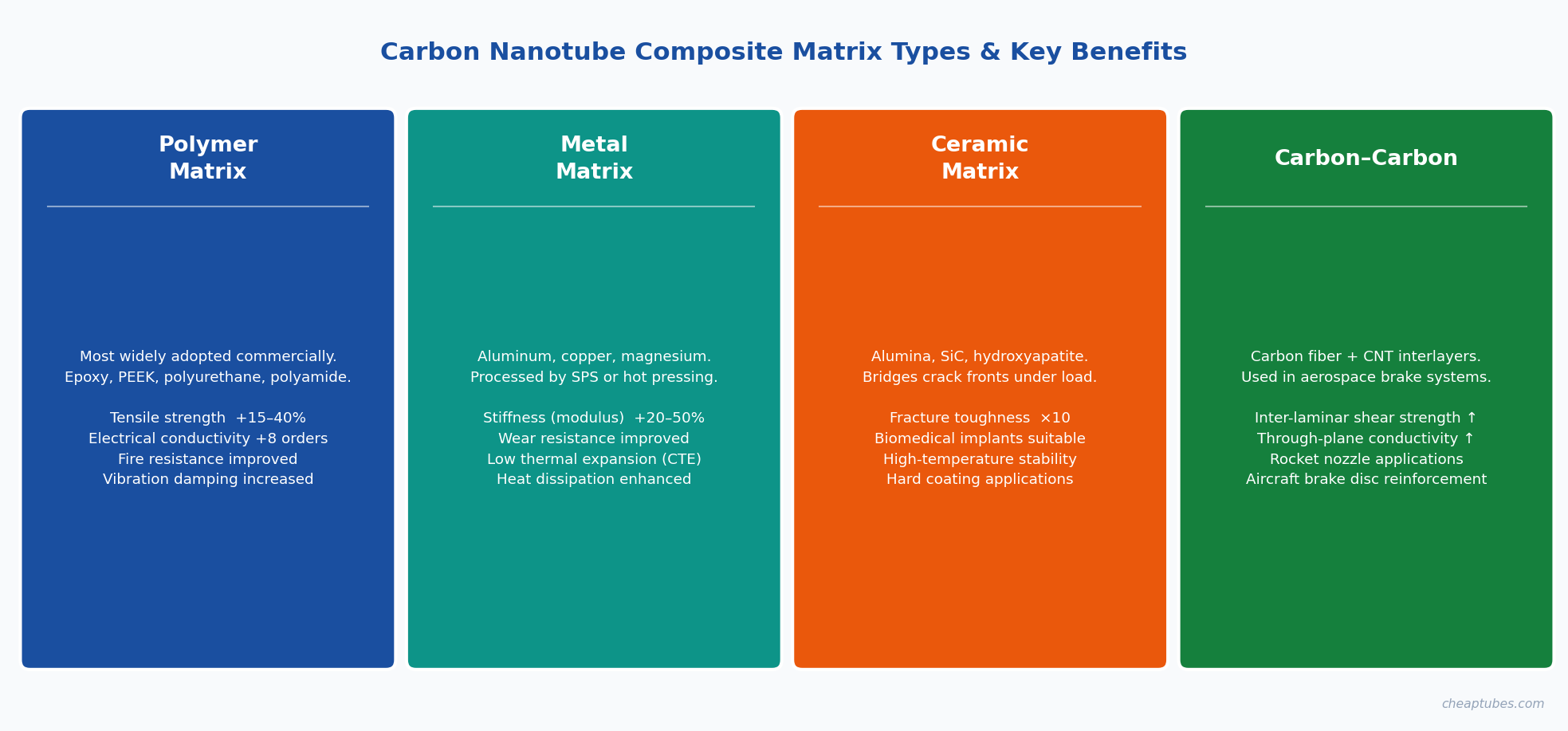
Polymer matrix composites are by far the most widely studied category. Epoxy resins, polyamides, polypropylene, PEEK, and polyurethane have all been combined with both SWCNTs and MWCNTs. The primary challenges are achieving uniform dispersion and strong interfacial adhesion between the CNT surface and the polymer chains. Surface functionalization — covalent attachment of carboxyl (–COOH) or amine (–NH₂) groups — improves wettability and load transfer but can introduce defects that slightly reduce the intrinsic CNT properties.
Common processing routes include solution blending (dissolving polymer and dispersing CNTs in solvent before casting or spinning), melt compounding (mixing CNTs into molten thermoplastics via twin-screw extrusion), and in-situ polymerization (growing the polymer in the presence of dispersed nanotubes). Each method offers trade-offs between dispersion quality, scalability, and residual solvent concerns.
Metal Matrix Composites
Aluminum, copper, magnesium, and titanium matrices reinforced with CNTs offer the prospect of lightweight structural components with stiffness and thermal conductivity approaching that of continuous carbon fiber while retaining the ductility of the base metal. Powder metallurgy — mixing CNT powder with metal powder and consolidating by spark plasma sintering (SPS) or hot isostatic pressing — is the most common fabrication route because it avoids the high temperatures that can damage nanotubes or cause unwanted carbide formation.
Al–CNT composites with 1–2 wt% MWCNT loading have demonstrated tensile strength improvements of 20–50% over unreinforced aluminum alloys, along with higher wear resistance and lower coefficients of thermal expansion — properties valued in precision electronic packaging and heat sinks for power electronics.
Ceramic Matrix Composites
Brittle ceramics such as alumina, silicon carbide, and hydroxyapatite gain significant toughness when CNTs bridge crack fronts and deflect propagating fractures. CNT-reinforced hydroxyapatite composites are of particular interest in biomedical implant research because the nanotube network can mimic the collagen-mineral hierarchy of natural bone while improving fracture toughness by an order of magnitude over monolithic hydroxyapatite.
Carbon–Carbon Composites
Adding CNTs to conventional carbon fiber-reinforced carbon (C/C) matrices improves the through-thickness thermal conductivity and inter-laminar shear strength — persistent weak points in traditional C/C composites used in aircraft brake discs and rocket nozzles. The synergy between microscale carbon fibers and nanoscale CNTs creates a multi-scale reinforcement architecture that addresses failures at multiple length scales simultaneously.
Key Mechanical Properties and Improvements
Individual SWCNTs exhibit a Young’s modulus near 1 TPa and tensile strength of 50–150 GPa — values that far exceed steel on a specific (per-unit-mass) basis. Translating these intrinsic properties into macroscopic composite performance depends on several factors:
- Dispersion state: Agglomerated bundles act as stress concentrators and dilute reinforcement efficiency. Achieving individualized, well-dispersed tubes is the central challenge in CNT composite processing.
- Aspect ratio: Longer tubes (high aspect ratio) provide more efficient load transfer along their length. MWCNTs with diameters of 10–30 nm and lengths of 5–50 µm are common choices for structural composites.
- Alignment: Aligned CNT arrays can improve tensile modulus along the fiber axis by 2–5× compared to randomly oriented composites at the same loading level. Electric field, magnetic field, shear-flow, and fiber-spinning techniques all enable partial alignment.
- Interfacial bonding: Covalent functionalization provides strong bonding but reduces CNT perfection. Non-covalent approaches using surfactants or pyrene derivatives preserve tube integrity while still improving wetting.
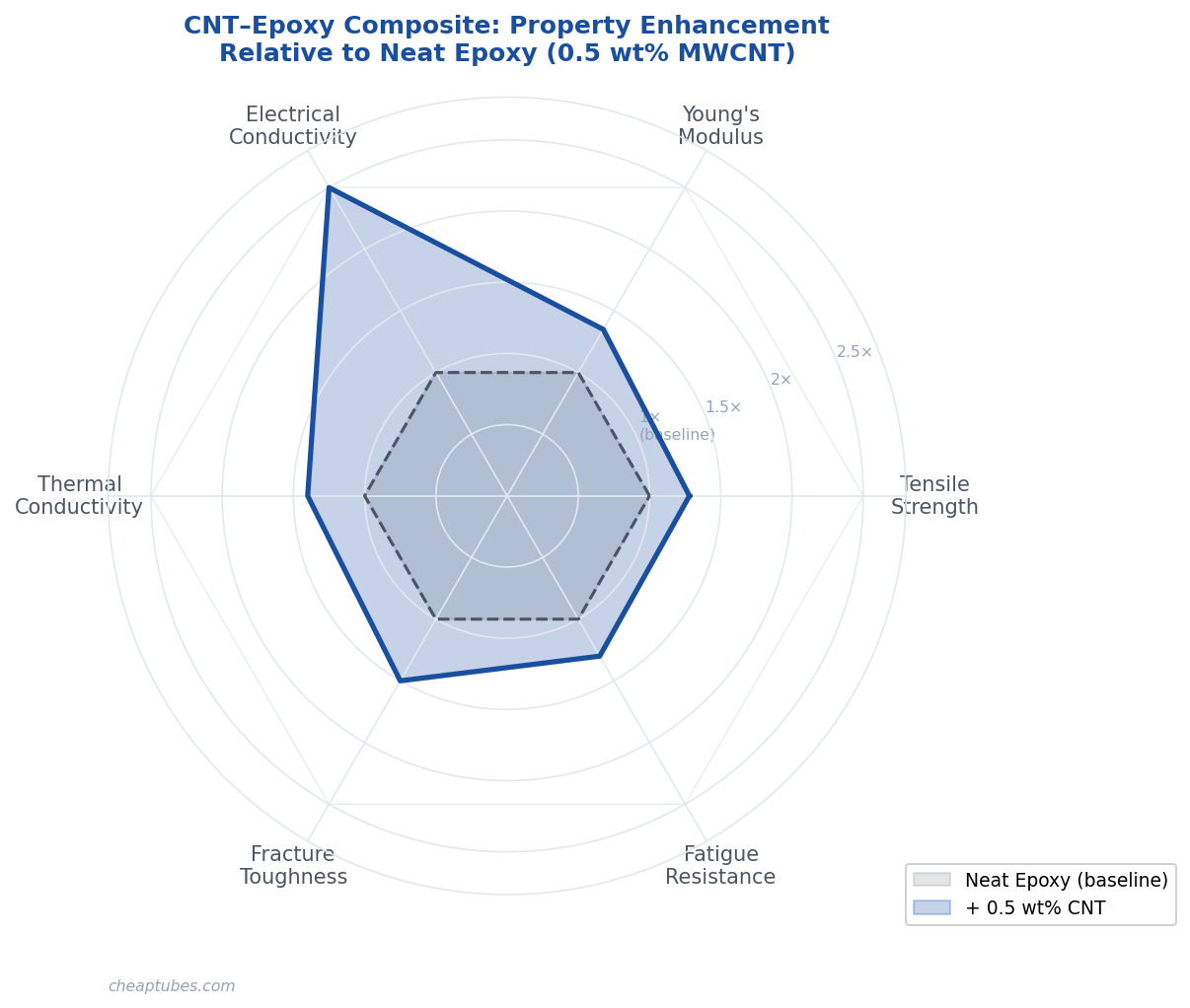
In practice, epoxy-CNT composites at 0.5 wt% loading typically achieve 20–40% improvement in tensile modulus, 15–30% increase in tensile strength, and meaningful gains in fracture toughness (KIc) relative to neat resin. Higher loadings are possible but begin to encounter re-agglomeration and viscosity challenges during processing.
Electrical and Thermal Properties
CNTs are exceptional electrical conductors along their axis, with individual metallic SWCNTs carrying current densities exceeding 10⁹ A/cm² — roughly 1,000× that of copper. Incorporating just 0.1–1 wt% of well-dispersed CNTs into an insulating polymer can induce a conductor-to-semiconductor or insulator-to-conductor transition, producing an electrically percolating network useful for antistatic packaging, electromagnetic interference (EMI) shielding, and piezoresistive strain sensing.
The percolation threshold — the critical CNT concentration where continuous conductive pathways form — depends strongly on aspect ratio. High-aspect-ratio MWCNTs can percolate at loadings as low as 0.05 wt%, far below conventional carbon black or graphite additives. This means composites can be made conductive while adding minimal mass and maintaining optical transparency in thin films.
Thermal conductivity improvements in CNT composites are more modest than the intrinsic nanotube values would suggest, largely because phonon scattering at nanotube–matrix interfaces limits heat conduction. Aligned CNT arrays grown directly on substrates (so-called “CNT forests”) outperform randomly dispersed composites because they minimize interface density. Nonetheless, 20–100% improvements in through-plane thermal conductivity have been reported for CNT-filled epoxies and thermoplastics, relevant for thermal interface materials in electronics cooling.
Applications of CNT Composites
Aerospace and Defense
Airframe skins, radomes, and structural panels benefit from CNT composites through weight savings, increased stiffness-to-weight ratio, and built-in electrical conductivity for lightning strike protection — an important certification requirement for composite aircraft. Boeing and Airbus have both publicly explored CNT-enhanced prepreg systems that reduce the need for embedded copper mesh for lightning protection, saving significant weight per aircraft.
Automotive
Body panels, mirror housings, and underhood components made from CNT-modified thermoplastics achieve the conductivity needed for electrostatic spray painting — a critical manufacturing step — at lower loadings than carbon black, enabling thinner walls and lighter parts. CNT composites also find use in fuel system components that require electrostatic dissipation to prevent ignition hazards.
Sporting Goods
Tennis rackets, bicycle frames, golf club shafts, and hockey sticks made with CNT-modified epoxy laminates achieve higher stiffness and vibration damping simultaneously — a combination difficult to achieve with conventional fiber reinforcement alone. CNTs in the resin interlayers between carbon fiber plies act as crack-arresting bridges that reduce delamination under impact.
Wearable Electronics and Smart Textiles
CNT-loaded elastomers and fibers enable stretchable conductors, pressure sensors, and actuators compatible with body-worn devices. The piezoresistive response of CNT networks — where resistance changes predictably with strain — is exploited in gloves that capture hand gesture data, compression bandages that monitor swelling, and e-skin patches for continuous vital sign monitoring.
Biomedical
Functionalized CNTs in biocompatible polymer scaffolds guide nerve cell growth and provide electrical stimulation pathways for neural regeneration research. CNT-reinforced bone cements and hydroxyapatite scaffolds show improved fracture resistance in orthopedic implant applications. Rigorous biocompatibility and toxicology studies remain essential as these applications advance toward clinical use.
Dispersion Methods and Processing Tips
Achieving high-quality CNT dispersion is the most common bottleneck in composite fabrication. The main approaches are:
- Ultrasonication: Probe or bath sonication in solvent breaks apart bundles through cavitation. Extended sonication times increase dispersion quality but also shorten CNTs. Typical protocols use 30–60 minutes of probe sonication at controlled temperatures to limit tube damage.
- Ball milling: Effective for dry blending of CNTs with metal or ceramic powders but can introduce structural defects. High-energy ball milling with process control agents like stearic acid is standard for metal matrix composite preparation.
- Calendering / three-roll milling: Preferred for high-viscosity epoxy systems; provides shear-intensive mixing without solvent and is scalable to production volumes.
- Functionalization: Acid treatment (refluxing in H₂SO₄/HNO₃ mixtures) attaches carboxyl and hydroxyl groups that improve wettability in polar matrices. Degree of functionalization is monitored by Raman spectroscopy D/G band ratios — a rising D/G ratio indicates increasing defect density.
- Master batch dilution: Pre-dispersing CNTs at high concentration in a compatible carrier resin, then diluting into the final matrix, often produces better results than adding CNTs directly to the full formulation.
Characterization and Quality Control
Standard characterization methods for CNT composites include scanning electron microscopy (SEM) for fracture surface analysis, transmission electron microscopy (TEM) for dispersion quality at the nanoscale, Raman spectroscopy for CNT structural integrity, thermogravimetric analysis (TGA) for CNT content and thermal stability, dynamic mechanical analysis (DMA) for storage modulus and damping, and four-point probe resistivity measurements for electrical percolation studies.
Consistent CNT raw material quality is a prerequisite for reproducible composite properties. Key CNT specifications to verify from suppliers include: purity (metal catalyst residue content), outer diameter distribution, length distribution, aspect ratio, surface area (BET), and Raman G/D ratio as an indicator of wall quality. Multi-walled carbon nanotubes and single-walled carbon nanotubes from Cheap Tubes are characterized by TEM, Raman, and TGA before shipment, with certificates of analysis available for each lot.
Selecting CNTs for Your Composite Application
The choice between SWCNTs and MWCNTs, and the specific diameter and length within each class, depends on the target property. For maximum electrical conductivity at the lowest loading, SWCNTs or thin MWCNTs (OD 8–15 nm) with very high aspect ratio are preferred. For structural reinforcement in demanding mechanical applications, longer MWCNTs (OD 20–30 nm, length 10–50 µm) provide excellent load transfer at moderate cost. For thermal interface materials requiring high through-plane conductivity, aligned CNT arrays or short, thick MWCNTs with minimum tube–tube junctions are often optimal.
Functionalized variants — carboxyl-functionalized, hydroxyl-functionalized, or amine-functionalized MWCNTs — are available for applications where direct covalent bonding to the matrix is required. Functionalized carbon nanotubes simplify integration into epoxy, polyurethane, and water-based systems without requiring custom acid treatment steps in-house.
Research-Grade CNTs for Composite Development
Cheap Tubes supplies research- and industrial-grade carbon nanotubes to composite developers, universities, and manufacturers worldwide. Our inventory includes pristine and functionalized SWCNTs and MWCNTs in gram-to-kilogram quantities, with consistent lot-to-lot quality backed by full analytical documentation. Whether you are screening CNT types for a new composite formulation or scaling an established process, we provide the technical datasheets and application support to accelerate your work.
Contact us to discuss your composite application requirements or to request samples for initial dispersion trials.
Specialty CNT grades for demanding composites: Beyond standard straight-tube MWCNTs, specialized architectures like helical multi-walled carbon nanotubes deliver unique mechanical interlocking and electromagnetic response for advanced composite designs.
Related Reading
Go deeper on related topics:
- History and Production Methods of Carbon Nanotubes — how CNTs are actually synthesized at scale — context for why certain composite grades perform the way they do.
- Functionalization of Graphene Nanoplatelets in Epoxy Composites — peer-reviewed mechanical data on surface chemistry and filler-matrix bonding.
- Graphene Sensors — how graphene and CNTs compare in strain and gas sensing applications.
- Fullerenes: Structure, Properties, and Applications — sp² carbon allotrope family context; useful background for CNT composite researchers exploring fullerene-reinforced systems.