
Helical Multi Walled Carbon Nanotubes
Helical Multi Walled Carbon Nanotubes
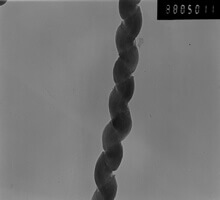
Helical Multi Walled Carbon Nanotubes are grown to be wrapped around each other in a helix pattern.
The content of helical structure CNTs is about 80wt%. The rest is standard CNTs. The total CNTs content is more than 90wt%, and most of the CNTs have 100-200nm outer diameter.
To find the price for a specific product and quantity, please click thru to the individual product page and enter the quantity you need.
Our website will display the price for that specific quantity. Quotes are available online thru our cart.
Simply add the products and quantities you need into the cart and then you can print or download a quote.
Showing the single result
What Are Helical Carbon Nanotubes?
Helical multi-walled carbon nanotubes (HMWCNTs) — also called coiled, spring-shaped, or toroidal CNTs — are a structurally distinct form of multi-walled nanotube in which the tube axis follows a helical path rather than a straight line. This coiled geometry arises from the periodic introduction of five- and seven-membered carbon rings (pentagons and heptagons) into the otherwise hexagonal graphene lattice during synthesis. Each pentagon introduces a positive curvature and each heptagon introduces a negative curvature; alternating pairs produce the regular helical winding observed in HMWCNTs.
Cheap Tubes offers helical MWCNTs with outer diameters of 100–200 nm and a helical content exceeding 80 wt% of the product. The remaining fraction consists of standard straight MWCNTs that grow simultaneously during synthesis. Total CNT content exceeds 90 wt%.
Structural Characteristics
| Property | Value |
|---|---|
| Outer Diameter | 100–200 nm |
| Coil Diameter | 300–500 nm |
| Helical Pitch | Variable (100–500 nm) |
| Helical Content | >80 wt% |
| Total CNT Purity | >90 wt% |
| Carbon Content | >90% |
| Synthesis Method | CVD with specific catalysts |
The coiled geometry has been confirmed by selected area electron diffraction (SAED) and high-resolution transmission electron microscopy (HRTEM), which reveal the graphitic layered wall structure and the continuous winding of the tube axis. Variable helix angles and polygonal cross-sections are observed at high magnification, consistent with the stress induced by the topological defects that drive helical growth.
Unique Properties Arising from Helical Geometry
The spring-like geometry of helical CNTs gives them properties not found in straight nanotubes. Most significantly, HMWCNTs behave as nanoscale mechanical springs with exceptionally high resilience — they can be compressed and stretched repeatedly without plastic deformation, recovering their original geometry elastically. This is analogous to a macroscopic metal coil spring, but at nanoscale dimensions and with carbon’s characteristic low density and high chemical stability.
The helical winding also generates a continuous magnetic moment when carrying current, giving HMWCNTs intrinsic electromagnetic inductance not present in straight CNTs. This property is being explored for microwave absorption, nanoscale inductors, and electromagnetic metamaterials.
Applications of Helical Carbon Nanotubes
Electromagnetic Wave Absorption
The most commercially advanced application for HMWCNTs is microwave and radar absorption. The helical geometry creates a resonant electromagnetic structure that couples efficiently to electromagnetic waves, converting microwave energy to heat through ohmic losses. At 5–30 wt% loading in rubber or polymer matrices, HMWCNT composites achieve reflection loss exceeding 20 dB (99% microwave absorption) across broad frequency ranges (2–18 GHz). This performance surpasses standard CNT composites of equivalent loading and makes HMWCNTs attractive for stealth coatings, EMI suppression, and anechoic chamber linings.
Mechanical Damping and Vibration Absorption
The spring-like mechanical behavior of HMWCNTs contributes to viscoelastic damping in polymer composites. At loadings of 1–5 wt%, HMWCNT composites show loss factors (tan δ) 2–5× higher than straight MWCNT composites at equivalent loading — a direct consequence of the reversible deformation and energy dissipation of the helical structure. Applications include vibration-damping structural panels, acoustic insulation composites, and impact-absorbing padding.
Stretchable and Flexible Electronics
When embedded in elastic substrates (PDMS, polyurethane), helical CNTs maintain electrical conductivity under large strains (50–200%) by accommodating substrate deformation through spring extension, rather than through plastic deformation of the nanotube itself. This makes HMWCNT/elastomer composites promising for stretchable electrodes in wearable sensors, artificial muscles, and soft robotics — applications where straight CNT networks lose conductivity under repeated stretching.
Nanoscale Sensing
Individual helical CNTs have been demonstrated as nanoscale force sensors, where the spring constant of the helix can be determined from resonance frequency measurements in a TEM. Arrays of HMWCNTs potentially function as nanoscale pressure sensors, accelerometers, or mass detectors with sensitivities far exceeding conventional MEMS devices.
Composite Reinforcement
The helical morphology provides mechanical interlocking with polymer matrices that straight CNTs do not offer. This enhances interfacial adhesion without chemical functionalization, improving stress transfer efficiency. HMWCNT-reinforced epoxy composites show 30–50% higher impact strength than straight MWCNT composites at equivalent loading, due to the crack-bridging and energy-dissipating behavior of the coiled tubes at fracture surfaces.
Research Background
Helical CNTs were first reported in the early 1990s and have been studied extensively for their unusual electromagnetic and mechanical properties. Their synthesis remains more challenging than straight MWCNTs — requiring specific catalyst formulations and CVD conditions to favor helical growth — which limits their availability and keeps pricing higher than standard MWCNTs. Cheap Tubes is one of the few commercial suppliers offering HMWCNTs in gram quantities for research and early-stage development.
Pricing is $12–15/g depending on quantity. Contact us for bulk pricing and to discuss application-specific requirements. SDS documentation is available from our SDS page.
Showing the single result