
By Mike Foley, Founder, Cheap Tubes Inc. · Last reviewed: April 30, 2026
TL;DR: Choosing single-walled carbon nanotubes comes down to four decisions: diameter (typical 1–2 nm; affects metallic/semiconducting ratio and bandgap), length (short 1–4 nm cuts vs standard micron-length tubes; controls dispersion and percolation behavior), purity (industrial-grade 90%+ vs research-grade 95%+ vs ultra-high 99%+), and functionalization (pristine vs COOH/OH/NH₂ surface groups, depending on whether you need conductivity or chemistry). For battery and supercapacitor electrodes, choose our pristine SWCNT 95%. For polymer composites and conductive inks, COOH-functionalized SWCNT-DWCNT mixes at $77.80–$125/g. For biomedical and drug-delivery, the NH₂-functionalized 99% grade or short COOH/OH variants. For transparent conductive films and OFETs, the high-purity 99% pristine grade. Every Cheap Tubes order ships with a Technical Data Sheet (TDS) and Safety Data Sheet (SDS).
What is a Single Walled Carbon Nanotube?
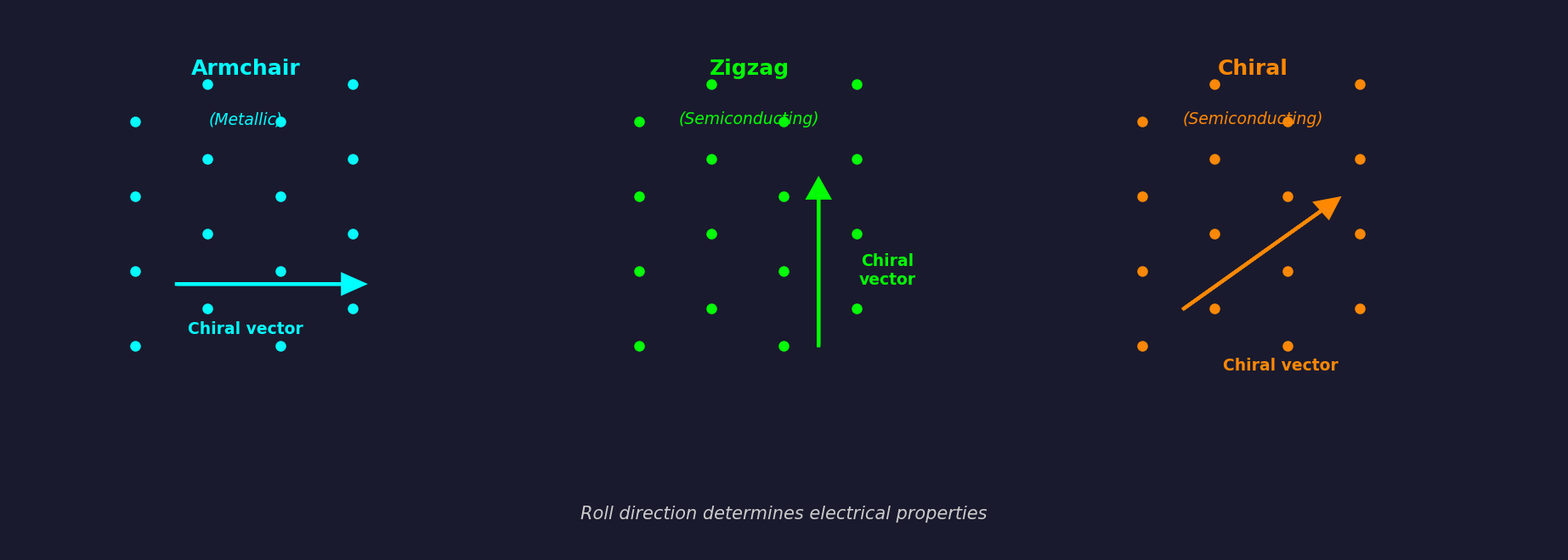
A single-walled carbon nanotube (SWCNT) is a hollow cylindrical molecule formed by rolling a single sheet of graphene into a tube approximately 0.7–2 nm in diameter and several micrometers in length. SWCNTs exhibit either metallic or semiconducting electronic behavior depending on their chirality, tensile strength up to 63 GPa per tube, and aspect ratios of 1,000–10,000, making them the benchmark nanocarbon for transparent conductive films, organic field-effect transistors, sensors, biomedical conjugation chemistry, and lithium-ion battery conductive networks.
On this page
- 1. The Four Decisions That Determine Which SWCNT You Need
- 2. Quick Comparison: SWCNT Product Lines at a Glance
- 3. Decision Tree by Application
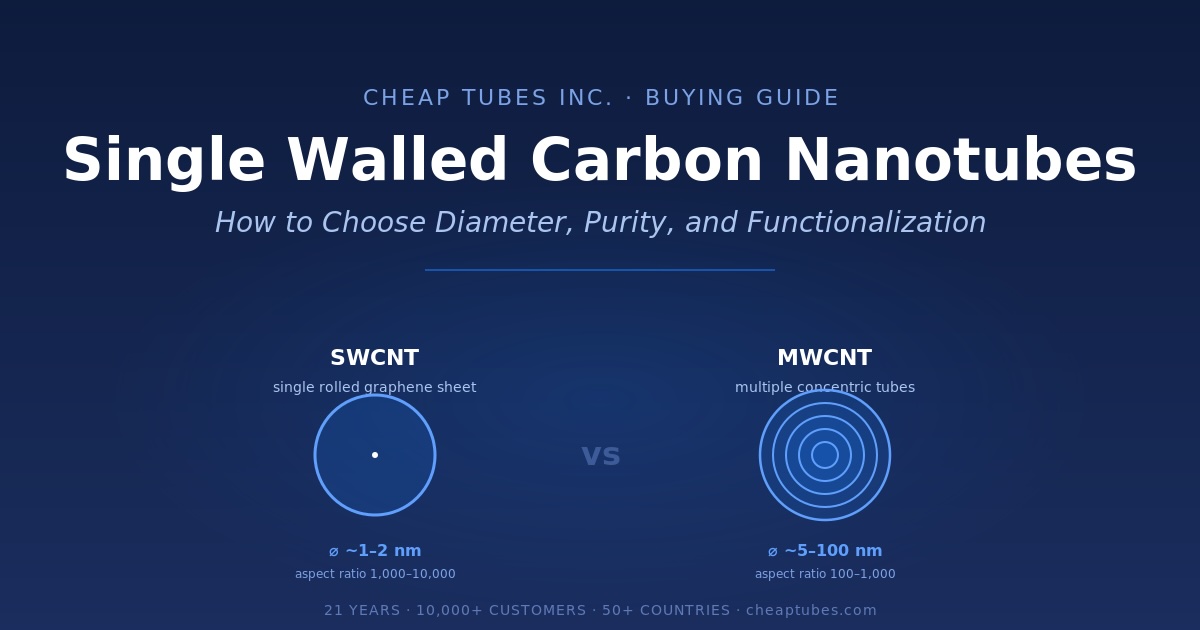
- 4. SWCNT vs MWCNT: Which Do You Actually Need?
- 5. Selecting a SWCNT Supplier
- 6. Characterization and Purity Verification
- 7. Synthesis Methods
- 8. Functionalization: Pristine vs Surface-Modified
- 9. Choosing the Right Purity Grade
- 10. Solubility, Dispersion, and Handling
- 11. Frequently Asked Questions
- 12. Related Resources and Products
1. The Four Decisions That Determine Which SWCNT You Need
Single-walled carbon nanotubes are not a single material. The properties of a SWCNT (its bandgap, conductivity, mechanical strength, surface chemistry, and processability) depend on four parameters that you, the buyer, control through product selection.
Diameter and chirality. SWCNT diameter (typically 1–2 nm) determines bandgap, the metallic-to-semiconducting ratio, and Raman fingerprint. Smaller-diameter tubes (~0.7–1 nm) are mostly semiconducting; larger-diameter tubes (~1.4–2 nm) include more metallic species. Most commercial SWCNTs are mixtures; chirality-pure SWCNTs require post-synthesis sorting and are dramatically more expensive.
- Length and aspect ratio. Standard SWCNTs are micrometer-length tubes: these give the highest aspect ratio for percolation and mechanical reinforcement, but disperse less easily. Short SWCNTs (1–4 nm cut by oxidative scissoring or mechanical milling) disperse readily and integrate well into polymer matrices, but lose some of the network-forming advantage.
- Purity grade. Industrial-grade 90%+ is suitable for bulk composites and exploratory work. Research-grade 95%+ is the workhorse for most published electrochemistry and device research. Ultra-high purity 99%+ is required for OFET fabrication, transparent conductive films, biomedical work, and any application where trace amorphous carbon, residual catalyst, or metallic impurities skew measurements.
- Surface functionalization. Pristine SWCNTs have hydrophobic, low-reactivity surfaces. Choose pristine when conductivity is the metric. Functionalized SWCNTs (COOH, OH, NH₂) sacrifice some conductivity in exchange for hydrophilicity, dispersibility, and reactive sites for conjugation chemistry.
Common SWCNT buying pitfalls to avoid
- Buying by carbon purity alone: a 95% carbon spec can still hide 30% MWCNTs. Always ask for SWCNT-specific purity verified by Raman or thermogravimetric analysis.
- Ordering pristine SWCNTs for water-based formulations: pristine tubes will not disperse without surfactants or sonication-induced shortening. Order COOH or OH functionalized grades for aqueous work.
- Specifying ultra-long tubes when short tubes are needed: TFTs, sensors, and inkjet inks need 0.5–2 µm shortened tubes; ultra-long pristine tubes will jam print heads and clog filtration.
- Skipping the SDS request: every reputable supplier provides a current SDS; if a supplier won’t share one, that is a red flag.
- Treating all CVD tubes equally: small differences in catalyst, temperature, and gas chemistry change diameter distribution and metallic-to-semiconducting ratio significantly.
2. Quick Comparison: SWCNT Product Lines at a Glance
| # | Product | Functionalization | Diameter | Length | Purity | Price (volume) | Best for |
|---|---|---|---|---|---|---|---|
| 1 | Single Walled Carbon Nanotubes 95% | None | 1–2 nm | std | 95%+ | contact for quote | Batteries, conductive inks, OPV reference acceptors, mechanical reinforcement |
| 2 | Single Walled-Double Walled Carbon Nanotubes 99% | None | 1–2 nm | std | 99%+ | contact for quote | OFET, transparent conductive films, precision photophysics |
| 3 | COOH Functionalized SWCNT-DWCNT | COOH | 1–2 nm | std | 90%+ | from $77.80/g | Polymer composites with epoxy/polyamide, conjugation chemistry, hydrophilic dispersion |
| 4 | COOH Functionalized SWCNT-DWCNT 99 | COOH | 1–2 nm | std | 99%+ | from $156.25/g | Sensitive electrochemistry, biosensor scaffolds, sub-percent contaminant work |
| 5 | OH Functionalized SWCNT-DWCNT | OH | 1–2 nm | std | 90%+ | from $78.00/g | Aqueous dispersion, hydroxyl-coupling chemistry, polar polymer composites |
| 6 | NH₂ Functionalized SWCNT-DWCNT | NH₂ | 1–2 nm | std | 99%+ | from $156.25/g | Drug delivery, antibody/peptide conjugation, amine-reactive crosslinking |
| 7 | Short COOH Functionalized SWCNT-DWCNT 1–4 nm | COOH | 1–2 nm | 1–4 nm | 90%+ | from $102/g | Polymer dispersion, biomedical, drug delivery, ink formulations |
| 8 | Short OH Functionalized SWCNT-DWCNT 1–4 nm | OH | 1–2 nm | 1–4 nm | 90%+ | from $102/g | Aqueous dispersion, biocompatible coatings, ink formulations |
Specialty options: SWCNT-DWCNT 60% and SWCNT-DWCNT 90% for industrial-grade and bulk research applications. Short SWCNT-DWCNT for ink and biomedical work where sub-micron lengths matter. Browse the full SWCNT line: SWCNT product catalog.
3. Decision Tree by Application
3.1 Lithium-ion and Lithium-Sulfur Battery Electrodes
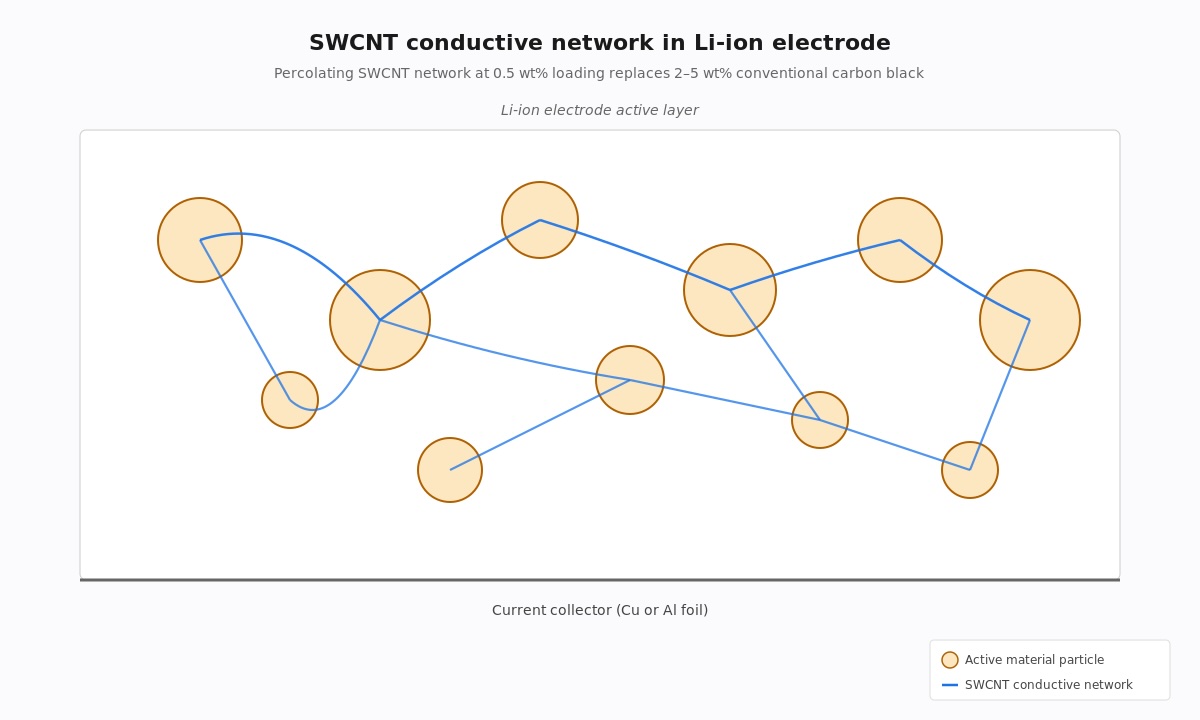
Primary: our pristine SWCNT 95%, for conductive additive replacement of carbon black at lower loading. Restored sp² conjugation gives sheet conductivity orders of magnitude above functionalized variants. Used at 0.1–1 wt% in cathode and anode formulations.
Why pristine, not functionalized: Battery electrodes need conductivity, not chemistry. Functional groups interrupt the conjugated π-system that carries current. Save the functionalized variants for matrix coupling.
Why SWCNT, not MWCNT: SWCNT delivers higher aspect ratio per gram, lowering percolation threshold. At 0.5 wt% loading, SWCNT can deliver the same conductivity contribution as 2–5 wt% MWCNT, and the inactive-mass savings translate directly to volumetric energy density.
3.2 Transparent Conductive Films (replacement for ITO)
Primary: our pristine SWCNT 99%
Transparent conductive films require: (1) high purity to minimize residual catalyst absorption, (2) consistent diameter distribution to minimize haze, (3) ability to thin-coat without bundling. The 99%+ pristine grade is the only choice that meets all three. Sheet resistance of 100–500 Ω/sq at 90% optical transparency is achievable with optimized SWCNT/surfactant dispersion and post-deposition acid treatment.
3.3 Polymer Composites — Mechanical Reinforcement
Primary: COOH-Functionalized SWCNT-DWCNT, from $77.80/g
The COOH groups improve compatibility with polar matrices (epoxy, polyamide, PVA, polyurethane) and form covalent or hydrogen bonds with curing agents. Functionalization sacrifices some conductivity but improves mechanical coupling: exactly the tradeoff you want for tensile-modulus and toughness gains.
Loading guidance: 0.25–1 wt% gives measurable property gains in well-mixed thermoset composites. Beyond 2 wt%, bundling typically reduces returns unless you’re using a high-shear mixer or extruder.
3.4 Conductive Polymer Composites and Antistatic Plastics
Primary: our pristine SWCNT 95% for percolation-controlled conductivity. Alternative: Industrial-grade SWCNT-DWCNT mixes for cost-sensitive bulk applications.
For antistatic plastics (10⁶–10⁹ Ω resistivity target), pristine SWCNTs at 0.5–1 wt% in PE, PP, ABS, or PEEK reach the percolation threshold cleanly. For EMI shielding compounds (>30 dB at 1–8 GHz), step up to 1.5–3 wt%.
3.5 Inks and Coatings (Spray, Inkjet, Slot-Die)
Primary: Short COOH Functionalized SWCNT-DWCNT 1–4 nm, from $102/g
Short SWCNTs disperse in water with COOH-mediated stability (no surfactant required), eliminating the clogging and sedimentation issues with full-length tubes. The 1–4 nm length is engineered for inkjet nozzle compatibility. For UV-curable or solvent-based inks, the OH-functionalized short variant works similarly.
Specialty option: Flexiphene aqueous nanomaterial emulsions are pre-dispersed for direct use without sonication.
3.6 Biomedical Research — Drug Delivery, Imaging, Theranostics
Primary: NH₂-Functionalized SWCNT-DWCNT 99%, from $156.25/g; or Short OH-Functionalized 1–4 nm, from $102/g for cellular-scale lengths.
Why functionalized: Pristine SWCNTs are hydrophobic and aggregate in physiological buffers. Amine groups enable covalent conjugation of antibodies, peptides, or PEG via standard EDC/NHS or maleimide chemistry. Short tubes (1–4 nm) are below the threshold for fibrosis-related concerns and are taken up by cells more readily than long fibers.
Regulatory note: SWCNT-based therapies remain research-only. The biomedical SWCNT literature is large but no SWCNT drug has FDA approval as of 2026. Standard nanomaterial PPE applies: particle containment, gloves, eye protection.
3.7 Sensors and Biosensors
Primary for chemiresistive sensors: our pristine SWCNT 99%
Primary for biosensors with target conjugation: COOH or NH₂ Functionalized 99%
SWCNT chemiresistive sensors achieve ppb-level sensitivity to NH₃, NO₂, and trace VOCs because each surface-adsorbed molecule modulates the conductivity of the entire tube. The 99%+ purity grade minimizes baseline drift from residual catalyst metal that would otherwise dominate gas-sensor noise floors.
3.8 Field-Effect Transistors and Flexible Electronics
Primary: our pristine SWCNT 99%
OFET performance scales with semiconducting purity: every metallic SWCNT in the channel shorts the device. Sorted semiconducting-enriched SWCNTs are available at 90–99% s-SWCNT content but are dramatically more expensive than mixed-purity material; the 99% pristine is the cost-effective starting point for many flexible electronics applications, with optional dielectrophoresis or selective burn-off to remove residual metallic content.
4. SWCNT vs MWCNT: Which Do You Actually Need?
The single most common buyer mistake we see in 21 years of supplying carbon nanotubes is overpaying for SWCNT when MWCNT would do the same job. The reverse mistake (buying MWCNT and discovering you needed SWCNT) is rarer but more painful because results don’t reproduce.
- Property SWCNT MWCNT
- Diameter ~0.7–2 nm ~5–100 nm
- Aspect ratio ~1,000–10,000 ~100–1,000
- Tensile strength (per tube) Up to ~63 GPa ~10–60 GPa (decreases with wall count)
- Electrical conductivity Metallic + semiconducting (chirality-dependent) Metallic-dominant; less chirality dependence
- Bandgap 0–2 eV depending on chirality ~0 (effectively metallic)
- Specific surface area ~1,300 m²/g ~200–400 m²/g
- Cost (per gram, comparable purity) ~5–20× MWCNT baseline
- Best for Transparent conductors, OFETs, biomedical, lightweight composites, photophysics Bulk composites, antistatic plastics, EMI shielding, mechanical reinforcement at scale
- Practical rule: If your published research depends on properties that scale with aspect ratio or surface area (sensor sensitivity, transparent conductive films, semiconducting-channel devices, surface chemistry per gram), SWCNT is worth the price. If you’re reinforcing polymer at 1–5 wt% loading or building bulk antistatic compounds, MWCNT is the better economic choice.
5. Selecting a SWCNT Supplier — What to Look For in 2026
The SWCNT market has changed substantially in the last 18 months. Capacity has expanded, prices have compressed, and quality dispersion across suppliers has widened. As of 2026, suppliers fall into three broad categories:
Supplier evaluation checklist
- Public batch-specific QC data: Raman spectrum, TGA curve, TEM image for the lot you are buying, not a generic datasheet
- Stable inventory and short lead time: ability to ship sample quantities from US or EU stock within 5–10 business days
- Transparent pricing tiers: sample, research, and bulk pricing posted or quoted clearly
- Current SDS available on request: jurisdiction-appropriate with proper hazard classification
- Technical depth in customer support: questions about chirality, dispersion, and characterization answered by someone who has handled the material
- Years in the SWCNT business: long-running suppliers have weathered multiple market cycles by shipping consistent material
Category A: High-volume mass producers (typically $10-25/g)
A small number of producers at industrial scale offer SWCNT material at the lowest price points in the market. The quality profile of high-volume mass-produced SWCNT is variable: characterization data may be available but is often a typical-batch fingerprint rather than a per-lot certificate, residual catalyst content can range from 5%–15%, and length distribution is broad. This material is fully usable for research and bulk composite applications where headline metrics aren’t dominated by trace contamination, and is a defensible choice for cost-sensitive research that doesn’t require lot-level reproducibility.
Category B: Specialty boutique producers (typically $300–2000+/g)
A handful of producers run small-batch chemistry with chirality enrichment, narrow-diameter selection, or proprietary growth chemistries. Their material commands premium pricing but is irreplaceable for chirality-pure photophysics, single-tube device research, and any application where a specific (n,m) population is required.
Category C: Vetted research-grade distributors (typically $50–500/g, Cheap Tubes lives here)
Distributors like Cheap Tubes serve the middle of the market: research-grade SWCNT with per-lot characterization data, multiple purity grades, and the option to scale from gram to kilogram for the same product line. We carry both economy options sourced from established mass producers (with our own QC verification) and premium grades suitable for sensitive research. The value we add is the QC step in between the producer and your bench: every lot we ship is verified against TGA purity, Raman ratio (G/D), and SEM/TEM imaging before it leaves Vermont.
Practical guidance for choosing a supplier:
- Always request a Technical Data Sheet for the specific lot you’re buying. “Typical” specs aren’t a substitute for batch-specific characterization.
- For research that will be published, save the TDS with your lab notebook: reviewers increasingly request it.
- For initial vendor evaluation, buy a 1g sample and run your own characterization: TGA for purity, Raman for graphitic quality, SEM for length distribution. A vendor that’s confident in their material won’t object to a sample order.
- Watch for “purity” claims that don’t specify the measurement method. SWCNT purity by TGA, by Raman D/G ratio, and by metals analysis are three different numbers; they should not be presented interchangeably.
6. Characterization and Purity Verification
Research-grade SWCNTs are defined by the purity of the starting material, and purity can only be claimed if it’s measured. Standard characterization methods:
- Thermogravimetric Analysis (TGA): heated in air, SWCNTs combust between 400–700 °C, leaving residual catalyst metal as the non-volatile remainder. The carbon-content percentage is the headline purity number on most TDS. Research-grade TGA purity is ≥95%; ultra-high-purity is ≥99%.
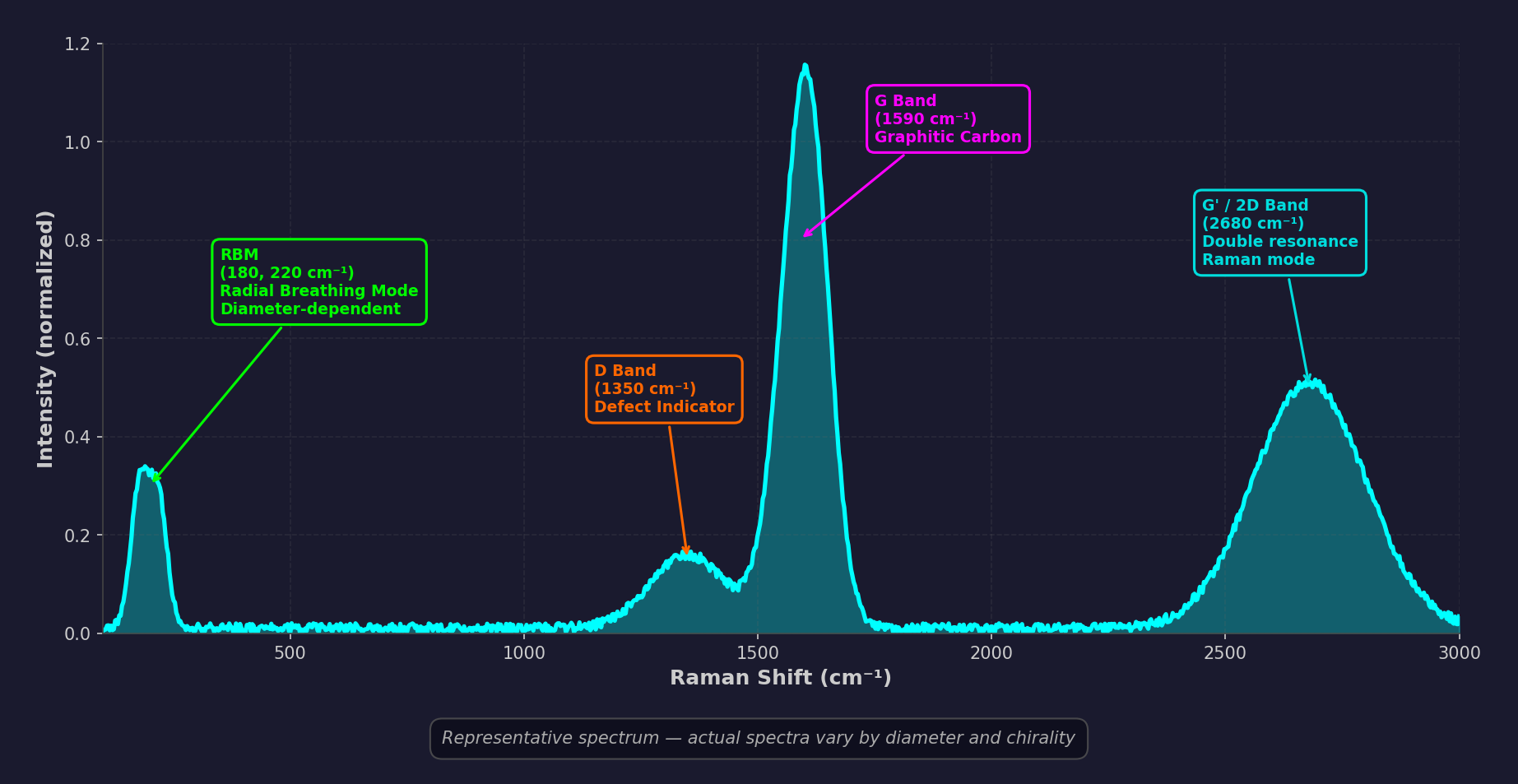
- Raman spectroscopy (G/D ratio): the G band (1580 cm⁻¹, sp² graphitic carbon) and D band (1350 cm⁻¹, defect-induced) define the I_G/I_D ratio. A high G/D ratio indicates graphitic quality with low defect density. Research-grade SWCNT shows G/D ≥ 30; pristine high-purity tubes can exceed G/D = 100. The radial breathing mode (RBM) at 100–300 cm⁻¹ is unique to SWCNTs and correlates inversely with diameter.
- SEM and TEM imaging: visual confirmation of length distribution, bundling, and amorphous-carbon contamination. SEM gives bulk morphology at micron scale; HR-TEM resolves single tubes and confirms wall count.
- UV-Vis-NIR spectroscopy: absorbance peaks in the 400–1400 nm range correspond to E11/E22 transitions in semiconducting tubes and E11M in metallic tubes. The ratio of these features confirms the metallic/semiconducting distribution.
- BET surface area: research-grade SWCNTs typically show 400–1,000 m²/g (well-debundled) up to ~1,300 m²/g (theoretical maximum for individual tubes). Lower BET indicates bundling or contamination.
- ICP-MS metals analysis: for biomedical and sensitive electrochemistry, ICP-MS quantifies residual Fe, Co, Mo, Ni catalyst metals to ppm-level accuracy.
- When Cheap Tubes ships research-grade SWCNT, the Technical Data Sheet includes TGA purity, Raman G/D, SEM imaging, and (on request for biomedical and ultra-high purity grades) ICP-MS metals data so you can verify lot-to-lot consistency.
7. Synthesis Methods (Brief)
The three commercial synthesis routes for SWCNT are:
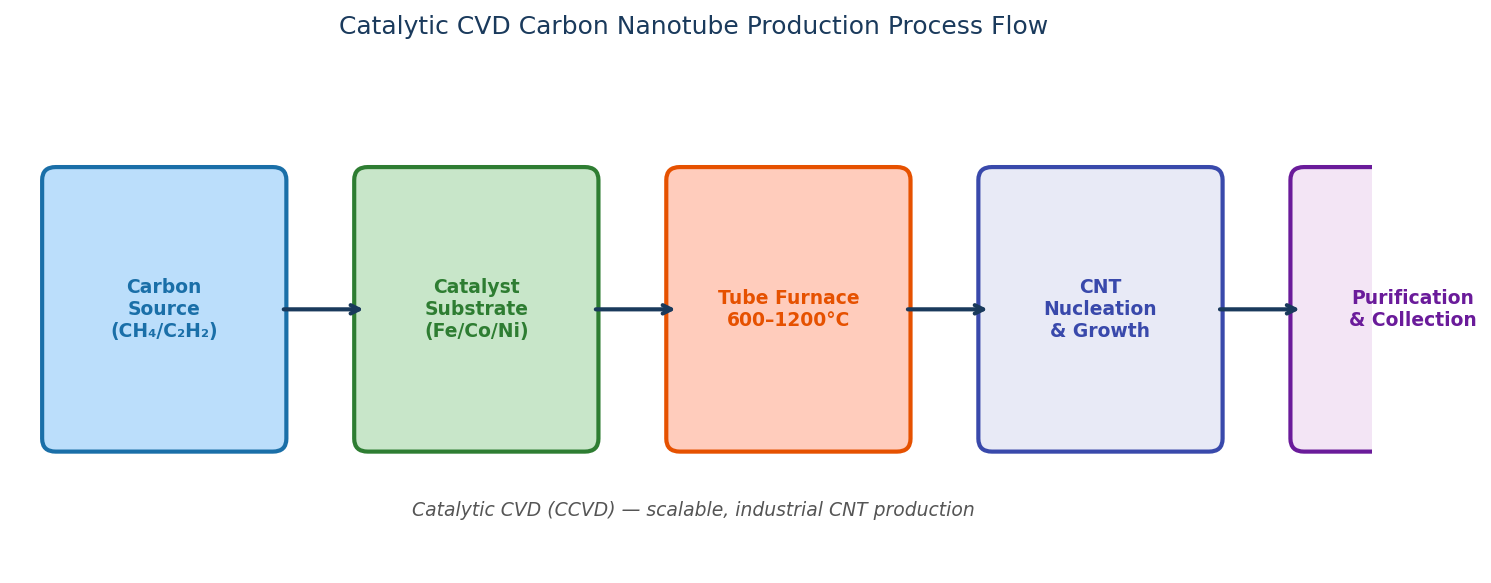
- Arc-discharge: graphite electrodes in helium with metal catalyst (Fe, Co, Ni, Y). The original SWCNT synthesis. Produces high-quality tubes at low yield; mostly displaced commercially by CVD.
- Laser ablation: pulsed laser onto a graphite-catalyst target. Excellent quality, narrow diameter distribution, but capital-intensive. Used for premium specialty material.
- Chemical Vapor Deposition (CVD): hydrocarbon feedstock (methane, ethylene, CO) decomposed over supported metal catalyst (Fe, Co, Mo on alumina or silica) at 600–1100 °C. The dominant commercial method. Variants include HiPco (CO disproportionation), CoMoCAT (Co/Mo on silica), and floating-catalyst CVD.
- Most commercial SWCNT material in 2026 is CVD-grown using one of several proprietary catalyst chemistries. The synthesis route doesn’t usually appear on TDS: what matters for the buyer is the resulting purity, diameter distribution, and metal content.
8. Functionalization: Pristine vs Surface-Modified
Pristine SWCNTs have hydrophobic, low-reactivity surfaces. Functionalization adds reactive groups for dispersion and chemistry, at the cost of some conductivity. The three functionalizations Cheap Tubes currently supplies for SWCNT-DWCNT material:
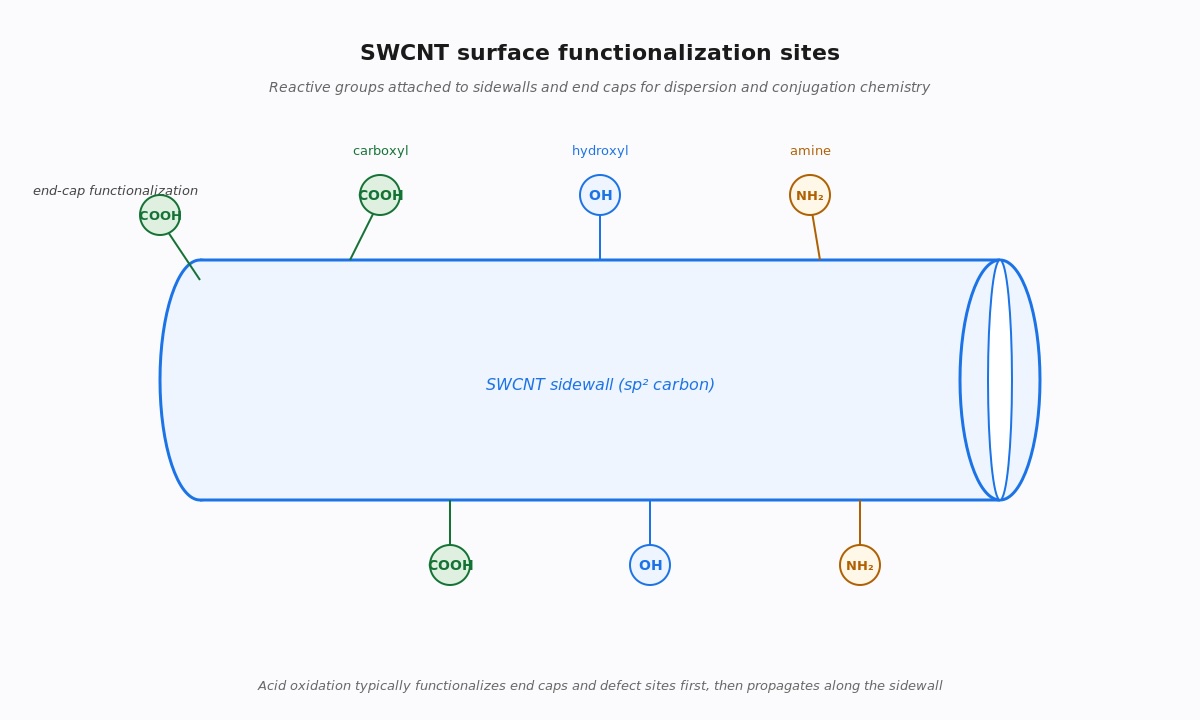
- COOH (carboxyl): added by acid oxidation (HNO₃ or H₂SO₄/HNO₃ mix). Hydrophilic, water-dispersible, compatible with EDC/NHS coupling. Standard route for biomedical and polymer-composite work. Available in 90%+ and 99%+ purity grades, plus a short 1–4 nm length variant for ink and drug-delivery applications.
- OH (hydroxyl): added by oxidation under milder conditions or by post-COOH reduction. Hydrophilic, less reactive than COOH, useful for hydrogen-bonding compatibility with polar polymer matrices and aqueous formulations. Available in 90%+ purity, plus a short 1–4 nm length variant.
- NH₂ (amine): typically a two-step process: COOH first, then amide-coupling to a diamine. Provides amine handles for antibody/peptide conjugation. The standard route for drug delivery, biosensor scaffolds, and amine-reactive crosslinking. Available in 99%+ purity.
- Functionalization density is reported as wt% by TGA or by atomic ratio from XPS. Cheap Tubes provides functionalization density on the TDS for each functionalized product. For other surface chemistries (fluorination, nitrogen doping, broader oxygen functionalization), contact us: custom functionalization is available on a project basis depending on quantity and target chemistry.
9. Choosing the Right Purity Grade
Not every application needs 99% purity. In 21 years of supplying SWCNTs, we’ve seen customers pay for higher grades than they need and others struggle with 90% material in research where 99% would have saved months.
- 90%+ industrial grade: bulk composite work, antistatic plastics, EMI shielding compounds, prototype-scale formulation. Cost-effective for kilogram quantities. Acceptable for many published composite papers.
- 95%+ research grade: workhorse for most published electrochemistry, OPV reference acceptors, Li-ion conductive additive research, polymer composite property studies. The right balance of price and reproducibility for the majority of academic and industrial R&D.
- 99%+ ultra-high purity: required for OFET fabrication, transparent conductive films, biomedical work, sensitive electrochemistry where trace metallic catalyst would dominate signal, single-tube spectroscopy, and any application where sub-percent contamination effects are publishable variables.
- Practical rule: pick the grade where your bottleneck step starts dominating signal-to-noise. Higher purity doesn’t help if your subsequent processing reintroduces contaminants.
10. Solubility, Dispersion, and Handling
SWCNTs are challenging to disperse: strong van der Waals attraction between tubes drives bundling. Practical guidance:
- Pristine SWCNT dispersion: typically requires either (a) surfactant in water (sodium dodecylbenzenesulfonate, sodium cholate, Polyvinylpyrrolidone, Pluronic F127 at 1 wt%) with probe sonication, (b) polar aprotic solvents (DMF, NMP, DMSO) without surfactant for moderate concentrations, or (c) chlorosulfonic acid for very high concentrations (>10 mg/mL) used in transparent conductive film research.
- Functionalized SWCNT (COOH, OH): disperse readily in water at 0.1–1 mg/mL with brief sonication. SWCNT dispersions are achievable with probe sonication at <30% amplitude and pulse the sonic probe on/off every 30 seconfds for 60 minutes, optionally an ice-bath can be used.
- Sonication caution: extended high-power sonication shortens SWCNTs. For preserving aspect ratio, use bath sonication or limit probe sonication to <5 minutes. For deliberate length reduction (e.g., for biomedical use), longer or higher-amplitude sonication achieves controlled cutting. Storage. Sealed dry powder, away from direct light, at room temperature is generally fine for pristine SWCNT. Functionalized variants are best refrigerated to preserve surface chemistry over months. Aqueous dispersions are stable for 2–4 weeks if refrigerated and protected from light. Safety. Standard nanomaterial PPE applies: nitrile gloves, lab coat, dust containment, fume hood for sonication or any process generating airborne particulate. Long fibrous SWCNTs require additional respiratory protection per OSHA nanomaterial guidance.
11. Frequently Asked Questions
Quick jump:
- SWCNT vs MWCNT: What’s the Difference?
- Pristine vs functionalized — which to pick?
- How to disperse SWCNTs in water
- Why SWCNTs cost so much more than MWCNTs
- Are SWCNTs safe to handle?
- Bulk pricing for SWCNTs
- What ships with every SWCNT order
- How to store SWCNT powder
- Where to buy research-grade SWCNTs
SWCNT vs MWCNT: What’s the Difference?
Single-walled carbon nanotubes (SWCNTs) consist of a single rolled-up graphene sheet, typically 0.7–2 nm in diameter. Multi-walled carbon nanotubes (MWCNTs) consist of multiple concentric tubes, typically 5–100 nm in outer diameter. SWCNTs have higher aspect ratio, higher specific surface area, and chirality-dependent semiconducting/metallic behavior; MWCNTs are essentially metallic, easier to disperse, and substantially less expensive per gram. Use SWCNTs for transparent conductors, OFETs, biomedical, and sensor applications; use MWCNTs for bulk composites, antistatic plastics, and EMI shielding.
How do I choose between pristine and functionalized SWCNTs?
Choose pristine for applications dominated by conductivity (battery electrodes, transparent conductors, FETs, sensors). Choose functionalized for applications dominated by chemistry (polymer composites with polar matrices, biomedical conjugation, aqueous dispersion). Functionalized SWCNTs are typically 10×–100× more easily dispersed but lose some conductivity due to interrupted π-conjugation. The COOH form is the most common and most versatile functionalization.
How do I disperse SWCNTs in water?
Pristine SWCNTs require a surfactant (sodium dodecylbenzenesulfonate, sodium cholate, or Pluronic F127 at 0.5–1 wt%) and probe sonication at <30% amplitude in an ice-bathed vessel for 45-60 minutes to break tube bundles. Functionalized SWCNTs (COOH, OH) disperse directly in water, though an additional surfactant is often used at 0.1–1 mg/mL with brief sonication.
For deeper dispersion, follow with mild centrifugation (5,000–10,000 g for 30 min) and decant the supernatant. This removes residual bundles and undispersed material.
What’s the price range for research-grade SWCNTs?
Research-grade SWCNT pricing in 2026 ranges from about $20–25/g for high-volume mass-produced material at the low end, $50–200/g for vetted research-grade material with per-lot characterization (the typical Cheap Tubes range), and $300–2000+/g for specialty material with chirality enrichment, narrow-diameter selection, or proprietary growth chemistries.
Functionalization adds 30–100% to base SWCNT cost. Cheap Tubes carries grades across the spectrum: see the SWCNT product line for current pricing.
Why is SWCNT so much more expensive than MWCNT?
Three reasons. First, SWCNT yields per gram of catalyst are typically 10×–100× lower than MWCNT yields, so the synthesis is intrinsically more material-intensive. Second, SWCNT purification is more demanding: separating SWCNTs from amorphous carbon and residual catalyst without damaging the tubes requires gentler oxidation conditions and more separation steps. Third, the SWCNT market is smaller, so economies of scale are less favorable. Expect SWCNT to cost 5×–20× MWCNT for comparable purity grade.
Are SWCNTs safe to handle?
Standard nanomaterial PPE applies: nitrile gloves, lab coat, dust containment, fume hood for any process generating airborne particulate. Long fibrous SWCNTs (over ~5 µm) trigger inhalation concerns analogous to asbestos in animal models, so respiratory protection is recommended for any process that could aerosolize the material. Functionalized SWCNTs in aqueous dispersion are typically lower-risk than dry powder handling. Always consult the specific product’s SDS: see the Cheap Tubes SDS library for the latest classifications.
Can I get bulk pricing on SWCNTs?
Yes. Quantities above 10 g typically receive a tiered discount; orders of 100 g or more are quoted individually based on purity and characterization requirements. Contact us with your target quantity and application. We’ll match you to the right grade and quote within one business day. Kilogram quantities of industrial-grade material are available on a project basis.
What ships with every SWCNT order?
Every Cheap Tubes SWCNT order ships with a Technical Data Sheet (TDS) including TGA purity, Raman G/D ratio, and SEM imaging from the lot you receive, plus a GHS-compliant Safety Data Sheet (SDS). For ultra-high-purity and biomedical-grade orders, ICP-MS metals analysis is included on request. Lot-level traceability means if you cite a specific batch in a publication, the same characterization data is reproducible from our records.
How do I store SWCNT powder?
Pristine SWCNT powder is air-stable and tolerates room-temperature storage in sealed containers, away from direct light, for years. Functionalized SWCNTs are best refrigerated (2–8 °C) to preserve surface chemistry over multi-month timelines: the COOH groups in particular can slowly decarboxylate at elevated temperatures. Aqueous dispersions: refrigerate, shield from light, and re-sonicate briefly before re-use to redisperse any sediment. We recommend preparing dispersions fresh for critical experiments.
Where can I buy research-grade SWCNTs?
Cheap Tubes carries SWCNT and SWCNT-DWCNT material in industrial, research, and ultra-high-purity grades, with multiple functionalizations and short-length variants. See the SWCNT product catalog for current options and pricing, or contact us for a custom quote.
12. Related Resources and Products
- Carbon Nanotubes: Properties and Applications: broader CNT overview including SWCNT and MWCNT
- Carbon Nanotubes: History and Production Methods: synthesis routes and historical context
- Carbon Nanotube Composites: Types, Properties & Applications: composite design principles for SWCNT and MWCNT
- Fullerenes: Structure, Properties, and Applications: sp² carbon allotrope cousin
- Graphene Oxide Buying Guide: selection criteria for graphene oxide and rGO
- SDS Library: safety data for all SWCNT and CNT products
References
- Iijima, S.; Ichihashi, T. Nature 1993, 363, 603 (single-walled carbon nanotube discovery).
- Bethune, D. S.; Kiang, C. H.; de Vries, M. S.; Gorman, G.; Savoy, R.; Vazquez, J.; Beyers, R. Nature 1993, 363, 605.
- Saito, R.; Dresselhaus, G.; Dresselhaus, M. S. Physical Properties of Carbon Nanotubes. Imperial College Press, 1998 (textbook reference).
- Bachilo, S. M.; Strano, M. S.; Kittrell, C.; Hauge, R. H.; Smalley, R. E.; Weisman, R. B. Science 2002, 298, 2361 (chirality-resolved spectroscopy).
- Hersam, M. C. Nature Nanotechnology 2008, 3, 387 (chirality sorting overview).
- De Volder, M. F. L.; Tawfick, S. H.; Baughman, R. H.; Hart, A. J. Science 2013, 339, 535 (CNT applications review).
Battery applications for SWCNT
SWCNT is the dominant carbon material for premium high-rate lithium-ion cells, silicon anode composites at 0.5–3 wt% loading, and lithium-sulfur cathode scaffolds. Specific battery application guides:
- Graphene & CNT Battery Applications hub: full overview of where SWCNT fits in modern battery design
- Silicon-CNT & Graphene Lithium-Ion Anodes: SWCNT 95–99% as the conductive backbone in Si anode composites
- CNT & Graphene in Li-S, Li-air, Solid-State Batteries: SWCNT 99% as polysulfide host scaffold
- CNT as Cathode Conductive Additive: SWCNT in premium high-rate cathode formulations
About the author
Mike Foley is the founder of Cheap Tubes Inc., a Vermont-based supplier of research-grade carbon nanomaterials since 2005. He has a BS in Business Administration and a high-tech manufacturing background spanning wafer fabs, thin-film optics, and nanotechnology, with a pending patent application related to nanoparticle dispersion. Cheap Tubes supplies single-walled and multi-walled carbon nanotubes, graphene, graphene oxide, fullerenes, MXene, and specialty nanomaterials to researchers and engineers in 50+ countries, including research groups at MIT, NASA, Rice, Harvard, 3M, and the US Army. More about Cheap Tubes · Contact / Request a quote · All resources
Application Spotlights for SWCNT
Short, peer-reviewed briefs covering published research that used Cheap Tubes SWCNT. New entries added as papers are published. See the full series at the Application Spotlights hub.
- NEW PRODUCT: Ultra-Long 100 μm, 99.5% Purity SWCNT: product launch Spotlight for the new Cheap Tubes ultra-long, high-purity SWCNT for transparent conductive films and next-generation applications. Spec-matched to Dubnov 2025 UL-CNT TCF demonstrations and historical Tai & Lubineau 2016 Cheap Tubes TCF research. Includes head-to-head comparison vs Tortech UL-CNT and OcSiAl TUBALL.
- 1,894 mAh/g silicon microparticle anode: PPBT/SWCNT stress-relieving conductive coating delivers 1894 mAh/g reversible capacity at 300 cycles, 0.027%/cycle decay, 85% initial Coulombic efficiency on silicon anodes. Gueon, Ren, Sun et al. (Reichmanis group), ACS Appl. Energy Mater. 2024, Lehigh + BNL + Stony Brook.
- 71 dB X-band EMI shielding in 14.3 micron film: one-step densification of Cheap Tubes COOH-SWCNT delivers 71 dB X-band shielding effectiveness (99.999992% attenuation), 106 S/m conductivity, 3.5 × 10⁵ dB cm2/g specific shielding. Yang, Ma, Khor, Su et al. (Jassby group), Carbon 214, 118370 (2023), UCLA + UCR + Technion + LBNL.
- 31x thermoelectric power factor with f-SWCNT in PEDOT:PSS: Cheap Tubes COOH and OH functionalized SWCNT in PEDOT:PSS composite delivers PF = 22 µW/m·K² (vs 0.7 for pristine SWNT) via atypical simultaneous increase of conductivity and Seebeck coefficient. Tonga, Wei, Lahti, Int J Energy Res 44(11), 9149-9156 (2020), UMass Amherst Chemistry.