
TL;DR: Choosing graphene oxide comes down to three decisions: form (oxide, reduced, or exfoliated), layer count (single layer, 2–4 layer, or multilayer), and flake size (450 nm to 50+ µm). For lithium-ion battery electrodes, choose Reduced Graphene Oxide Industrial Grade ($110/g) or Exfoliated rGO Powder ($115/g). For polymer composites and bulk research, Graphene Oxide Powder at $90/g is the industrial-grade choice. For sensors, membranes, and biomedical work where defect-free single sheets matter, Single Layer Graphene Oxide at $140/g or the size-controlled 450 nm and 1-20 µm variants are the right call. Every Cheap Tubes order ships with a Technical Data Sheet (TDS) and Safety Data Sheet (SDS).
By Mike Foley, Founder, Cheap Tubes Inc., published April 2026
1. Which Three Decisions Determine the GO You Need?
Graphene oxide is not a single material. It’s a family of related carbon nanomaterials, each with measurably different chemistry, conductivity, surface area, and dispersion behavior. The “right” graphene oxide for your work depends entirely on three questions:
- Do you need oxygen functional groups, or do you need conductivity? This determines whether you want graphene oxide (GO), reduced graphene oxide (rGO), or exfoliated rGO. They look similar in a vial but behave very differently in your experiment.
- Does your application need single sheets, or are stacks acceptable? This is your layer count decision. Single-layer (1L) is most expensive and offers maximum surface area; few-layer (2-4L) is a practical compromise; multi-layer / standard powder is most cost-effective.
- Does flake size matter for your process? Smaller flakes (450 nm) disperse better in inks and biomedical formulations. Larger flakes (1-20 µm) provide more continuous conductive paths for sensors and films.
Get those three right, and you’re in a narrow set of products that will work for your application.
2. Quick Comparison: All 8 GO Products at a Glance
| # | Product | Form | Layers | Flake size | Price (volume) | Best for |
|---|---|---|---|---|---|---|
| 1 | Graphene Oxide Powder | Oxide | Multilayer | Standard (300-800 nm) | from $90/g | Bulk research, polymer composites, industrial-grade |
| 2 | Reduced Graphene Oxide Industrial Grade | Reduced | Multilayer | Standard | from $110/g | Battery electrodes, conductive composites at scale |
| 3 | Exfoliated Reduced Graphene Oxide Powder | Exfoliated | Few-layer | Standard | from $115/g | High-conductivity composites, supercapacitors |
| 4 | Single Layer Graphene Oxide | Oxide | 1L | 300-800 nm | from $140/g | Sensors, membranes, baseline single-sheet research |
| 5 | Few Layer Graphene Oxide 2-4L | Oxide | 2–4L | Standard | from $140/g | Performance/cost compromise, electrochemistry |
| 6 | Reduced Graphene Oxide | Reduced | Multilayer | Standard | from $190/g | Sensitive electrochemistry, higher-purity rGO |
| 7 | Single Layer GO 1-20 µm | Oxide | 1L | 1-20 µm (premium size) | from $190/g | Large-flake sensors, transparent conductive films |
| 8 | Single Layer GO 450 nm | Oxide | 1L | <450 nm (premium size) | from $190/g | Inks, biomedical, drug delivery |
Specialty: Graphene Oxide Gel is available as a pre-dispersed format on request: most graphene oxide disperses readily in water with brief sonication, so the gel is a niche convenience format rather than a primary recommendation.
Pricing note: Pricing varies by quantity. Established products (Single Layer GO, Few Layer GO, the size variants, and the premium Reduced Graphene Oxide) show volume-tier pricing for 10 g+ orders. Newer products (Graphene Oxide Powder, rGO Industrial Grade, Exfoliated rGO Powder) currently show single-gram pricing: volume tiers will be added as demand stabilizes. Size-controlled variants (450 nm and 1-20 µm) command a premium over the standard 300-800 nm flake size. Refer to each product page for current quantity-tier pricing.
All products ship from Vermont with a Technical Data Sheet (TDS) and Safety Data Sheet (SDS). Bulk pricing is available: contact us for orders above 100 g.
3. Which GO Product Fits Your Application?
Find your application below. Each section names the product we recommend and explains why.
3.1 Which GO Product Is Best for Lithium-ion Battery Electrodes?
Primary: Reduced Graphene Oxide Industrial Grade, from $110/g
Alternative: Exfoliated Reduced Graphene Oxide Powder, from $115/g
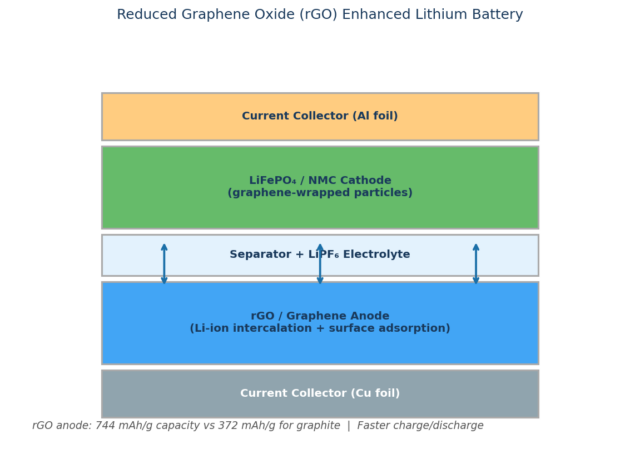
Why rGO and not GO: Battery applications demand electrical conductivity, not surface chemistry. Graphene oxide’s oxygen functional groups (hydroxyl, epoxide, carboxyl) interrupt the conjugated π-system that carries current. Chemical or thermal reduction strips those groups, restoring conductivity to within ~1-2 orders of magnitude of pristine graphene. For Li-ion electrodes, this matters: rGO can replace or supplement carbon black as a conductive additive at lower loading, improving rate capability without dramatically increasing inactive mass.
Industrial Grade vs Exfoliated: both ship with conductivity data on the TDS.
- Industrial Grade rGO: multilayer and most cost-effective at scale, for kilogram quantities for prototype cell builds.
- Exfoliated rGO: mechanically separated into thinner stacks during processing, giving higher specific surface area and more accessible electrochemical sites. Useful for higher-performance cells where capacity retention at high C-rate is the bottleneck.
For sensitive electrochemistry where trace metallic impurities from chemical reduction would interfere (e.g., pristine cathode work, metal-air batteries), our premium Reduced Graphene Oxide at $190/g is purified to a higher standard.
3.2 Which GO Product Is Best for Polymer Composites?
Primary: Graphene Oxide Powder, from $90/g for nonconductive reinforcement
For conductive composites: Exfoliated rGO Powder, from $115/g
Why GO for mechanical work: graphene oxide’s surface oxygen groups make it covalently or hydrogen-bond compatible with most polar polymer matrices. Single-sheet dispersion isn’t required for tensile-modulus improvement; multilayer GO at 0.5-2 wt% loading achieves measurable property gains in well-mixed composites. Use GO Powder when your matrix is a thermoset epoxy or polar thermoplastic.
Compatible matrices include:
- Epoxy
- Polyamide
- PVA
- Polyurethane
Why exfoliated rGO for conductive composites: When you need both mechanical reinforcement and electrical percolation (e.g., antistatic plastics, EMI shielding compounds), rGO is the single-component answer. Exfoliated rGO provides higher aspect ratio per gram than the standard industrial grade, lowering the percolation threshold.
3.3 Which GO Product Is Best for Inks, Coatings, and Spray Formulations?
Primary: Single Layer Graphene Oxide 450 nm, from $190/g
Why size-controlled small flakes: Inks and coatings require uniform dispersion that doesn’t settle, clog spray nozzles, or produce visible defects in dried films. Sub-micron flake size (450 nm median) eliminates the gross sedimentation problems associated with multi-micron flakes, while the high oxygen content of single-layer GO keeps dispersions stable in water and polar organic solvents (DMF, NMP, DMSO) without surfactants.
If your application is a transparent conductive coating (where transparency depends on flake-size uniformity and rGO is required for conductivity), the workflow is: disperse 450 nm GO, deposit, then thermally or chemically reduce on the substrate.
3.4 Which GO Product Is Best for Sensors, Biosensors, and Field-Effect Devices?
Primary: Single Layer GO 1-20 µm, from $190/g
Why large single sheets: Sensor performance depends on the continuous conductive path across the active area. Multi-flake interfaces introduce contact resistance and noise. Single-sheet 1-20 µm flakes can span practical sensor channel dimensions (typically 1-10 µm) with a single piece of material, eliminating those contact problems.
- Chemical sensors, where surface oxygen groups are the sensing chemistry: use the as-supplied GO.
- FET-style devices, where conductivity matters: reduce the GO post-deposition (vapor-phase hydrazine, thermal anneal at 200-300 °C in inert atmosphere, or photochemical reduction).
3.5 Which GO Product Is Best for Membranes (Water Filtration, Gas Separation)?
Primary: Single Layer Graphene Oxide, from $140/g or Single Layer GO 1-20 µm, from $190/g for thicker/larger-area membranes
Why single-layer GO: Membrane separation depends on the controlled inter-sheet spacing of stacked GO sheets, typically 0.7-1.4 nm depending on hydration. Single-layer feedstock produces the most predictable interlayer chemistry; multilayer feedstock dilutes the active surface and introduces flake-edge defects that act as bypass channels. GO membranes are widely studied for water purification and ion selective transport, which is part of why interlayer spacing control matters so much for this application.
- Lab-scale research (typical sample sizes of a few cm²): the standard Single Layer GO is the cost-effective starting point.
- Larger membranes, or applications where consistent flake size matters more than interlayer chemistry: the 1-20 µm size-controlled variant gives more reproducible casting.
3.6 Which GO Product Is Best for Biomedical Work (Drug Delivery, Bioimaging, Antibacterial Coatings)?
Primary: Single Layer GO 450 nm, from $190/g
Why small single-layer flakes: the 450 nm variant has been size-fractionated specifically for biomedical applications, which typically demand:
- Cellular-scale dimensions (sub-micron) for cell uptake or tissue penetration
- Single-layer chemistry for predictable surface functionalization (PEGylation, antibody conjugation, drug loading via π-π stacking)
- Tight size control to satisfy regulatory characterization
GO is preferred over rGO for biomedical work: the oxygen functional groups are essential for both colloidal stability in physiological buffers and for the conjugation chemistry that attaches targeting moieties or therapeutic payloads.
3.7 Which GO Product Is Best for Industrial-Grade Polymer and Bulk Applications?
Primary: Graphene Oxide Powder, from $90/g
This is the industrial-grade choice for applications where multilayer graphene oxide is acceptable and larger flakes are actually beneficial: most polymer composite work falls here. Larger, multilayer flakes integrate well into polymer matrices, contribute meaningfully to mechanical properties at modest loading, and don’t carry the cost of single-layer or size-controlled variants. Bulk discounts apply at 50 g+; contact us for kilogram pricing.
Use this product for:
- Thermosetting epoxies
- Polyamide composites
- Polyurethane reinforcement
- Screening studies
- Any process where you’re optimizing matrix dispersion rather than chasing single-sheet performance
4. When Do You Need to Reduce GO to rGO?
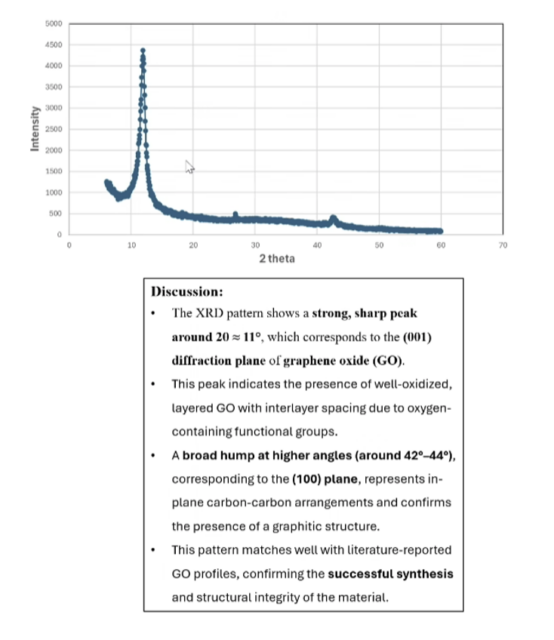
Graphene oxide and reduced graphene oxide are produced from the same precursor (typically graphite via Hummers-method oxidation, then exfoliation; the Tour method is a common alternative oxidation route), but the reduction step transforms the material’s chemistry, electrical properties, and dispersibility. Picking the wrong one is the single most common buyer mistake.
As made, graphene oxide is an electrical insulator: the oxygen groups disrupt the sp² network that makes pristine graphene conductive. Reducing GO chemically or thermally removes most of that oxygen and restores much of the electrical conductivity, and the product of that step is reduced graphene oxide (rGO). This is why GO works as a scalable, low cost route to graphene like materials rather than a finished conductor on its own.
Graphene oxide (GO):
- Carbon-to-oxygen ratio typically 2:1
- Hydroxyl, epoxide, carboxyl groups on basal plane and edges
- Insulating (sheet resistance 10⁹–10¹² Ω/sq)
- Disperses readily in water (1-5 mg/mL) and polar organics
- Hydrophilic: colloidal stability without surfactants
- Compatible with conjugation chemistry (EDC/NHS coupling, click chemistry)
Reduced graphene oxide (rGO):
- Carbon-to-oxygen ratio typically 8:1 to 12:1 (after thermal/chemical reduction)
- Most oxygen groups removed; π-conjugation partially restored
- Conductive (sheet resistance 10²–10⁵ Ω/sq depending on reduction)
- Hydrophobic; dispersion in water requires surfactants or sonication
- Mechanical and thermal properties closer to pristine graphene
Which GO do I need? If your application uses electricity (current, capacitance, sensing impedance), choose rGO. If your application uses chemistry (functional groups, hydrogen bonding, biomolecule conjugation, hydrophilic dispersion), choose GO.
Mid-cases: when GO + post-reduction is the right choice: If you need GO’s processability (water dispersion for casting, spray, or printing) but conductivity in the final product, the workflow is: disperse GO, deposit, then reduce in place. We’ve supplied this combination to many electrode-manufacturing labs.
Practical thermal reduction protocol: Once a GO film is deposited, you can achieve good reduction by heating the dried film in an inert atmosphere (typically argon with a small fraction of hydrogen) at 200–400 °C. This converts most of the residual oxygen functionality back to sp² carbon and recovers a substantial fraction of the conductivity of pristine graphene, without requiring chemical reductants or specialized equipment. Higher temperatures (toward 400 °C) give more complete reduction but require thermally stable substrates. Hydrazine vapor treatment is the more reactive alternative for thermally sensitive substrates; it works at near-room temperature but requires careful safety handling and waste disposal.
5. How Many Layers Do You Need: Single, Few, or Multilayer?
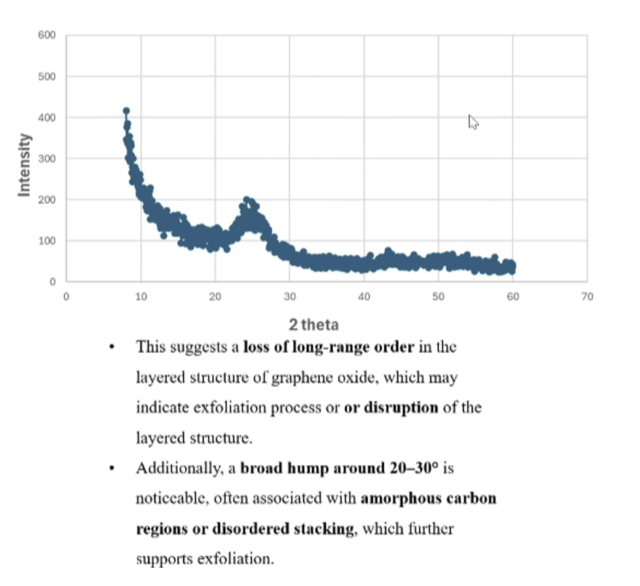
The “graphene” in graphene oxide can mean a single sheet or a stack of several sheets. The difference matters for any application where the oxygen-functional-group density per gram, surface area, or interlayer spacing controls performance.
Single Layer (1L):
- Highest specific surface area (>700 m²/g for ideal 1L)
- Maximum oxygen-group density per gram
- Most expensive (more processing steps to delaminate)
- Best for: membranes, sensors, biomedical, precision electrochemistry
Few Layer (2-4L):
- Surface area ~200-400 m²/g
- Performance/cost compromise: most physical-property advantages of 1L at lower cost
- Most consistent batch-to-batch (less dependent on exfoliation completeness)
- Best for: composites, electrochemistry, general research
Multilayer (Standard Powder):
- Bulk material; layer count varies (typically 5-20 layers)
- Most cost-effective per gram
- Sufficient for many polymer-composite and electrochemistry applications
- Best for: bulk research, cost-sensitive work, formulation development
Practical guide: Prototyping and academic research typically use single-layer GO so the reported results aren’t confounded by layer-count variability. Multilayer is the right choice for commercial applications: polymer composites, conductive masterbatches, and any process where consistent industrial-grade performance at lower cost is the goal.
6. How Do You Choose the Right Flake Size?
Lateral flake size affects how the material processes, disperses, and performs in your final composite or device.
450 nm (small):
- Excellent dispersion stability (slower sedimentation by Stokes’ law)
- Compatible with spray coating, inkjet printing, biological systems
- Lower contact-resistance benefit at sensor scale (more inter-flake junctions)
1-20 µm (medium-large):
- Better continuous conductive paths in films
- Practical for transparent electrodes, EMI films, larger membrane areas
- Some sedimentation in thin (<1 wt%) dispersions over hours-to-days
Standard / unspecified (~50+ µm typical for bulk powder):
- Most cost-effective
- Acceptable for composites, bulk electrochemistry, general research
- May need size-fractionation for specific applications
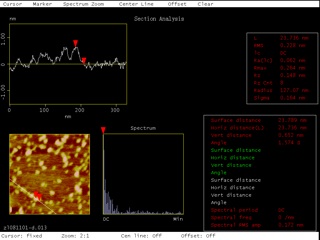
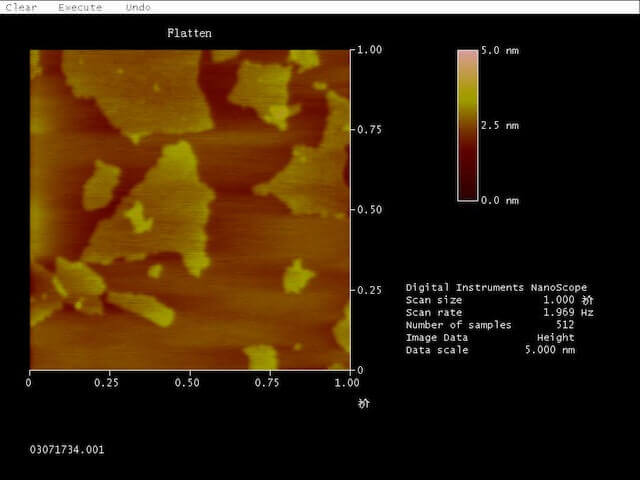
If you’re not sure which size, start with the standard Single Layer GO or the bulk Powder and characterize what you actually have via dynamic light scattering or AFM before committing to a size-specific variant.
7. What Ships With Every Cheap Tubes Order?
Every order ships with two documents:
- Technical Data Sheet (TDS): specifications, characterization summary (XPS, Raman, BET surface area, particle size where relevant), and recommended handling.
- Safety Data Sheet (SDS): GHS-compliant safety, transport, storage, and disposal information. View all SDS documents.
Cheap Tubes Inc was founded in 2005 in Townshend, Vermont. We’ve supplied research-grade nanomaterials (carbon nanotubes, graphene, fullerenes, MXene, and graphene oxide) to over 10,000 customers across academia, industry, and government for 21 years. Published specs, real characterization, and shipped paperwork are not features. They’re our minimum.
Need bulk pricing, custom specifications, or a TDS sample before ordering? Contact us.
8. Frequently Asked Questions
What’s the difference between graphene oxide and reduced graphene oxide?
Graphene oxide keeps its oxygen functional groups; reduced graphene oxide has had most of them removed.
Graphene oxide retains the oxygen functional groups (hydroxyl, epoxide, carboxyl) that make it hydrophilic, easy to disperse in water, and chemically reactive, but those same groups make it electrically insulating. Reduced graphene oxide has had most of those oxygen groups removed (chemically, thermally, or electrochemically), restoring electrical conductivity at the cost of dispersibility. Use GO for chemistry; use rGO for electricity.
How do I reduce graphene oxide myself?
Two practical methods cover most lab needs: thermal reduction in an inert atmosphere, or hydrazine vapor treatment.
- Thermal reduction in inert atmosphere: once a GO film or coating is dried on the substrate, anneal it at 200–400 °C in argon (typically with a small fraction of hydrogen, e.g., Ar/H₂ 95/5). This is the protocol we use ourselves and recommend for substrates that tolerate the temperature. Reduction extent scales with temperature and dwell time: 30–60 minutes at 250–300 °C is a reasonable starting point for thin films; higher temperatures or longer holds increase the C/O ratio further. The atmosphere prevents oxidation; the optional H₂ accelerates removal of oxygen functional groups.
- Hydrazine vapor treatment: for thermally sensitive substrates (polymers, biological surfaces), expose the GO film to hydrazine vapor at 60–100 °C for several hours. This works at lower temperatures but requires fume hood, careful waste disposal, and PPE. Hydrazine is acutely toxic and a suspected carcinogen.
For dispersions or bulk powder reduction, chemical reductants (sodium borohydride, ascorbic acid, hydrazine in solution) are options but typically leave more residual functional groups than thermal annealing. If you need pre-reduced material, our Reduced Graphene Oxide Industrial Grade and Exfoliated rGO Powder ship already reduced with characterization data on the TDS.
How do I disperse graphene oxide?
Most graphene oxide disperses readily in water at 1-5 mg/mL with brief sonication.
A bath sonicator works for screening and casual dispersions, but for reproducible, high-quality dispersions we recommend a probe-style (tip) sonicator: it delivers far higher localized energy and produces more uniform sheet exfoliation. Typical conditions: 5–15 minutes at 30–50% amplitude with the probe submerged in a small volume (10–50 mL) and the vessel ice-bathed to prevent heating. Single-layer GO disperses faster and at higher concentrations than multilayer. Polar organic solvents (DMF, NMP, DMSO, ethanol) also work; non-polar solvents (toluene, hexane) do not. Reduced GO is hydrophobic and typically requires either surfactants or solvent exchange: refer to the TDS for recommended dispersion conditions for your specific lot.
Does graphene oxide ship hazmat?
No. GO and rGO powders ship as ground-non-hazardous.
GO and rGO powders ship as ground-non-hazardous (UN classification N.O.S. when in non-fibrous powder form below regulatory thresholds). Air shipment is possible but check our SDS for the latest classification. International shipments may have country-specific restrictions; contact us before placing an international order.
What’s the shelf life of GO and rGO powders?
GO powder lasts 18-24 months refrigerated; rGO tolerates room-temperature storage for 36+ months.
Refrigerated storage is recommended to preserve GO solubility: over time, GO powder stored at room temperature can lose dispersibility as oxygen functional groups slowly migrate or rearrange, reducing the easy water-dispersion behavior that makes GO useful. Stored sealed in a refrigerator, GO powder maintains its as-supplied solubility and oxygen content for 18-24 months. rGO is more stable (less reactive) and tolerates room-temperature storage; typically 36+ months sealed. Sonicated dispersions in water are stable for 4-8 weeks if refrigerated and protected from light; we recommend preparing dispersions fresh for critical experiments.
Can I get bulk pricing?
Yes. Quantities above 50 g typically receive a tiered discount.
Orders of 1 kg or more are quoted individually based on layer-count and characterization requirements. Contact us with your target quantity and application: we’ll match you with the right product and quote within one business day.
Do you sell custom particle sizes?
We carry three standard sizes; custom fractionation is available on a project basis.
We carry the size variants listed in this guide (450 nm, 1-20 µm, and standard bulk). Custom size fractionation is available on a project basis for orders above 50 g: contact us with your target size distribution and we’ll quote process and lead time.
How do I store unused product?
Keep powders sealed, away from light and humidity, and refrigerate GO to preserve solubility.
Keep powders sealed in the original container, away from direct light, humidity, and oxidizing atmospheres. Refrigeration is recommended for GO powders to preserve solubility; rGO tolerates room-temperature storage. For dispersions, refrigerate (2-8 °C), shield from light, and re-sonicate briefly before re-use to redisperse any sediment.
What’s the difference between Single Layer GO 450 nm (SKU 060101) and Single Layer GO 1-20 µm (SKU 060103)?
Both are single-layer GO from the same precursor; they differ only in post-exfoliation size fractionation.
The difference is post-exfoliation size fractionation: 060101 has been processed to a 450 nm median lateral dimension; 060103 has been processed to a 1-20 µm size range. Choose 060101 for biomedical, ink, and high-stability dispersion applications; choose 060103 for sensor channels, transparent conductive films, and large-area membranes.
9. Related Resources and Products
If you came here researching graphene oxide but want broader context:
- Fullerenes: Structure, Properties, and Applications: comparison of carbon allotropes; useful background for understanding GO’s place in the nanocarbon family
- Graphene Batteries: An Insider’s Guide: extended discussion of GO/rGO in lithium-ion, supercapacitor, and emerging battery chemistries
- Carbon Nanotube Composites: GO and CNT composites are often complementary; this resource covers selection criteria for both
Browse the full GO product line: Graphene Oxide category
Other nanomaterials at Cheap Tubes: Graphene Nanoplatelets | Carbon Nanotubes | Fullerenes | MXene
Last reviewed: April 2026. Specifications and pricing on this page are current as of publication; refer to individual product pages for the most up-to-date specifications and any inventory-related notes.