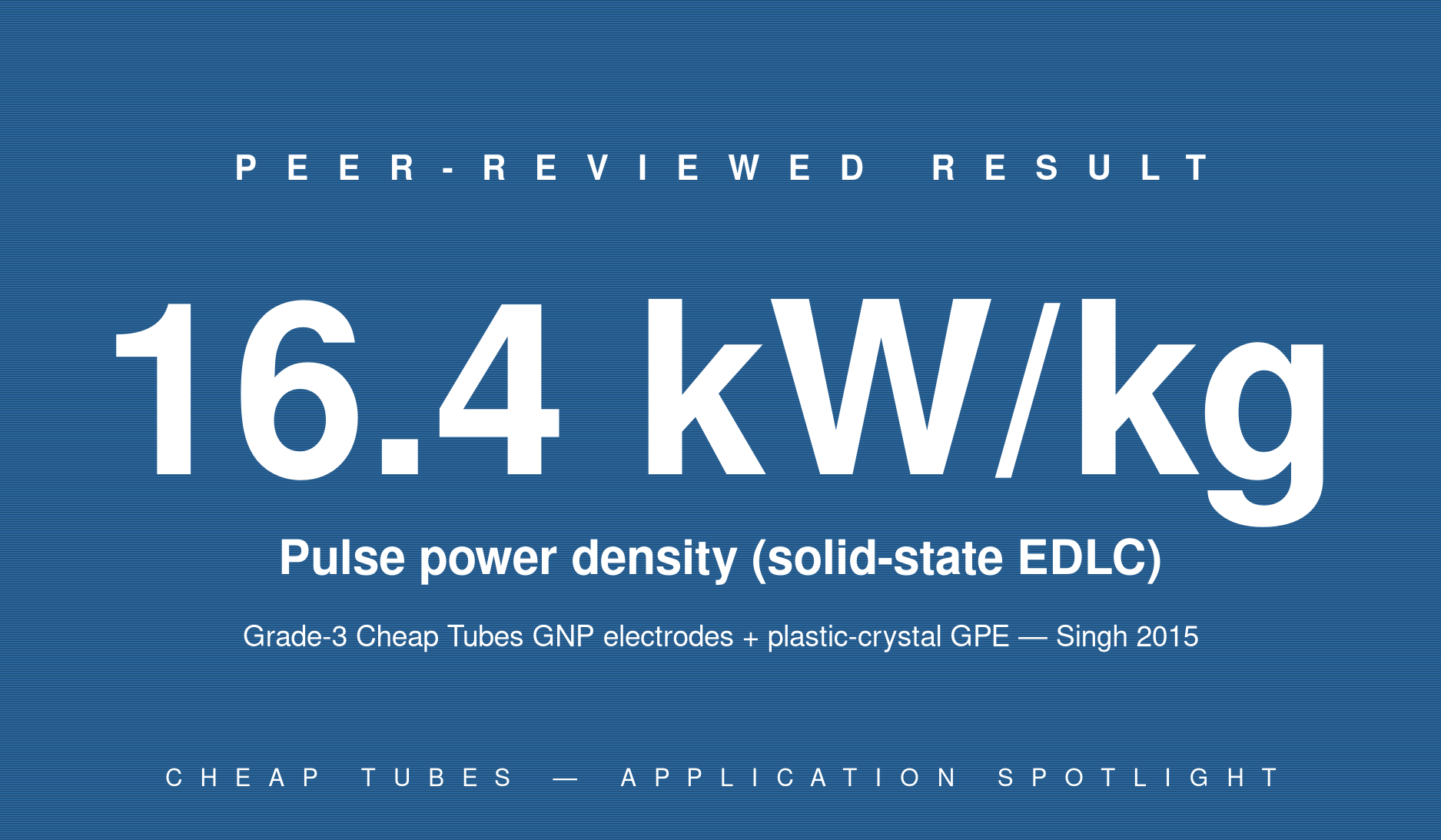
Solid-state supercapacitors promise the safety, packaging, and form-factor advantages of solid electrolytes — flexibility, no liquid leakage, wide thermal range — without the energy and power penalties of bulky liquid-electrolyte designs. The hard part is finding an electrode-electrolyte pairing that delivers both high specific capacitance and high rate capability in a fully solid stack. A 2015 study from the Department of Physics & Astrophysics at the University of Delhi, published in Energy, demonstrated exactly that pairing using Cheap Tubes Grade-3 graphene nanoplatelets as electrodes and a flexible plastic-crystal succinonitrile gel polymer electrolyte. The fully solid-state EDLC delivered a pulse power density of 16.4 kW/kg, specific capacitance of 57 F/g, energy density of 8.2 Wh/kg, and stable cycling through ~3,500 charge-discharge cycles.
The Research Question
EDLCs (electrical double layer capacitors, also called supercapacitors) with graphene electrodes had been demonstrated before in the literature, but mostly with liquid electrolytes — with all the leakage, flammability, packaging, and shelf-life problems that creates. Ionic-liquid gel polymer electrolytes had partially addressed the safety problem but introduced complex ion transport behavior. A clean solid-state EDLC required a stable, mechanically robust electrolyte with high ionic conductivity, a wide electrochemical stability window, and excellent interfacial contact to porous graphene electrodes.
The Delhi group set out to test whether plastic-crystal succinonitrile — a polar, plastic-phase organic solid — could serve as a universal solid solvent for a lithium-salt gel polymer electrolyte, paired with commercial graphene nanoplatelets as the electrode. The benchmark questions: could a fully solid stack hit the rate-capability ceiling that liquid-electrolyte EDLCs were known for? And could it sustain that performance for thousands of cycles?
Materials and Methods
Electrode material — Cheap Tubes Grade-3 graphene nanoplatelets
Paper §2.1 verbatim: “GNP ((Graphene nano-platelet), Grade-3) powder was purchased from Cheap Tubes Inc., USA having 4-5 graphene layers, average thickness of 8 nm and particle diameter <2 μm.”
- BET specific surface area: ~747 m²/g.
- Pore structure: micropore volume 0.084 cm³/g, mesopore volume 0.802 cm³/g — predominantly mesoporous, slit-shaped pores between parallel graphene sheets (Type-IV isotherm, H3-type hysteresis per IUPAC).
- Crystallography (XRD): sharp (002) peak at 2θ ~26.4° plus weak (100)/(101) at 42.5°/43.4°.
- Raman: standard D / G / D’ / G’ bands at 1305, 1578, 1608 and 2600 cm⁻¹ — characteristic of few-layer graphene with low defect density.
Electrode formulation
- Composition: 80 wt% GNP : 10 wt% acetylene black : 10 wt% PVdF-HFP binder.
- Slurry: ground in mortar & pestle with NMP (N-methyl-2-pyrrolidone).
- Coating: spin-coated on 250 μm graphite sheet current collector.
- Drying: overnight under vacuum at ~100°C before cell assembly.
Gel polymer electrolyte
- Composition: 80 wt% (1 M LiTFSI in succinonitrile) + 20 wt% PVdF-HFP host polymer, solution cast from acetone.
- Final film: free-standing flexible film, 350–400 μm thick.
- Ionic conductivity: ~2.39 × 10⁻³ S/cm at 20°C.
- Electrochemical stability window: ~3.5 V vs. Ag.
- Operating temperature range: −30 to 80°C (from DSC / Arrhenius analysis).
- Mechanical: 0.106 MPa tensile stress, 62% elongation at break, 5.76 MJ/m³ toughness — substantially better than equivalent EC:PC organic-solvent gel.
Cell architecture
Two symmetric GNP-coated electrodes sandwiching the gel polymer electrolyte, spring-loaded in an MTI split cell holder. Characterization: electrochemical impedance spectroscopy (100 kHz–10 mHz), cyclic voltammetry (scan rates 50–3000 mV/s), and galvanostatic charge-discharge (current loads 0.25–5 A/g).
Key Results
Miller figure of merit
at 10 mHz
at 2 V cell voltage
after initial 20% fade
Rate capability — the headline result
The paper’s central claim is high rate performance, and the EIS and CV data back it up:
- Knee frequency: ~58 Hz — the cell stays capacitive (steeply rising imaginary impedance) well into the audio-frequency range.
- Response time τ₀: ~791 ms — comparable to other reported solid-state graphene EDLCs.
- Pulse power (Miller figure of merit): 16.4 kW/kg.
- Sustained specific power: Pmax > 4 kW/kg.
- Cyclic voltammetry stays rectangular up to 1,000 mV/s scan rate — the textbook signature of a true capacitive response with low equivalent series resistance, and unusually high for a fully solid stack.
Specific capacitance and energy density
The 57 F/g specific capacitance is competitive with reported graphene-electrode EDLCs using liquid electrolytes (a 2008 Stoller paper reported 99 F/g with organic electrolyte and 135 F/g with aqueous; Beidaghi 2012 reported 53 F/g with 1 M Na₂SO₄). Achieving 57 F/g in a fully solid-state stack is the meaningful comparison — and it’s at the high end of solid-state benchmarks. The 8.2 Wh/kg energy density is modest compared with batteries but appropriate for the power-density tier the cell targets.
Cycle life
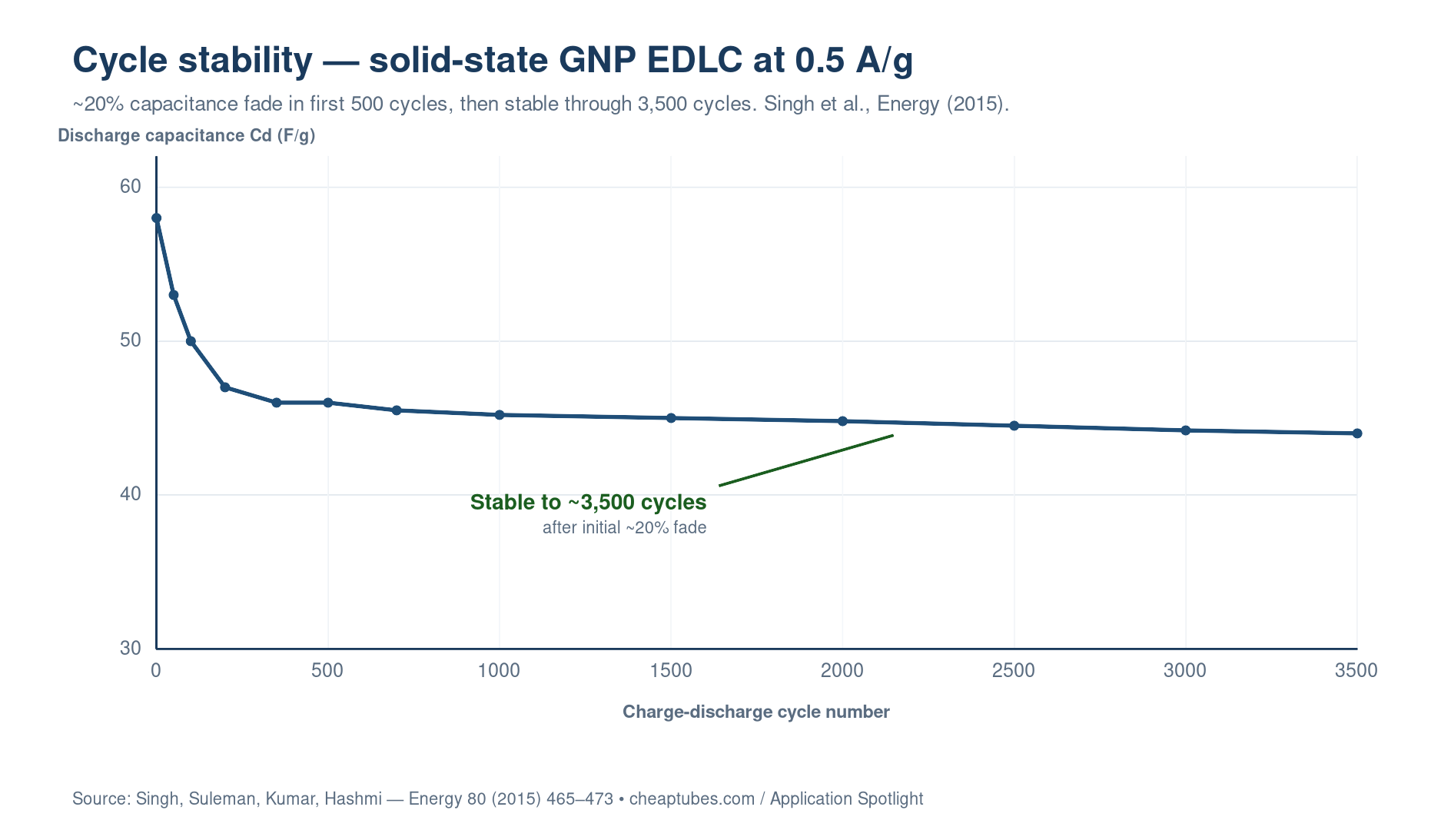
The cell sees a ~20% drop in discharge capacitance over the first ~500 cycles (attributed to electrolyte-ion blockage of the GNP micropore network), then stabilizes and runs essentially flat through ~3,500 cycles. The mechanism: ions can’t navigate the smallest micropores reliably, but the large mesopore volume (0.802 cm³/g) provides accessible, easy-switching ion pathways that don’t degrade. Once the inaccessible micropore population is excluded, the working capacitance is stable.
Why the Grade-3 GNP works here
Two specifications of the Cheap Tubes Grade-3 material align directly with the requirements of a high-rate solid-state EDLC:
- Few-layer (4-5 graphene layers) at ~8 nm thickness — thin enough that both faces of each platelet contribute to the double-layer capacitance, but thick enough to be mechanically robust during slurry processing and electrode cycling. Single-layer graphene tends to restack and lose accessible surface area; thick GNPs lose double-layer area per gram.
- ~747 m²/g BET surface area with predominantly mesoporous (0.802 cm³/g mesopore) structure — mesopores are the right pore size for fast electrolyte ion transport. Microporous activated carbons have higher BET numbers (often 1500–2500 m²/g) but their rate capability is limited by slow ion diffusion in narrow pores. The GNP mesopore network gives up some surface area in exchange for fast charge-discharge.
The combination is well suited to high-power solid-state energy storage where pulse power density and cycle life matter more than absolute energy density — pulse load applications, regenerative braking buffers, RF burst transmitters, and rapid-response sensor power supplies.
Application Areas
- Flexible / wearable electronics — flexible solid-state cells with no liquid electrolyte risk are well suited to body-conformal devices.
- Pulse-power buffers for wireless and IoT — RF burst transmitters and low-duty-cycle sensor nodes benefit from very high pulse power even at modest stored energy.
- Regenerative braking / kinetic energy recovery — supercapacitors complement batteries at the high-power end of hybrid powertrains.
- Power-quality / hold-up capacitors — ride-through energy storage for industrial drives and data-center power conditioning, where solid-state form factor and wide thermal range are operational advantages.
- Hybrid supercapacitor-battery cells — GNP electrodes can be paired with redox-active counter electrodes to combine EDLC rate capability with pseudocapacitive energy density.
Order the Cheap Tubes Grade-3 GNPs Used in This Study
The few-layer graphene nanoplatelet material used in the Delhi study is available from Cheap Tubes at research and production volumes. Spec card: 4-5 graphene layers, ~8 nm average platelet thickness, <2 μm lateral particle diameter, ~750 m²/g BET specific surface area, predominantly mesoporous. Production-scale supply, custom dispersions, and EDLC-electrode formulation support available on request.
Graphene Nanoplatelets for Supercapacitor & Energy-Storage Electrodes
Few-layer GNPs for EDLC, hybrid supercapacitor, and conductive-additive applications in lithium-ion, lithium-sulfur, and solid-state cell chemistries. SDS, TDS, and CoA included with every shipment. Production-scale supply and custom dispersions on request.
Browse GNP Grades → See the Battery Applications HubFrequently Asked Questions
What makes graphene nanoplatelets a good supercapacitor electrode material?
Few-layer GNPs combine three key features for EDLC performance: (1) high specific surface area accessible to electrolyte ions (~750 m²/g for the Grade-3 material in this study), (2) a predominantly mesoporous pore structure that allows fast ion diffusion (high rate capability) without the diffusion bottleneck of microporous activated carbons, and (3) high in-plane electrical conductivity that minimizes the equivalent series resistance of the electrode.
Why a solid-state electrolyte instead of liquid?
Liquid electrolytes in supercapacitors create leakage risk, flammability concerns, complicated packaging, and limited shelf life. Solid-state gel polymer electrolytes — especially plastic-crystal-based systems like the succinonitrile + PVdF-HFP gel in this paper — offer flexible form factor, wide operating temperature, low flammability, and excellent electrode-electrolyte interfacial contact, with comparable ionic conductivity to organic-solvent electrolytes.
What is “pulse power” and why is 16.4 kW/kg notable?
Pulse power, sometimes called the Miller figure of merit, is the available energy divided by the cell’s response time. It represents how much instantaneous power the device can deliver during a short pulse load — the relevant figure for RF transmitters, regenerative braking, or any application with high transient current demand. 16.4 kW/kg is a high value for a fully solid-state EDLC and reflects the low equivalent series resistance achieved by the GNP electrode + plastic-crystal gel electrolyte pairing.
How does this compare with commercial supercapacitors?
Commercial liquid-electrolyte supercapacitors (Maxwell, Skeleton, Eaton class devices) typically achieve specific power in the 5-20 kW/kg range with specific energy 4-10 Wh/kg. The solid-state cell in this paper sits in the same performance tier with the additional advantages of flexibility, no liquid handling, and wide thermal range — trade-offs that matter for embedded and wearable applications.
Can I use this material for lithium-ion battery electrodes too?
Yes. The same Grade-3 GNP material is commonly used as a conductive additive in lithium-ion cathodes (LFP, NMC, NCA) and in silicon-graphene composite anodes to buffer volumetric strain and maintain electronic conductivity. See our CNT & Graphene Battery Applications hub for the full range of energy-storage applications.
Where do I order GNPs for supercapacitor trial work?
Order from Cheap Tubes Graphene Nanoplatelets, available in research and production volumes. Contact us with your target cell architecture (electrolyte chemistry, voltage window, target power/energy density) and we will recommend the appropriate grade and dispersion protocol.