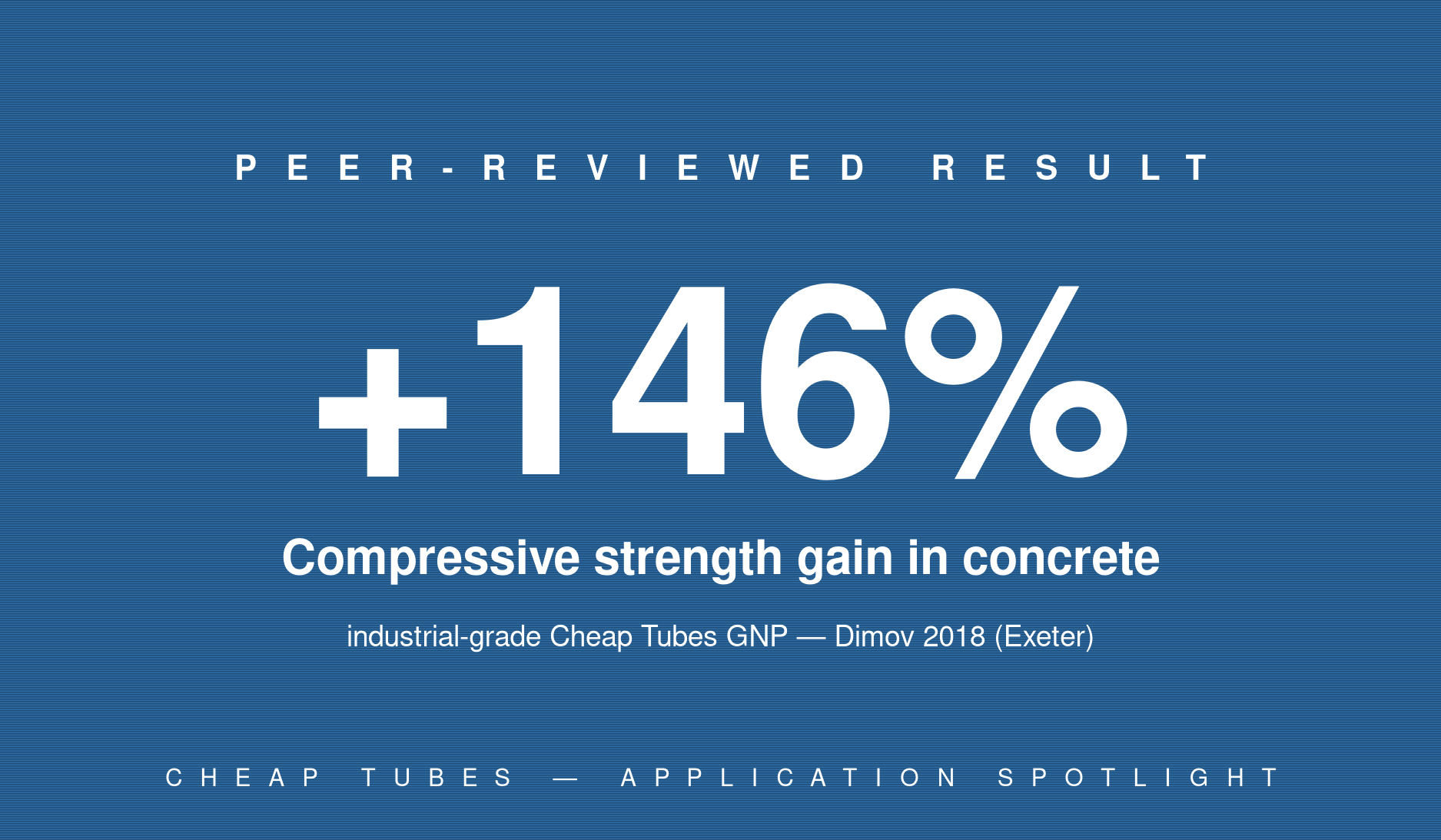
Concrete is the most-produced material on Earth — and one of the most carbon-intensive. Any technology that can deliver more structural performance per kilogram of cement reduces both project material costs and the embodied carbon of construction. A 2018 study from the Centre for Graphene Science at the University of Exeter, published in Advanced Functional Materials, demonstrated that industrial-grade graphene nanoplatelets from Cheap Tubes, water-stabilized with a sodium-cholate surfactant and mixed into Portland cement concrete at sub-percent loading, increased compressive strength by up to 146%, flexural strength by 79.5%, and reduced water permeability by ~400% at the optimal loading.
The Research Question
Graphene-reinforcement of concrete had been demonstrated in research literature before this study, but two obstacles had kept it from production adoption: dispersion (graphene tends to agglomerate in alkaline cement slurries, neutralizing the reinforcement) and cost (the academic reports relied on high-purity exfoliated graphene at prices incompatible with construction-material economics).
The Exeter team set out to answer a more practical question: could industrial-grade graphene nanoplatelets — cheap, mass-produced from natural graphite — be water-dispersed using a food-grade surfactant and deliver the same multiscale reinforcement that high-end exfoliated graphene had shown? And critically, could those gains hold up in a standard ordinary-Portland-cement concrete mix with conventional sand and coarse aggregate, not in a special engineered cement paste?
Materials and Methods
Concrete mix
- Cement: Ordinary Portland Cement (OPC) Type II.
- Mix ratio: cement : fine dry sand : 10 mm coarse aggregate = 1 : 2 : 3 by mass.
- Water-to-cement ratio: 0.57, held constant across all batches.
- Mixing time: 10 minutes mechanical mixing; demoulded at 24 hours; water-cured to test age.
GNP dispersion
- GNP source: Industrial Grade 3 graphene nanoplatelets supplied by Cheap Tubes. Paper text: “Same exfoliation speed and time were used for the industrial grade 3 graphene nanoplatelets (supplied by cheaptubes.com).”
- Surfactant: Sodium cholate — a food-grade amphiphilic stabilizer.
- Dispersion equipment: Silverson L5M high-shear rotor-stator mixer at 5,000 rpm for 2 hours.
- Optimum loading: 0.6–0.8 g/L in the concrete mixing water. Compressive strength peaked at 0.6 g/L; water-permeability minimum at 0.8 g/L. Range tested: 0–1.0 g/L.
Test methods
- Compressive strength: 100 mm steel-cube moulds, tested at 7, 14, 21, and 28 days per architectural and engineering reference standards (full standards documentation in the paper’s SI).
- Flexural strength: 3-point bending on 100 mm × 100 mm × 400 mm rectangular beams; mid-span deflection measured by displacement transducer; tested at 7 and 28 days.
- Water permeability: Comparative capillary water-penetration depth test at matched IG concentrations.
- Companion testing: cyclic compressive loading (5 loops to 60% of fc); electrical resistivity via 4-probe with embedded copper-mesh electrodes; thermal imaging via FLIR.
- Statistical robustness: >150 cubes tested across all conditions, with 20-sample batches per group.
Key Results
vs. plain OPC concrete
3-pt bending, 28-day
capillary penetration depth
Compressive strength & flexural strength
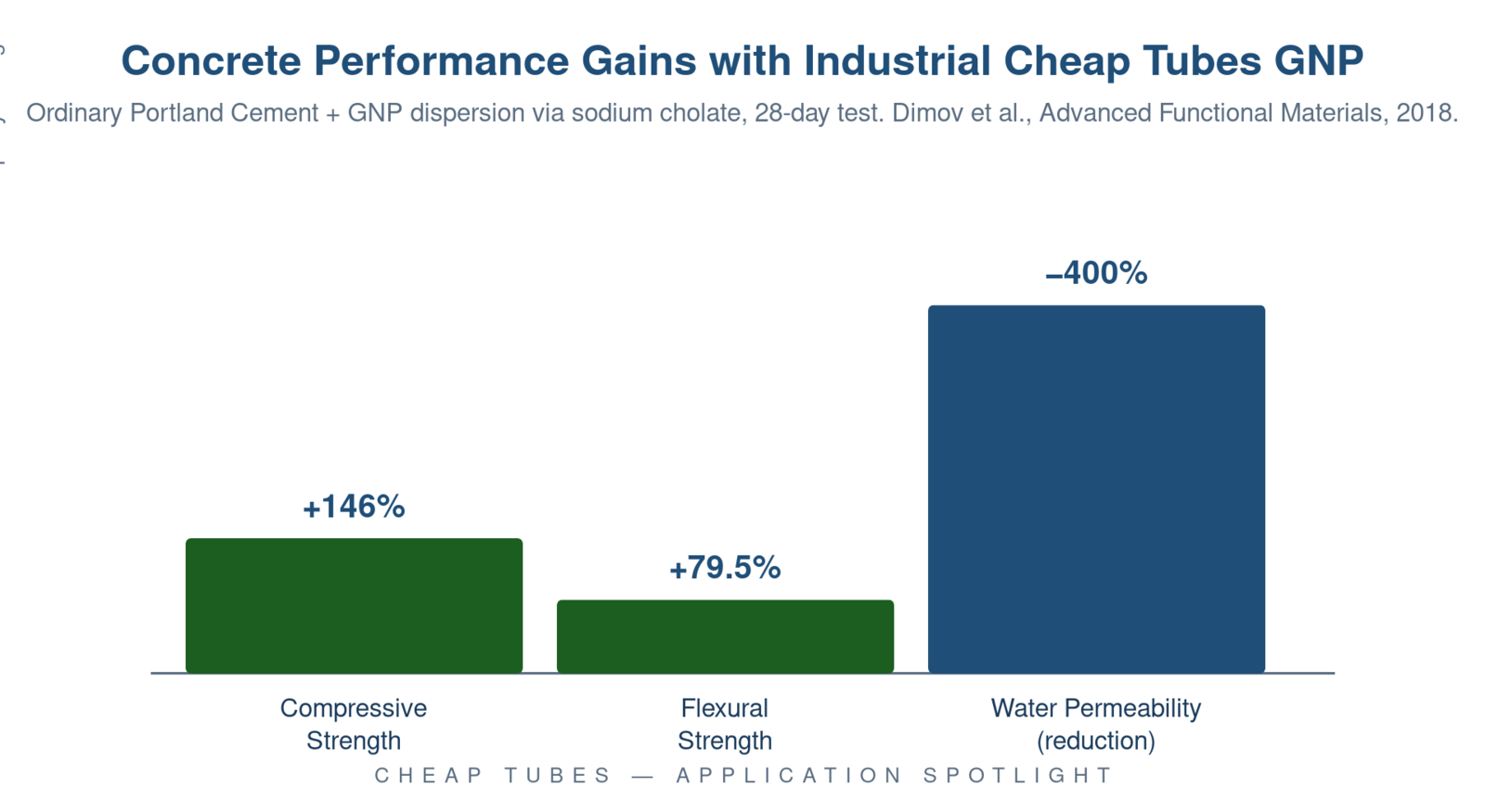
The headline compressive strength gain of 146% is the maximum value reported across the tested loadings. At 0.6 g/L industrial GNP loading (the optimum), the 28-day compressive strength of the concrete cubes was approximately 2.5× the plain-cement baseline. The corresponding flexural strength gain of 79.5% at the same loading places the modified concrete in a structural-performance bracket that previously required either fiber reinforcement or steel rebar to achieve. This is achieved through a sub-percent additive at the mixing-water stage with no changes to the cement composition, aggregate, or curing protocol.
Water permeability — the unexpected result
The paper describes the 400% water-permeability reduction as a “surprising decrease”, and for good reason. Water ingress is the primary durability failure mode for concrete structures — freeze-thaw damage, rebar corrosion, alkali-silica reaction, and sulfate attack all initiate from capillary water penetration. Reducing water permeability four-fold is not just a property improvement; it is a fundamentally longer service life.
The mechanism is the same one driving the strength gain: well-dispersed graphene nanoplatelets in the cement paste act as nanoscale obstacles in the capillary pore network. Water trying to migrate through the cured concrete must detour around platelets whose lateral dimensions are larger than the pore-throat diameters. The capillary path length effectively increases, and the rate of penetration drops.
Why This Result Matters at Industrial Scale
The critical distinction between this study and prior graphene-in-concrete work is the use of industrial-grade GNPs. The Exeter group deliberately worked with the lower-cost, mass-produced grade of Cheap Tubes’ graphene nanoplatelets rather than research-grade exfoliated graphene. The performance gains came not from premium material but from process engineering of the dispersion: high-shear water-stabilized mixing with food-grade sodium cholate surfactant, achievable on equipment that already exists in cement-plant ready-mix lines.
At 0.6 g/L mixing water, a typical concrete formulation contains roughly 0.1 g of GNP per kg of cured concrete. Even at industrial GNP pricing, the additive cost is a small fraction of the total mix cost. The structural performance gain is large enough to plausibly downgauge sections, reduce cement content while holding strength, or extend service life by reducing water-ingress durability failures.
Application Areas
- Marine and coastal infrastructure — piers, seawalls, tunnel linings, and offshore structures where water ingress drives corrosion and freeze-thaw damage. The 400% permeability reduction directly extends service life.
- Bridge decks and tunnel liners — chloride ingress from de-icing salts is the dominant cause of rebar corrosion in cold climates. GNP modification slows the diffusion path significantly.
- High-strength precast structural elements — columns, beams, and pile foundations where the +146% compressive gain enables thinner sections or lower cement content.
- Nuclear and chemical containment structures — reduced water and gas permeability is a primary design driver for these specialized concrete applications.
- 3D-printed concrete — emerging additive-manufacturing applications benefit from improved early-age strength development and reduced shrinkage cracking.
- Carbon-reduced concrete formulations — the strength gain enables lower clinker content (substituting fly ash or slag) while maintaining structural performance, directly reducing embodied carbon.
Our Industrial Graphene Nanoplatelets
The industrial-grade graphene nanoplatelets used in this study remain available from Cheap Tubes at production volumes. Our industrial GNP grades are optimized for cost-effective scale-up rather than maximum specific surface area. They are well-suited to applications — like concrete — where dispersion engineering and bulk reinforcement matter more than gram-level material purity.
Industrial Graphene Nanoplatelets for Concrete and Cementitious Composites
Available in industrial grades at production-scale pricing, optimized for bulk reinforcement applications including concrete, polymer composites, and conductive coatings. SDS and TDS included with every shipment. Representative data provided; a representative Certificate of Analysis is available on request. Production-scale supply and custom dispersions on request.
Browse GNP Grades → Request Industrial QuoteFrequently Asked Questions
What GNP loading produces the maximum strength gain in concrete?
Based on Dimov et al. (2018), the compressive strength peak is at approximately 0.6 g/L industrial GNP in the mixing water, which corresponds to roughly 0.1 g GNP per kg of cured concrete. Flexural strength peaks near the same loading; water permeability bottoms out at 0.8 g/L. Loadings tested ranged 0–1.0 g/L; above 1.0 g/L the dispersion-stability advantage was lost.
Why did the Exeter group use industrial-grade rather than research-grade graphene?
Specifically to demonstrate a result with commercial relevance. Research-grade exfoliated graphene is too expensive for use in bulk concrete at any practical project scale. By achieving 146% compressive strength gain with industrial-grade GNPs that are mass-produced from natural graphite, the study confirmed the result was a function of dispersion engineering — not the cost-prohibitive material grade.
What surfactant was used to disperse the GNPs?
Sodium cholate — a food-grade amphiphilic stabilizer commonly used to water-disperse hydrophobic nanomaterials. The cholate molecule has both hydrophobic and hydrophilic moieties, allowing it to wet the GNP surface and present a charged exterior to water for electrostatic stabilization.
What dispersion equipment is required?
A Silverson L5M high-shear rotor-stator mixer at 5,000 rpm for 2 hours produced the dispersions used in this study. Similar high-shear inline mixers, ultrasonicators, or three-roll mills are all production-compatible. The shear energy is required to overcome the van der Waals adhesion between graphene platelets and disperse them as individual sheets.
Does this work with sulfate-resistant or fly-ash cements?
The Dimov study used OPC Type II. The mechanism (nano-platelet dispersion in the cement paste improving particle packing and reducing capillary pore connectivity) is matrix-agnostic and should apply to most Portland-cement variants and fly-ash or slag blends. Project-specific dispersion qualification trials are recommended before production specification.
Where can I order industrial GNPs for trial work?
Our industrial GNP grades are available at Cheap Tubes Graphene Nanoplatelets in research and production volumes. Contact us with your concrete mix design and target performance and we will recommend the platelet size and dispersion-protocol pairing.