
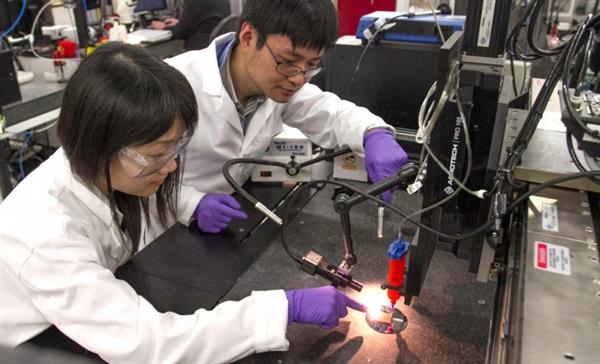
Imagine our surprise when reviewing cutting edge research papers to include in our newsletter for February and we find another long time client has published an equally impressive article using our graphene oxide to 3d print graphene aerogel supercapacitors.
Supercapacitors Based on Three-Dimensional Hierarchical Graphene Aerogels with Periodic Macropores
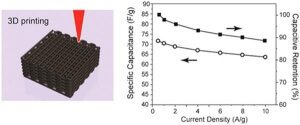
“Graphene is an atomically thin, two-dimensional (2D) carbon material that offers a unique combination of low density, exceptional mechanical properties, thermal stability, large surface area, and excellent electrical conductivity. Recent progress has resulted in macro-assemblies of graphene, such as bulk graphene aerogels for a variety of applications. However, these three-dimensional (3D) graphenes exhibit physicochemical property attenuation compared to their 2D building blocks because of one-fold composition and tortuous, stochastic porous networks. These limitations can be offset by developing a graphene composite material with an engineered porous architecture. Here, we report the fabrication of 3D periodic graphene composite aerogel microlattices for supercapacitor applications, via a 3D printing technique known as direct-ink writing. The key factor in developing these novel aerogels is creating an extrudable graphene oxide-based composite ink and modifying the 3D printing method to accommodate aerogel processing. The 3D-printed graphene composite aerogel (3D-GCA) electrodes are lightweight, highly conductive, and exhibit excellent electrochemical properties. In particular, the supercapacitors using these 3DGCA electrodes with thicknesses on the order of millimeters display exceptional capacitive retention (ca. 90% from 0.5 to 10 A·g−1) and power densities (>4 kW·kg−1) that equal or exceed those of reported devices made with electrodes 10−100 times thinner. This work provides an example of how 3D-printed materials, such as graphene aerogels, can significantly expand the design space for fabricating high-performance and fully integrable energy storage devices optimized for a broad range of applications.
Recently, we utilized an extrusion-based 3D printing technique known as direct-ink writing (DIW), to fabricate highly compressible graphene aerogel microlattices. These 3Dprinted graphene aerogels showed even better mechanical strength than most bulk graphene assemblies while maintaining the large surface area of single graphene sheets. The DIW technique employs a three-axis motion stage to assemble 3D structures by robotically extruding a continuous “ink” filament through a micronozzle at room temperature in a layer-by-layer scheme. The prerequisite for this method is to design gelbased viscoelastic ink materials possessing shear thinning behavior to facilitate extrusion flow under pressure and a rapid pseudoplastic-to-dilatant recovery resulting in shape retention after deposition. Furthermore, the inks’ physical and electrochemical properties can be significantly improved to even realize multifunctionality by the addition of functional fillers, such as conductive nanoparticles, nanotube/wires, as well as nanofibers. Here, we demonstrate a fabrication strategy for 3D-printed graphene composite aerogels (3D-GCAs) with designed architecture for microsupercapacitor applications.”
You can find the full article here http://pubs.acs.org/doi/abs/10.1021/acs.nanolett.5b04965
What Is a Graphene Aerogel?
Graphene aerogels are among the most extraordinary materials ever produced. By assembling individual graphene sheets into a three-dimensional porous network and then removing the solvent through freeze-drying, researchers create a solid material that is up to 99.8% air by volume. The result is a structure lighter than most gases, yet mechanically robust and electrically conductive — properties that no conventional porous carbon material can match simultaneously.
The key to graphene aerogel performance lies in the structure of the individual building blocks. Graphene oxide (GO) — graphene functionalized with oxygen-containing groups — disperses readily in water, making it ideal as an ink or precursor for 3D fabrication. Once printed and reduced (either thermally or chemically), the oxygen groups are removed and the electrical conductivity of the graphene network is restored. The resulting reduced graphene oxide aerogel inherits the high surface area of the GO precursor while recovering the conductivity of pristine graphene.
Why Supercapacitors Need Graphene Aerogels
Conventional supercapacitors store energy in the electric double layer at the electrode-electrolyte interface. The amount of energy stored scales directly with the accessible surface area of the electrode. Activated carbon — the standard electrode material — offers high surface area but poor conductivity, forcing a trade-off between energy density and power delivery.
Graphene aerogel electrodes resolve this trade-off. The continuous graphene network provides charge transport pathways that are orders of magnitude more conductive than activated carbon, while the hierarchical pore structure (micropores, mesopores, and macropores coexisting in the same scaffold) gives electrolyte ions fast, unobstructed access to virtually every surface. The result is a supercapacitor that charges and discharges in milliseconds while storing significantly more energy per unit mass than conventional designs.
The specific capacitance values demonstrated in the literature for graphene aerogel supercapacitors range from 120 to over 300 F/g depending on the fabrication method and electrolyte — two to three times what activated carbon electrodes typically deliver at comparable power densities.
The Role of 3D Printing in Electrode Architecture
Traditional graphene aerogel fabrication relies on bulk gelation — GO is dispersed in water, gelled by a reducing agent or pH shift, then freeze-dried. The resulting monolith has a random, stochastic pore network. Pores vary widely in size and connectivity, limiting electrolyte diffusion into the interior of thick electrodes.
Direct-ink writing (DIW) changes this by engineering the pore architecture deliberately. The GO ink is extruded through a fine nozzle in programmed patterns, building up a periodic lattice layer by layer. The macropores between printed filaments are defined by the print path, not by random gelation chemistry. This means researchers can independently tune electrode thickness, porosity, and filament spacing to optimise both energy density and ion transport simultaneously.
The breakthrough demonstrated in the research described above — electrodes millimeters thick that match or exceed the performance of electrodes 10 to 100 times thinner — directly reflects this architectural control. Thick electrodes store more total energy. The periodic macropore channels ensure that even the deepest layers of the electrode remain electrochemically accessible to the electrolyte, eliminating the ion diffusion bottleneck that limits conventional thick-film approaches.
Graphene Oxide Ink Formulation
The printability of a GO ink depends on its rheological properties. A DIW ink must flow under the shear stress of extrusion (shear-thinning behaviour) but recover its solid-like structure immediately after deposition, so printed filaments hold their shape before freezing or drying.
Achieving these properties requires careful control of GO concentration, flake size distribution, and the addition of rheology modifiers such as hydroxypropyl methylcellulose (HPMC) or fumed silica. The flake size matters: larger GO flakes create stronger entanglement networks at lower concentrations but can clog fine nozzles. Most successful DIW inks for aerogel supercapacitors use GO flakes in the 1–20 µm lateral size range at concentrations between 5 and 20 mg/mL.
Post-printing, the scaffold is typically reduced by thermal annealing in an inert atmosphere at 200–1000°C. Higher annealing temperatures remove more oxygen functional groups, recovering more of the intrinsic graphene conductivity. The trade-off is that higher temperatures can cause some structural shrinkage. Most optimised protocols use temperatures between 800°C and 1000°C, achieving sheet resistance values below 10 Ω/sq within the aerogel filaments.
Applications Beyond Energy Storage
While supercapacitor electrodes represent the most studied application, 3D-printed graphene aerogels are finding uses wherever lightweight structures with high surface area, thermal conductivity, or electrical conductivity are needed. Current active research areas include:
- Flexible and wearable energy storage — printed aerogel films integrated into textiles for on-body supercapacitors
- Electromagnetic shielding — the conductive 3D network dissipates microwave radiation with shielding effectiveness exceeding 20 dB at thicknesses below 1 mm
- Thermal management — anisotropic aerogel lattices channel heat preferentially along the filament direction, useful for heat spreaders in compact electronics
- Strain and pressure sensing — the compressible aerogel network changes resistance predictably under mechanical deformation, enabling highly sensitive piezoresistive sensors
- Oil and chemical absorption — the hydrophobic graphene surface selectively absorbs oils and organic solvents from water at uptake capacities exceeding 100× the aerogel mass
Graphene Oxide for Aerogel Research
Cheap Tubes has supplied graphene oxide to research groups worldwide since 2005, including the group at Lawrence Livermore whose 3D-printed aerogel work is described above. Our GO is available in both powder and aqueous dispersion form, with multiple oxidation levels to suit different ink rheology and reduction chemistry requirements.
For aerogel supercapacitor research, the most commonly requested grades are our high-oxidation GO dispersions (8–10 wt% oxygen content), which give the highest yield of functional groups for stable aqueous inks, and our large-flake GO powder (lateral size 10–50 µm) for maximum entanglement and gel strength. Both are available with a certificate of analysis confirming C/O ratio, flake size distribution, and layer count.
For groups working on composite aerogels with enhanced energy density, our graphene nanoplatelets can be blended with GO to introduce partially graphitized domains that improve conductivity before annealing. Contact us for technical guidance on formulating inks for your specific print system and target electrode architecture.
Build Your Own Graphene Supercapacitor Electrodes
We supply the graphene nanoplatelets and graphene oxide used in energy storage R&D — from academic prototype to pilot scale. Datasheets, SDS, and bulk pricing available. Trusted by 1,000+ research groups since 2005.