
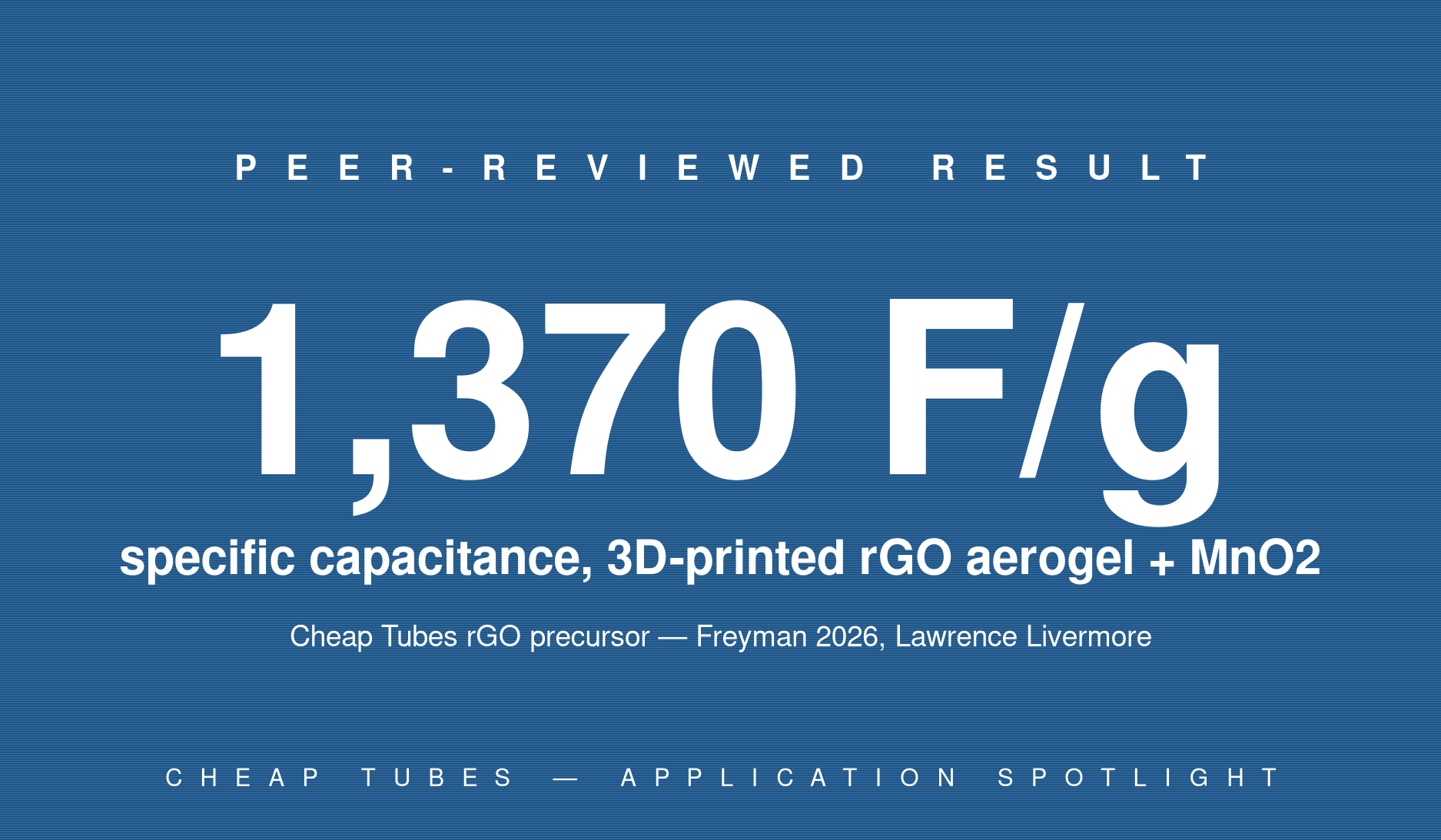
The energy storage problem with MnO2 supercapacitor electrodes has always been mass transport: MnO2 is a high-theoretical-capacitance pseudocapacitive material (~1,370 F/g at the materials level), but at the practical loadings needed for usable areal capacity, the ions can't reach the active sites fast enough and the rate capability collapses. 3D printing — specifically the direct ink writing (DIW) technique — gives engineers a way to print hierarchical, open-channel electrode architectures that move ions efficiently from electrolyte into the bulk of the active material. A 2026 study from Lawrence Livermore National Laboratory, with collaborators at UC Santa Cruz, published in Energy Advances, asked a question that hadn't been cleanly answered before: when 3D-printing carbon scaffolds for these MnO2-coated supercapacitor electrodes, does it matter whether you start from graphene oxide (GO) or reduced graphene oxide (rGO)? Both are commercially available; both can be printed. The answer turned out to be yes — and meaningfully. The rGO-based scaffold delivered 1,370 F/g specific capacitance, materially outperforming the GO-based scaffold. The paper used Cheap Tubes reduced graphene oxide as the precursor for the rGO ink, and cites the Cheap Tubes product URLs directly in its references.
The Research Question
3D-printed graphene aerogels have been demonstrated as supercapacitor scaffolds before, including prior work from the same Worsley / Chandrasekaran group at LLNL. The path most teams take is to print from graphene oxide ink (because GO disperses well in water and forms thixotropic inks that print cleanly), then carbonize the printed structure to drive the GO toward reduced graphene oxide at high temperature. The Freyman paper compares this default route against an alternative: print directly from reduced graphene oxide ink, then carbonize. Same final material category, two different starting points. The hypothesis the paper tested: does the oxygen content and defect density of the starting precursor influence the final aerogel architecture, electrochemistry, and mechanical performance in a way the carbonization step doesn't fully erase?
Materials and Methods
Cheap Tubes rGO — cited directly in the references
From the paper's Synthesis of reduced graphene oxide ink (verbatim): "An aqueous suspension of reduced graphene oxide (30 mg mL−1, CheapTubes) was prepared with the addition of 5 wt% Pluronic F127 (Sigma Aldrich). To this suspension, 18 wt% cellulose nanocrystals (Celluforce) were added and mixed in a FlakTech planetary mixer at 2,500 rpm in one-minute increments until a smooth ink was generated."
The paper's bibliography references the product pages directly:
- Reference [13]: "Reduced Graphene Oxide, https://www.cheaptubes.com/product/reduced-graphene-oxide/"
- Reference [14]: "Single Layer Graphene Oxide, https://www.cheaptubes.com/product/single-layer-graphene-oxide/"
Direct product-URL citation in a peer-reviewed reference list is meaningful in two ways. It documents exactly which commercial supply the study used, and it gives the Cheap Tubes product pages a peer-reviewed inbound link from a top US national lab.
Ink formulation, printing, and post-processing
- Thixotropic rGO ink: 30 mg/mL Cheap Tubes rGO + 5 wt% Pluronic F127 surfactant + 18 wt% cellulose nanocrystals (CNC) as the rheological modifier.
- Comparison GO ink: parallel formulation with single-layer GO (Cheap Tubes, ref 14) at the same loading.
- 3D printing: direct ink writing (DIW) into 1 cm × 1 cm × 1 cm lattice structures.
- Post-processing: freeze drying, then carbonization at high temperature to drive both inks toward graphene aerogel scaffolds.
- MnO2 deposition: 10 mA/cm2 applied for varying durations (5 minutes and 2 hours) onto the carbonized scaffold.
Characterization
- Electrochemistry: cyclic voltammetry, galvanostatic charge-discharge at 0.5 mA/cm2, EIS spectroscopy, capacitance retention over cycling.
- Mechanical: Instron 5966 compression testing with 1 kN load cell. Cubes compressed to 70% and 90% strain.
- Morphology: SEM cross-sections of both GO- and rGO-based aerogels, before and after MnO2 deposition.
Key Results
MnO2-coated rGO aerogel
areal capacitance winner
elastic recovery
5 min and 2 hour loadings
Specific capacitance — the headline number
The MnO2-coated, 3D-printed rGO-aerogel scaffold delivered a specific capacitance of 1,370 F/g. That number is near the theoretical limit for MnO2 pseudocapacitance and is what makes the 3D-printed architecture matter — without the hierarchical pore structure, the rate capability and ion transport limit the achievable practical capacitance well below the theoretical ceiling. The 3D-printed scaffold is what lets the MnO2 deliver its theoretical performance at a practical thickness.
The precursor choice matters
The central question the paper asked — does it matter whether you start from GO or rGO when 3D printing the aerogel scaffold? — got a clean answer. The rGO-based aerogels showed superior areal capacitance vs the GO-based aerogels at matched fabrication parameters. The paper attributes the difference to the lower oxygen content and lower defect density of the rGO starting material, which produces different rheology in the cellulose-viscosified ink and different microstructure in the carbonized aerogel. The result is that the rGO-precursor aerogel has a more open, more accessible pore structure that hosts MnO2 more efficiently and lets electrolyte ions reach the pseudocapacitive sites faster.
Mechanical robustness
The 3D-printed aerogels survived compression to 70% strain with elastic recovery — meaningful for any application where the electrode is mechanically loaded (flexible devices, structural energy storage, embedded sensors). Beyond 70% the printed lattice begins to densify and lose its open-pore architecture.
Why Cheap Tubes rGO Works for This Ink
- Aqueous-suspension format at 30 mg/mL — the rGO disperses cleanly in water at high solid loading, which is what direct-ink-writing thixotropic inks need. Coarse, poorly-exfoliated rGO would not produce the smooth, printable suspension the protocol requires.
- Low residual oxygen content — the lower oxygen content of rGO vs GO is what drives the better aerogel performance in the paper. Inconsistent or partial reduction would scramble the comparison; consistent commercial-grade rGO is what makes the precursor study clean.
- Defect density compatible with cellulose viscosifiers — the paper specifically notes that the interaction between the rGO and cellulose nanocrystal viscosifier in the ink is what produces the printable, post-print-stable network. Commercial rGO with consistent surface chemistry is what makes that interaction reproducible.
Application Areas
- 3D-printed supercapacitor electrodes — the direct target, including pseudocapacitor architectures with MnO2, NiO, Co3O4, and other transition-metal-oxide active layers.
- Structural energy storage — load-bearing electrodes that simultaneously store energy and carry mechanical load (vehicles, aerospace, wearables).
- Hierarchical battery electrodes — the same precursor + DIW methodology transfers to Li-ion, Na-ion, and Zn-ion battery cathodes / anodes where pore architecture limits rate capability.
- Hybrid GO/rGO inks for tailored architectures — the precursor-comparison framework the paper establishes can be used to design composite inks that combine the rheology benefits of one precursor with the electrochemistry of the other.
- Lattice-architecture catalyst supports — the same 3D-printed aerogel scaffolds are used as supports for electrocatalysts in hydrogen evolution, CO2 reduction, and fuel cell research.
Order the Cheap Tubes rGO Used in This Study
The Lawrence Livermore team’s paper references two Cheap Tubes products directly in its bibliography (references 13 and 14): Reduced Graphene Oxide — the precursor used for the high-performing rGO ink that delivered the 1,370 F/g result — and Single Layer Graphene Oxide — the GO precursor used in the GO vs rGO comparison. Both are in stock at Cheap Tubes. Browse the full Graphene Oxide product category for additional grades and formats. Research and production volumes, with SDS, TDS, and Certificate of Analysis on every shipment, and custom dispersions on request.
Reduced Graphene Oxide for 3D-Printed Supercapacitor and Battery Electrodes
Reduced graphene oxide for 3D-printed direct-ink-writing electrode architectures, supercapacitor and battery scaffolds, MnO2 / NiO / Co3O4 hybrid pseudocapacitor inks, electrocatalyst supports, and aerogel composites. Aqueous-suspension and powder formats; custom concentration and surfactant-compatible grades on request.
Order Reduced Graphene Oxide (ref 13) → Order Single Layer GO (ref 14) → Browse all GO gradesFrequently Asked Questions
What is direct ink writing (DIW) and why does it matter for supercapacitor electrodes?
Direct ink writing is an extrusion-based 3D printing technique where a thixotropic ink is extruded through a nozzle and deposited layer-by-layer. For supercapacitor electrodes, DIW enables hierarchical lattice architectures with open channels for fast ion transport and large surface area for high capacitance — properties that conventional slot-die or blade-coated electrodes can't achieve at practical thickness. The 3D architecture is what lets the MnO2 pseudocapacitor reach its theoretical capacitance at usable electrode mass.
Why does it matter whether you 3D print from GO or rGO?
Both can be carbonized to graphene aerogel and used as a supercapacitor scaffold. But the Freyman paper finds that the precursor choice persists through to the final structure: rGO-based aerogels deliver higher areal capacitance than GO-based aerogels under matched conditions. The paper attributes this to the lower oxygen content and defect density of rGO, which produce different rheology in the cellulose-viscosified ink and different microstructure in the carbonized aerogel.
What MnO2 deposition protocol did the paper use?
10 mA/cm2 applied for either 5 minutes or 2 hours, deposited electrochemically onto the carbonized 3D-printed scaffold. The two durations let the paper compare thin-layer vs thick-layer MnO2 loadings on the same scaffold architecture, isolating the contribution of the carbon scaffold from the MnO2 active layer.
Is 1,370 F/g comparable to commercial supercapacitor materials?
1,370 F/g is at the upper end of the published range for MnO2 pseudocapacitor electrodes and approaches the theoretical materials-level limit. Commercial activated-carbon supercapacitors (Maxwell, Skeleton class) typically achieve 100-300 F/g, but with much faster rate capability. The 3D-printed rGO + MnO2 architecture targets the high-capacitance / pseudocapacitor end of the supercapacitor design space.
Where do I order rGO for 3D-printed electrode R&D?
Order the matching SKU used in this study: Reduced Graphene Oxide from Cheap Tubes. The paper references the product page directly in its bibliography (reference 13). Other GO grades (single-layer, powder, gel, larger lateral) are also available. Contact us with your target ink concentration, surfactant compatibility, and DIW nozzle dimensions for grade recommendations.
Can the same rGO ink be used for battery electrodes, not just supercapacitors?
Yes. The same direct-ink-writing rGO precursor + cellulose viscosifier framework transfers to Li-ion, Na-ion, and Zn-ion battery cathodes and anodes — including silicon-graphene composite anodes (where the 3D architecture buffers volumetric strain) and high-loading LiFePO4 / NMC cathodes (where the open lattice improves rate capability). The same group has published in the battery direction as well; the Freyman precursor study generalizes.