
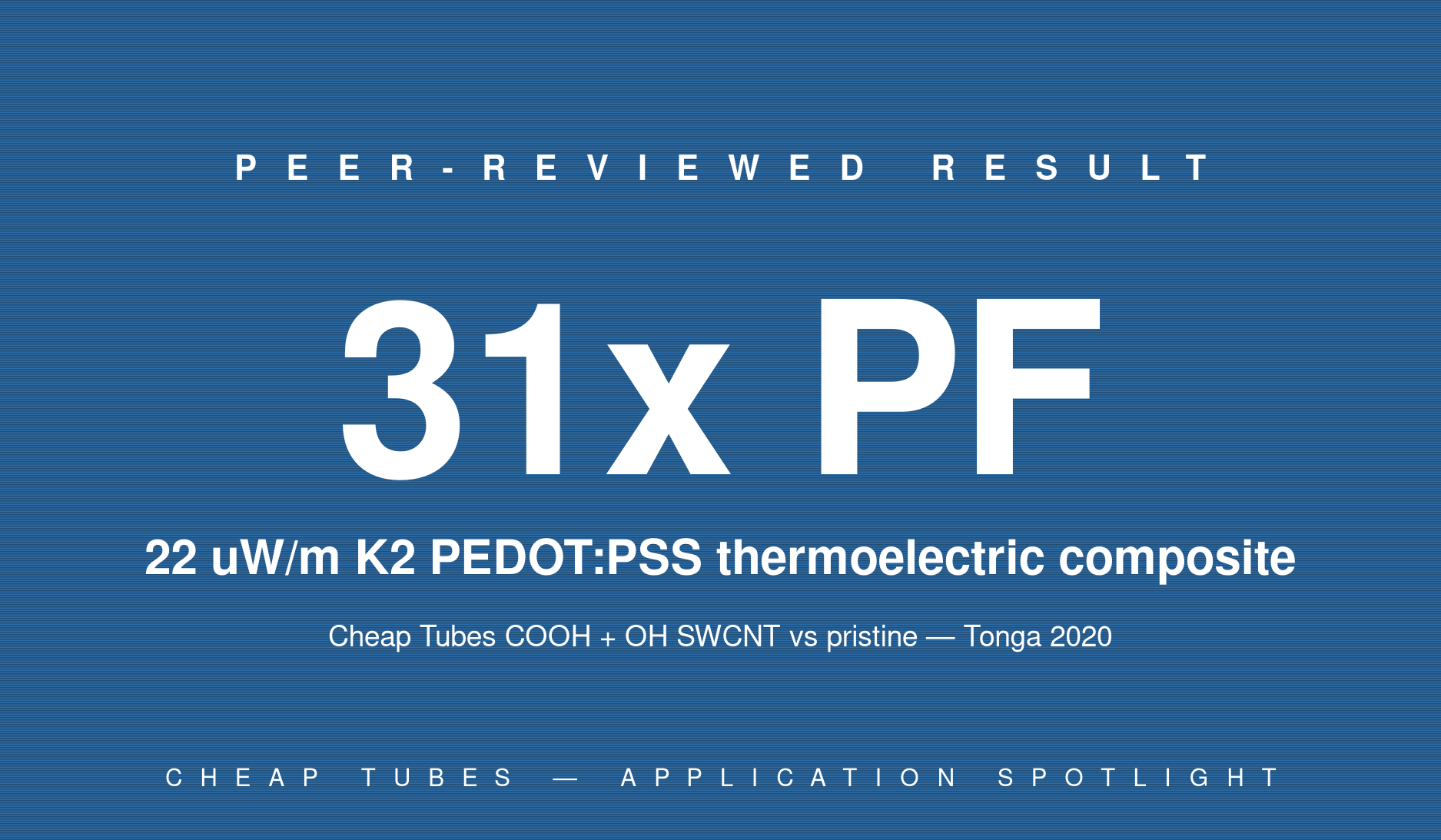
Organic thermoelectric materials offer a path to flexible, lightweight, low-cost energy harvesting from body heat, IoT-device waste heat, and any low-grade temperature differential where rigid bismuth-telluride modules are inappropriate. PEDOT:PSS, the most studied conducting polymer for organic thermoelectrics, has a moderate Seebeck coefficient but limited intrinsic conductivity. The standard strategy — blend SWCNT into PEDOT:PSS — increases conductivity but typically lowers Seebeck (the universal Wiedemann-Franz-style trade-off in TE materials). A 2020 study from the Department of Chemistry at the University of Massachusetts Amherst by Tonga, Wei, and Lahti, published in the International Journal of Energy Research, broke that trade-off using Cheap Tubes carboxyl (COOH) and hydroxyl (OH) functionalized single-walled carbon nanotubes. The functionalized SWCNT/PEDOT:PSS blends showed simultaneous increases in both electrical conductivity and Seebeck coefficient, raising the thermoelectric power factor to 22 µW/m·K² — an ~31× improvement over the same composite with pristine SWNT (0.7 µW/m·K²). Funded by the U.S. Defense Threat Reduction Agency.
The Research Question
The figure of merit for a thermoelectric material is ZT = S2σT/κ, where S is the Seebeck coefficient, σ is electrical conductivity, κ is thermal conductivity, and T is absolute temperature. The numerator S2σ is the "power factor" (PF), reported in units of W/m·K2. Higher PF means more electrical power produced per unit temperature differential. The hard problem in PF engineering is that S and σ usually move in opposite directions — the same doping that raises carrier concentration (and σ) raises Fermi level and lowers S, and vice versa. The Tonga group set out to ask whether functionalized SWCNT — with COOH or OH groups on the nanotube wall — could break that inverse relationship in a PEDOT:PSS composite by simultaneously improving charge transport and increasing Seebeck via interface energy-filtering effects.
Materials and Methods
SWCNT — functionalized variants from Cheap Tubes
From the paper's Experimental Section (verbatim): "Functionalized SWNTs were purchased from CheapTubes. SWNT-COOH: >90% purity with outer diameter 1-4 nm and 5-30 μm length. SWNT-OH: >90% purity with outer diameter 1-2 nm and 5-30 μm length. SWNT was purchased from Sigma-Aldrich with ≥50-70% purity and diameters of 1.2-1.5 nm."
- SWNT-COOH: >90% purity, 1-4 nm OD, 5-30 μm length — Cheap Tubes.
- SWNT-OH: >90% purity, 1-2 nm OD, 5-30 μm length — Cheap Tubes.
- Pristine SWNT control: Sigma-Aldrich, 50-70% purity — used as the comparison baseline.
The contrast is informative: the Cheap Tubes functionalized material was used because the authors needed both surface-chemistry control (COOH or OH for hydrogen bonding to PEDOT:PSS) and high purity (>90%) to keep amorphous carbon and metal residue from dominating the electrical response. The Sigma pristine material at 50-70% purity served only as the baseline; functionalized SWCNT at >90% purity is what produced the result.
PEDOT:PSS host polymer
- CLEVIOS™ PVP Al 4083, the standard hole-transport-layer formulation.
- ~1.5 wt% solids in water, PEDOT:PSS weight ratio 1:6.
Blend preparation and film casting
- Solvent: water only — the COOH and OH functionalization on the SWCNT walls enables surfactant-free dispersion in aqueous PEDOT:PSS.
- SWCNT loading: swept from 10 wt% to 65 wt% to identify the optimal composition.
- Film casting: drop-cast or spin-cast on substrate; samples sized for in-plane four-probe conductivity and thermoelectric measurement.
Characterization
- Four-probe in-plane electrical conductivity (σ).
- Seebeck coefficient (S) by temperature gradient + thermocouple measurement.
- Power factor PF = S2σ calculated from measured S and σ.
- FTIR and UV-Vis to verify hydrogen-bonding interactions between the SWCNT surface groups and PEDOT chains.
Key Results
SWNT-COOH composite
vs pristine SWNT (0.7)
14x pristine PEDOT:PSS
up from 18 (atypical)
Atypical thermoelectric behavior — both σ and S increase together
The headline finding is the breaking of the usual S vs σ trade-off. With COOH-functionalized SWCNT loading swept from 10% to 65%, electrical conductivity climbed monotonically to ~115 S/cm (from 8 S/cm in pristine PEDOT:PSS — a 14× gain). What's unusual is that the Seebeck coefficient went up from 18 µV/K to 42 µV/K over the same composition range, rather than down. The product S2σ therefore got the benefit of both terms, producing the 22 µW/m·K² power factor — a ~31× gain over the pristine-SWNT control composite (0.7 µW/m·K²) and a ~2,400× gain over PEDOT:PSS alone (0.009 µW/m·K²).
COOH outperforms OH
At matched SWCNT loading, the COOH-functionalized blend produced PF = 22 µW/m·K² while the OH-functionalized blend produced PF = 16 µW/m·K². Both are dramatic improvements over the pristine SWNT and PEDOT:PSS-only baselines, but COOH is the stronger surface chemistry for this application — consistent with the carboxylate's stronger hydrogen-bond donor character vs hydroxyl.
Why — the energy-filtering mechanism
The authors attribute the atypical S+σ co-increase to two effects acting in concert:
- Conformational extension of PEDOT chains. Hydrogen bonds between the COOH or OH groups on the SWCNT wall and the polythiophene backbone induce PEDOT chains to adopt extended, linear conformations rather than coiled ones. Extended chains improve charge mobility (raises σ).
- Energy-filtering at SWCNT/PEDOT junctions. The energy barriers at the nanotube/polymer interface block low-energy carriers from contributing to transport, leaving only the higher-energy carriers — which carry more energy per charge and therefore raise the Seebeck coefficient.
Both mechanisms require the surface functionalization. Pristine SWCNT has no anchor for H-bonding with PEDOT (no chain straightening) and no engineered junction barrier (no energy filtering). The COOH and OH variants from Cheap Tubes deliver both.
Why Cheap Tubes Functionalized SWCNT Works Here
- >90% purity matters for thermoelectrics. Amorphous carbon and metal-catalyst residue carry their own electronic states and degrade clean PF measurements. The Sigma-Aldrich pristine baseline at 50-70% purity produced PF = 0.7 µW/m·K²; the Cheap Tubes functionalized material at >90% purity produced PF = 22 µW/m·K² — the purity gap is part of the story.
- Surface-chemistry choice matters. COOH and OH variants both produce dramatic improvements but COOH is stronger. Cheap Tubes supplies both as standard catalog items, letting researchers compare surface chemistries directly without one-off custom synthesis.
- Aqueous processing. The COOH and OH functionalization makes the SWCNT water-dispersible without surfactants — compatible with PEDOT:PSS (CLEVIOS™) which is itself an aqueous formulation. The whole composite is processed in water.
Application Areas
- Wearable and on-skin energy harvesting — body-heat-powered IoT sensors, smartwatch self-charge augmentation, medical monitoring patches. The flexible PEDOT:PSS/SWCNT film is the right form factor.
- Industrial waste-heat recovery (low-grade) — pipe surfaces, exhaust ducts, server-rack air outlets where the temperature differential is <100 °C and rigid bismuth-telluride is impractical.
- Self-powered sensors — environmental monitors, agricultural sensors, structural health monitors in remote installations where battery replacement is costly.
- Soft / printed thermoelectric devices — inkjet- or screen-printed thermoelectric modules for distributed sensing networks.
- Defense and security wearables — the paper's DTRA funding hints at the use case: soldier-mounted sensors and field IoT powered by body heat without battery dependency.
Order the Cheap Tubes COOH and OH SWCNT Used in This Study
The carboxyl- and hydroxyl-functionalized SWCNT used by the Tonga group at UMass Amherst are catalog items from Cheap Tubes:
- SWNT-COOH: >90% purity, 1-4 nm outer diameter, 5-30 μm length. The headline-result variant of the Tonga study (PF = 22 µW/m·K²). Available pristine or with COOH content tailored to the application.
- SWNT-OH: >90% purity, 1-2 nm outer diameter, 5-30 μm length. The second variant of the Tonga study (PF = 16 µW/m·K²). Currently special-order at Cheap Tubes.
- SWNT-NH₂: available as the amine-functionalized counterpart for epoxy crosslinking and biomolecule conjugation.
Functionalized SWCNT (COOH / NH₂ / OH) for Conducting Polymer Composites and Energy Harvesting
Carboxyl-, amine-, and hydroxyl-functionalized SWCNT for thermoelectric composites, conducting polymer blends, biosensors, and aqueous dispersion-stable formulations. Pristine and functionalized grades, with SDS, TDS, and CoA included. Production-scale supply and custom dispersions on request.
Order COOH-SWCNT (PF = 22) → Order OH-SWCNT (PF = 16) → Browse all SWCNT gradesFrequently Asked Questions
What is a thermoelectric power factor and why is 22 microWatt per meter per Kelvin squared significant?
Power factor PF = S2σ is the figure of merit for a thermoelectric material's ability to convert a temperature gradient into electrical power, independent of thermal conductivity. Organic thermoelectrics typically run in the 1-10 µW/m·K² range. 22 µW/m·K² puts the COOH-functionalized SWCNT/PEDOT:PSS composite at the top of the organic-TE performance envelope and within sight of low-end inorganic competitors, with the major advantage that the organic composite is flexible, lightweight, and water-processable.
Why do COOH and OH groups on SWCNT improve PEDOT:PSS thermoelectric performance?
The functional groups form hydrogen bonds with the polythiophene backbone of PEDOT. This forces the polymer chains into extended, linear conformations (rather than coils), which improves charge mobility and raises electrical conductivity. The SWCNT/PEDOT interface also serves as an energy filter: low-energy charge carriers are blocked at the junction barriers while high-energy carriers pass through, raising the Seebeck coefficient.
Why is the simultaneous increase in conductivity and Seebeck unusual?
In most thermoelectric materials, the doping that raises carrier concentration (and conductivity) also lowers Seebeck coefficient via Fermi-level shift. The two effects pull in opposite directions, limiting power factor gains. The hydrogen-bonded SWCNT/PEDOT system breaks this trade-off because the conductivity increase comes from polymer conformational change (not from doping) and the Seebeck increase comes from interface energy filtering — two independent mechanisms that don't fight each other.
What is the difference between SWNT-COOH and SWNT-OH for thermoelectrics?
In the Tonga study, the COOH-functionalized SWCNT produced PF = 22 µW/m·K² and the OH-functionalized SWCNT produced PF = 16 µW/m·K² at matched loading. Both are dramatic improvements over pristine SWNT or PEDOT:PSS-only baselines. COOH is the stronger hydrogen-bond donor and produces the larger effect; OH is the second-choice surface chemistry where COOH is not compatible with downstream processing.
Can this be printed or inkjet-deposited for flexible devices?
Yes — the aqueous SWCNT/PEDOT:PSS composite is compatible with standard printing methods (inkjet, screen, gravure) and with flexible polymer substrates. Application directions in the field include wearable on-skin energy harvesters, distributed IoT sensor self-power, and printed thermoelectric arrays for low-grade waste-heat recovery.
Where do I order COOH or OH functionalized SWCNT for thermoelectric R&D?
Order the matching SKUs directly: COOH-Functionalized SWCNT (Tonga PF = 22 µW/m·K²) or OH-Functionalized SWCNT (PF = 16). Or browse all SWCNT grades., available in COOH, OH (special-order), and NH₂ functionalization. Contact us with your target polymer host (PEDOT:PSS, P3HT, polyaniline, etc.), loading range, and substrate / processing requirements for grade and dispersion-protocol recommendations.