
5G base stations, automotive radar, drone shielding, satellite electronics, and high-density consumer devices all need lightweight, thin, mechanically robust electromagnetic interference (EMI) shielding. The benchmark for commercial EMI shielding is around 40 dB shielding effectiveness (SE). Above 60 dB starts to satisfy aerospace, defense, and medical-grade requirements. The standard ways to get there — metal foils, metallized fabrics, or thick conductive composites — are heavy, brittle, or both. Carbon nanotube films are an attractive alternative because they are light, flexible, and electrically conductive, but the typical CNT-film conductivity is limited by contact resistance at the points where neighboring nanotubes touch. A 2023 study from the David Jassby group at UCLA, with collaborators at UC Riverside (Balandin lab), Technion, and Lawrence Berkeley National Lab, published in Carbon, demonstrates a one-step densification method that collapses the inter-tube spacing in Cheap Tubes carboxyl-functionalized single-walled CNT (SWCNT-COOH) films, raising film conductivity to ~106 S/m and delivering 71 dB X-band shielding effectiveness (99.999992% wave attenuation) in a 14.3 micron film. Gold decoration of the dense film boosts SE per unit thickness further — 66.12 dB at only ~3 microns.
The Research Question
SWCNT films are intrinsically attractive for EMI shielding — high in-plane conductivity, low density, flexible, machinable into thin layers — but the practical performance has always been limited by contact resistance between neighboring tubes. The standard approach to fix this is "densification": use chlorosulfonic acid (CSA) to dissolve the SWCNT bundle, then re-cast and recover, removing the inter-tube voids. The catch: the standard CSA process needs three or four sequential steps (dissolve, cast, wash, neutralize) and the resulting films often need post-treatment to recover the conductivity. The Jassby group's question: can the entire densification be done in a single thermal-evaporation step from a CNT/CSA suspension, producing a dense, conductive, mechanically stable film without the multi-step sequence?
Materials and Methods
SWCNT — COOH-functionalized, Cheap Tubes Inc.
From the paper's Experimental Section 2.1, Materials subsection (verbatim): "Carboxyl group functionalized single-walled CNT (SWNT-COOH) with a diameter of 1-4 nm was purchased from Cheap Tubes Inc. (USA)."
- SWCNT specs: COOH-functionalized single-walled, 1-4 nm outer diameter.
- Why COOH: the carboxyl groups give the SWCNT colloidal stability in polar acids and improve dispersibility. They also serve as anchor sites for subsequent gold decoration in the metal-coated variant.
- Why SWCNT (not MWCNT): SWCNT has higher specific electrical conductivity and a higher Young's modulus per unit mass than MWCNT, making it the right choice when both EMI SE per gram and thinness matter.
One-step densification
- Solvent: chlorosulfonic acid (CSA), a strong superacid known to fully exfoliate SWCNT into individual tubes via protonation.
- Process: SWCNT-COOH suspended in CSA at varying loading, cast as a film, then dried by thermal-induced evaporation. The CSA evaporates and the SWCNT network collapses into a densified film — no separate compression step.
- Post-treatment: dense films rinsed in 1 M acid or 1 M alkali bath for 1 hour to remove residual CSA, then washed in DI water.
- Thickness control: achieved by varying CNT loading in the CNT/CSA suspension before evaporation — range tested: 1.3 to 14.3 microns.
Gold decoration (for thinner-film variant)
For the higher-performance-per-thickness variant, the dense CNT film is coated with a thin gold layer by reduction of HAuCl4 onto the COOH-functionalized SWCNT surface. The COOH groups serve as anchor sites for gold nanoparticle nucleation. The metal coating dramatically increases reflection at the front surface, which complements the absorption losses inside the dense CNT layer.
Characterization
- EMI SE measurement: X-band (8.2-12.4 GHz) using a vector network analyzer (VNA), with films mounted in standard rectangular waveguide fixtures.
- Conductivity: four-point probe sheet resistance and bulk conductivity calculations.
- Morphology: SEM cross-section to verify densification; high-resolution TEM to confirm individual-tube alignment.
- Density: direct mass / volume measurement — ~1.0 g/cm3 for the densified film.
Key Results
99.999992% attenuation
pure dense CNT, no metal
approaching metallic regime
absolute shielding/mass
Pure dense film — 71 dB at 14.3 micron
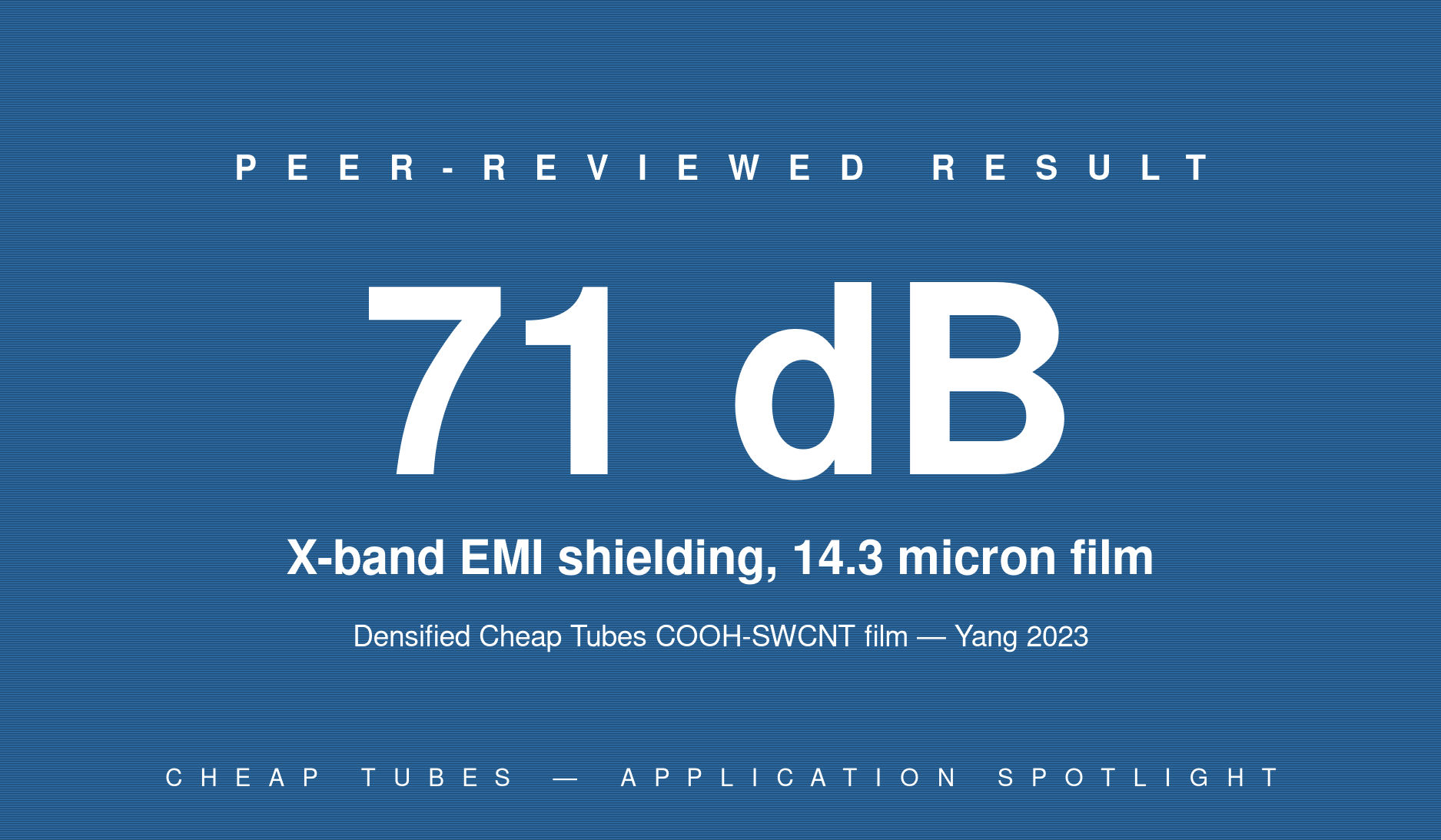
The headline result is the 71 dB X-band shielding effectiveness measured on the densified CNT film alone — no metal coating required. 71 dB corresponds to 99.999992% attenuation of the incident wave (only 8 parts per 100 million pass through). For context: commercial EMI shielding minimum is ~20 dB (99% attenuation); telecommunication and defense electronics generally specify ~40-60 dB (99.99 to 99.9999% attenuation); 71 dB is in the aerospace / medical-grade tier. And it's achieved in a film thinner than a human hair (14.3 microns).
Loose vs densified vs gold-decorated
The paper's comparison data is instructive for understanding what densification does:
- Loose (undensified) CNT film: 43.90 dB — at the bottom of the practical-shielding range.
- Dense CNT film (same SWCNT, densified): 56.67 dB at the same film thickness — a 12.77 dB gain (just under 20× more attenuation) purely from collapsing inter-tube voids.
- Dense CNT film, full thickness (14.3 micron): 71 dB — the headline result.
- Dense CNT + thin gold layer (~3 micron total): 66.12 dB — near the dense-film headline, but in a much thinner total stack, because the metal adds reflective shielding at the front surface.
Specific (mass-normalized) shielding effectiveness
For weight-sensitive applications (aerospace, drones, wearable electronics), the comparison that matters is SSE/t — shielding effectiveness per unit density per unit thickness. The dense COOH-SWCNT films delivered 3.50 × 10⁵ dB cm2/g, putting them on par with or above competing MXene shielding materials at similar thickness. That metric is the one that matters when the weight budget is fixed.
Why COOH-SWCNT from Cheap Tubes works here
- Carboxyl functionalization — colloidal stability in CSA. The COOH groups disperse the SWCNT in the chlorosulfonic acid superacid without surfactants, enabling the one-step thermal-evaporation route. Pristine SWCNT bundles tend to aggregate in CSA without functionalization help.
- COOH groups as gold nucleation sites. For the metal-decorated variant, the carboxyl groups serve as anchor points for Au3+ reduction. This gives uniform gold-nanoparticle coverage on the dense CNT film without requiring a separate seed layer.
- SWCNT (not MWCNT) for SE per gram. SWCNT has higher intrinsic specific conductivity and lower mass density than MWCNT, so the per-gram and per-thickness shielding numbers come out higher. For EMI shielding budgets driven by mass (aerospace, drones), this is a real differentiator.
Application Areas
- 5G and 6G infrastructure — base-station shielding, mmWave antenna enclosures, in-cabin radar shielding.
- Aerospace and defense — satellite electronics shielding, aircraft avionics bay liners, military radar shielding where ITAR or weight constraints exclude metal sheet shielding.
- Automotive radar — ADAS sensor shielding, in-cabin EMC, electric-vehicle inverter shielding.
- Drone and UAV electronics — weight budget makes high SSE/t critical.
- Consumer electronics — high-density laptop and smartphone shielding where film thickness matters for industrial design.
- Medical imaging / MRI — RF shielding for high-field MRI rooms.
Order the Cheap Tubes COOH-SWCNT Used in This Study
The carboxyl-functionalized SWCNT used by the Jassby group is available from Cheap Tubes at research and production volumes. Spec card: outer diameter 1-4 nm, length 5-30 μm, >90% to >99% purity options, COOH content typically 1.5 to 3 wt%. SDS and TDS included with every shipment. Representative data provided; a representative Certificate of Analysis is available on request. Also available pristine, NH₂-, and OH-functionalized for buyers needing different surface chemistry.
Carboxyl-Functionalized SWCNT for EMI Shielding and Conductive Films
COOH-functionalized SWCNT for densified EMI shielding films, transparent conductive films, conductive textiles, sensor electrodes, and bioconjugation. Pristine and functionalized grades, with SDS and TDS included. A representative Certificate of Analysis is available on request. Production-scale supply and custom dispersions on request.
Order COOH-Functionalized SWCNT → Browse all SWCNT gradesFrequently Asked Questions
What does 71 dB EMI shielding effectiveness actually mean?
EMI shielding effectiveness (SE) is reported in decibels and measures attenuation: SE = 10 × log10(P_incident / P_transmitted). 71 dB means the transmitted wave power is reduced by a factor of about 12.6 million — 99.999992% of the incident electromagnetic energy is blocked. Commercial EMI shielding minimum is around 20 dB (99% attenuation); telecom and consumer electronics typically need 40-60 dB; 71 dB is in the aerospace and medical-imaging tier.
Why does densification of the CNT film matter so much?
The conductivity of a loose CNT film is limited by contact resistance at the points where neighboring nanotubes touch. Densification collapses the void space between tubes, dramatically increasing the number and quality of inter-tube contacts. In this paper, the same SWCNT material went from 43.90 dB SE in the loose film to 56.67 dB in the dense film at the same thickness — a 12.77 dB gain (about 20× more attenuation) purely from removing inter-tube voids.
Why use COOH-functionalized SWCNT instead of pristine?
The COOH groups stabilize the SWCNT dispersion in the chlorosulfonic acid solvent used in the one-step densification process — pristine SWCNT bundles tend to aggregate. For the gold-decorated variant, the COOH groups also serve as nucleation anchors for the gold nanoparticle layer. The functionalization enables both the processing and the metal decoration.
Why X-band frequencies (8.2 to 12.4 GHz)?
X-band is the standard frequency range used for EMI shielding characterization because it covers a broad commercial and military application range — weather radar, marine radar, military radar, satellite communications, and modern Wi-Fi. Shielding effectiveness in X-band correlates well with performance at lower frequencies (commercial telecom) and is commonly required by industry specs.
Can I scale this densification process to larger areas?
The paper's one-step thermal evaporation route is the key advantage for scale-up — it removes the multi-step CSA wet processing that limits area in traditional dense-CNT-film manufacture. The process scales to whatever area can be cast in a single layer and dried; commercial scale-up paths are similar to those used for transparent conductive film coating.
Where do I order SWCNT for EMI shielding R&D?
Order COOH-functionalized SWCNT from Cheap Tubes Single Walled Carbon Nanotubes, available in research and production volumes. Contact us with target shielding frequency band, film thickness, and substrate compatibility for grade and dispersion-protocol recommendations.