
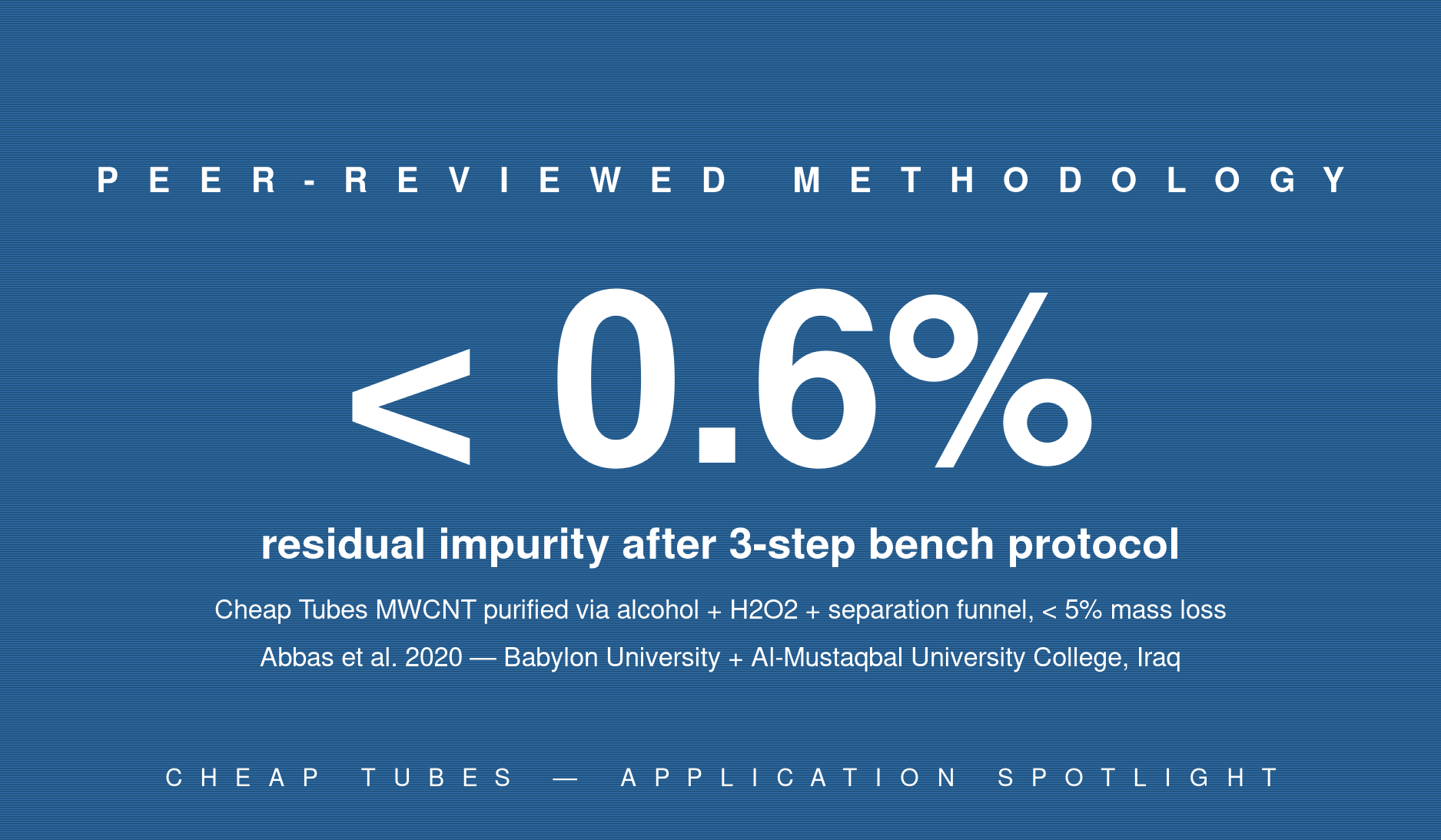
Most carbon nanotube applications don't need ultra-high-purity material. Electrical percolation in composites, mechanical reinforcement in cement, conductive ink for flexible electronics — all of these work fine with typical MWCNT supply at 90-98% purity (the current Cheap Tubes Standard MWCNT spec is 98%; Industrial Grade is 90%). The catalyst residues (typically Mo or Co from the CVD growth process) and the amorphous-carbon byproducts that come with industrial-grade and research-grade MWCNT are mechanically and electrically transparent for those uses. But some applications need higher purity: catalysis where metal residues bias the active-site chemistry, biomedical work where Mo/Co cytotoxicity matters, or electronic applications where impurity-driven charge traps degrade device performance. For those cases, researchers have historically had two paths: (1) buy pre-purified material (Graphitized MWCNT, 99.5%+, produced by thermal post-treatment that vaporizes the catalyst metals) or (2) start with affordable research-grade MWCNT and purify in-house. A 2020 paper from a multi-institutional Iraqi team — Babylon University and Al-Mustaqbal University College — published in Journal of Physics: Conference Series, demonstrates a published, peer-reviewed, bench-scale purification protocol that takes Cheap Tubes MWCNT down to <0.6% residual impurity with less than 5% MWCNT mass loss. Three steps: methanol stirring, hydrogen peroxide oxidation, separation funnel phase separation. No concentrated nitric acid. No specialty equipment. Scalable.
When MWCNT Purification Matters — And When It Doesn't
Research-grade and industrial-grade MWCNTs ship with characteristic impurities from the CVD growth process:
- Catalyst metal residues — typically Mo, Co, Fe, or Ni, depending on the synthesis route. Present as nanoparticles encapsulated inside or trapped between MWCNT bundles.
- Amorphous carbon — non-graphitic carbonaceous byproducts deposited alongside the MWCNT during growth.
- Nano-capsules — carbon-shelled metal particles, hybrid structures with non-CNT morphology.
- Substrate residues — trace material from the catalyst support, if not fully removed during initial post-processing.
Applications where these don't matter: polymer composite mechanical reinforcement, EMI shielding films, conductive coatings, cement nanocomposites, structural composites, thermal management additives, electrode percolation networks. The impurity loading is small enough that the MWCNT's mechanical and electrical contribution dominates.
Applications where they do matter: heterogeneous catalysis (residual metals bias active-site composition), biomedical applications (cytotoxicity concerns), high-purity electronic devices (impurity-driven charge traps), single-tube electronic characterization, fuel cell electrocatalyst supports, sensor electrodes that need defined surface chemistry. For these cases, purification or pre-purified product (Graphitized MWCNT) is the right path.
The Abbas Protocol — Step-by-Step
The published protocol has two sections (methanol pre-treatment + H2O2 oxidation-separation), each with multiple steps. The total time is moderate (a long working day or two), and all reagents and equipment are standard chemistry-lab inventory.
Section 1 — Methanol pre-treatment
- Disperse the Cheap Tubes MWCNT in 100 mL of methanol.
- Stir for 2 hours at room temperature.
- Filter and wash the product with distilled water.
- Thermal treatment at 90 °C for 4 hours.
The methanol step removes loosely-adsorbed surface contamination, opens up the MWCNT bundles, and dries out any residual moisture. By itself this drops about 1.4% of the impurity load (per the paper's EDX measurement). The real heavy lifting comes from the H2O2 section.
Section 2 — H2O2 oxidation + separation funnel (5 steps, last 2 repeated twice)
- Step 1: treat the methanol-pre-purified MWCNT with 100 mL of 30 wt% H2O2 at 20 °C, stirring for 2 hours. The hydrogen peroxide oxidizes the amorphous carbon and partially oxidizes the catalyst-metal surfaces, dissolving Mo and Co species into the aqueous phase.
- Step 2: allow the mixture to reach room temperature with continuous stirring.
- Step 3: transfer to a separation funnel and shake for 15 minutes, then allow the mixture to separate into phases. The purified MWCNT settles; the impurity-laden suspension floats at the top.
- Step 4: the settled precipitate is mixed with 100 mL of distilled water before thermal treatment at 90 °C (call this fraction A — this is the purified MWCNT being recovered).
- Step 5: the float fraction from step 3 is diluted with 75 mL of distilled water and given the same step-4 treatment (this is fraction B — the impurity-rich material being collected for analysis or disposal).
- Repeat steps 4 and 5 twice — each cycle removes an additional fraction of the residual impurities.
Key Results
after 3-step protocol
across full protocol
via EDX analysis
no concentrated acid needed
The XRD signature changes
Before purification, XRD of the Cheap Tubes MWCNT shows six peaks: 16.4°, 25.7°, 44.3°, 44.7°, 64.4°, and 77.9°. The 16.4° peak is planar graphite ordering; 25.7° and 44.3° are the characteristic tubular structure of MWCNT; 44.7° and 77.9° are molybdenum; 64.4° is cobalt. The Mo and Co peaks are the catalyst residues. After the full purification protocol, the Mo and Co peaks disappear or drop to noise level, while the characteristic MWCNT peaks at 25.7° and 44.3° increase in relative intensity — the carbon nanotube structure is now dominant in the diffraction signal.
Raman D-band / G-band confirms graphitic ordering
The Raman G-band at 1,585 cm-1 (graphitic in-plane sp2 stretching) increases in intensity relative to the D-band at 1,340 cm-1 (defect-mode) as the protocol progresses. The lower ID/IG ratio after purification means the amorphous-carbon defect contribution has been removed, leaving the more graphitic MWCNT surface intact.
EDX confirms 95% catalyst removal
Energy-dispersive X-ray spectroscopy on the purified MWCNT shows the Mo and Co signals drop by 95% compared to the unpurified starting material. The float fraction B (the impurity-rich phase from the separation funnel) shows the inverse signal — high Mo and Co concentration, confirming the protocol is physically separating the metals from the MWCNT, not just chemically degrading them.
Surface area — what the numbers actually mean
BET surface area shifts during purification:
- Unpurified Cheap Tubes MWCNT: 449.4 m²/g — baseline.
- After one H2O2 treatment: 346.9 m²/g.
- After two H2O2 treatments: 317.5 m²/g.
- Float fraction B (the impurity-rich material removed): 620.2 m²/g.
The BET surface area of the purified MWCNT is lower than the starting material, which seems counterintuitive until you read the float-fraction-B number. The high-surface-area material being removed is amorphous carbon + nano-capsules — high-defect, high-edge structures with lots of surface area but not the surface area researchers actually want for MWCNT-specific applications. Purified MWCNT has the cleaner, lower-defect tube surface that's suited for catalysis, biosensors, and electronic device fabrication.
Two Paths to Higher-Purity MWCNT — DIY or Pre-Purified
For researchers who need higher purity than research-grade MWCNT, the choice between purifying in-house and buying pre-purified material is a workflow and economics decision:
Option A — DIY purification
Buy Industrial Grade MWCNT or research-grade Multi Walled CNTs, apply the Abbas protocol in-house. Lower per-gram material cost; requires lab time + standard chemistry equipment + careful technique. Best for groups that already have wet-chemistry workflow and want to control purification parameters for their specific application.
Option B — Pre-purified Graphitized MWCNT
Buy Graphitized MWCNT — 99.5%+ purity. The graphitization post-treatment at high temperature vaporizes the catalyst metals and converts amorphous carbon to graphitic structure. Higher per-gram cost but zero in-house purification time, consistent lot-to-lot purity, ready to use. Best for groups that want predictable spec and don't want wet-chem variability in their workflow.
The Abbas protocol and our graphitization treatment achieve the same end-state through different paths — both remove Mo / Co catalyst metals and reduce amorphous-carbon content. The Abbas paper's value to the research community is that it provides a documented, peer-reviewed bench protocol for groups choosing path A.
What You Need to Run This Protocol
- Cheap Tubes MWCNT — any grade. The Abbas group used CT MWCNT measured at 35-90 nm OD via SEM, 1.3-2.8 μm length, with typical Mo and Co CVD residues. The protocol applies broadly to CVD-grown MWCNTs regardless of diameter or research vs industrial grade.
- Methanol — 100 mL per gram-scale MWCNT batch.
- Hydrogen peroxide (30 wt%) — 100 mL per batch. Standard lab-grade.
- Distilled water for washing.
- Standard separation funnel (250+ mL).
- Magnetic stirrer + hotplate capable of 90 °C.
- Vacuum filtration setup for product recovery.
- Optional: XRD, Raman, SEM/EDX, BET for purity characterization (the paper used all four).
No concentrated nitric acid, no fuming sulfuric acid, no specialty inert-atmosphere equipment, no high-pressure reactors. The protocol is designed to be reproducible in a standard chemistry teaching lab.
Order MWCNT for Purification or Pre-Purified Material
Cheap Tubes supplies MWCNTs across three product lines suited to different purification needs:
- Industrial Grade MWCNTs — 90%+ purity, affordable at scale, suitable starting material for the Abbas-style DIY purification protocol.
- Standard Multi Walled Carbon Nanotubes — research-grade purity across a full diameter range (8 nm through 50 nm), available for the bench protocol or direct application use.
- Graphitized Multi Walled Carbon Nanotubes — 99.5%+ purity, pre-purified via thermal graphitization that removes catalyst residues and converts amorphous carbon to graphitic structure. Available in matched 8-15 nm through 50 nm diameter SKUs.
Three MWCNT Product Lines for Three Purity Needs
Match the Cheap Tubes MWCNT line to the purity your application needs. Industrial Grade for composite percolation, EMI shielding, and applications where catalyst residues don't affect performance. Standard MWCNT for general research and composite reinforcement at research-grade purity. Graphitized MWCNT for catalysis, biomedical, electronics, and any application requiring 99.5%+ purity without DIY purification.
Industrial Grade MWCNT → Standard MWCNT → Graphitized MWCNT →Frequently Asked Questions
Do I need to purify MWCNT for my application?
For most applications, no. Polymer composite mechanical reinforcement, EMI shielding films, conductive coatings, cement nanocomposites, structural composites, thermal management additives, and electrode percolation networks all work fine with research-grade or industrial-grade MWCNT. The impurity loading at 5-10% is small enough that the MWCNT mechanical and electrical contribution dominates. Purification is needed for heterogeneous catalysis (residual metals bias active-site composition), biomedical applications (cytotoxicity concerns), single-tube electronic characterization, fuel cell electrocatalyst supports, and sensor electrodes that need defined surface chemistry.
What impurities are in CVD-grown MWCNT?
Catalyst metal residues (typically Mo, Co, Fe, or Ni depending on the synthesis route), amorphous carbon byproducts, nano-capsules (carbon-shelled metal particles with non-CNT morphology), and trace substrate residues. The Abbas paper characterized Cheap Tubes MWCNT and confirmed Mo and Co catalyst residues via XRD (peaks at 44.7 and 77.9 degrees for Mo, 64.4 degrees for Co) plus amorphous carbon impurities visible by Raman D-band intensity.
Why does the BET surface area DECREASE after purification?
Counterintuitive but correct. The unpurified Cheap Tubes MWCNT measured 449 m2/g. After purification it measured 317 m2/g. The removed material (the float fraction B) measured 620 m2/g – much higher surface area than the purified MWCNT. This is because amorphous carbon and nano-capsule impurities have high-defect, high-edge structures with lots of surface area, but it is not the surface area researchers actually want for MWCNT-specific applications. The clean tube surface that survives purification is what matters for catalysis and biosensor work.
How long does the full Abbas protocol take?
Roughly a long working day or two, depending on batch size. Section 1 (methanol pre-treatment) is 2 hours stirring plus 4 hours thermal treatment – about 7 hours including setup. Section 2 (H2O2 oxidation + separation) is 2 hours stirring plus 15 minutes shaking plus phase separation plus thermal treatment – about 6 hours per cycle, with steps 4 and 5 repeated twice. Total wall-clock time is 1-2 days for a single batch.
Can I skip the purification by buying pre-purified MWCNT?
Yes. Graphitized Multi Walled Carbon Nanotubes from Cheap Tubes ship at 99.5%+ purity. The graphitization post-treatment at high temperature vaporizes catalyst metals (Mo, Co, Fe, Ni) and converts amorphous carbon to graphitic structure – achieving the same end-state as the Abbas protocol but factory-done rather than DIY. Higher per-gram cost but zero in-house purification time, consistent lot-to-lot purity. Available in 8-15 nm, 10-20 nm, 20-30 nm, 30-50 nm, and 50 nm diameter grades plus COOH- and OH-functionalized variants.
Where do I order MWCNT for purification or pre-purified material?
For the Abbas-style DIY purification, start with Industrial Grade MWCNT (lowest cost) or Standard MWCNT (research grade). For pre-purified material, order from the Graphitized MWCNT category. All three lines are available in matched diameter SKUs and ship with SDS / TDS / CoA documentation.