
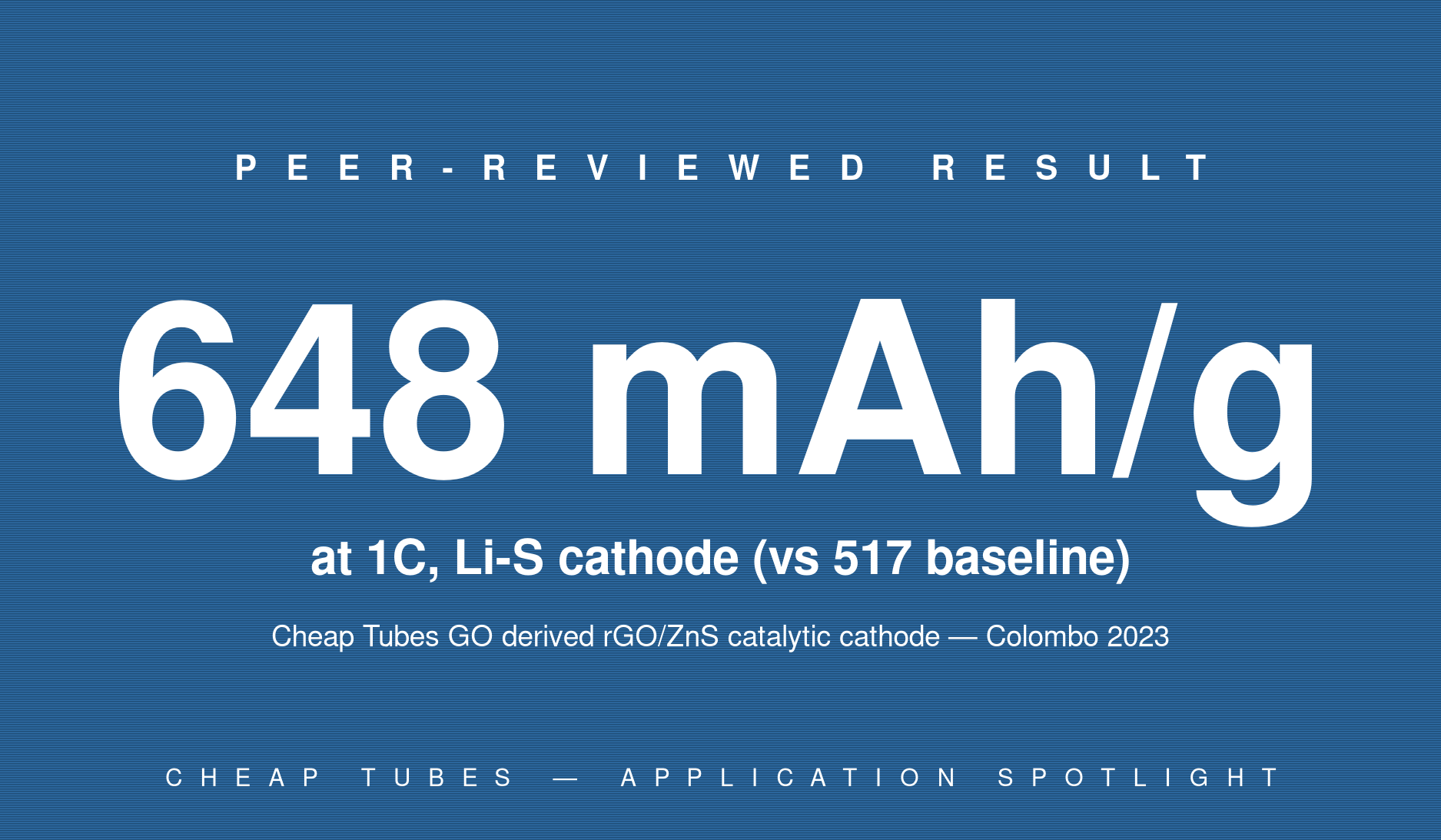
Lithium-sulfur (Li-S) batteries promise an energy-density jump over today's Li-ion: theoretical specific capacity of 1,675 mAh/g and theoretical energy density around 2,500 Wh/kg, plus low-cost, earth-abundant sulfur. The practical problem has always been the polysulfide shuttle: intermediate lithium polysulfides (Li₂Sx, 4 ≤ x ≤ 8) dissolve in the electrolyte, migrate to the anode, and parasitically consume capacity over cycling. Cathode host materials with high surface area, polysulfide-binding chemistry, and catalytic activity toward the Li-S redox reactions are the standard fix. A 2023 study from the Politecnico di Torino DISAT group, published in Nanomaterials, used Cheap Tubes graphene oxide as the precursor for a sulfur-and-nitrogen co-doped reduced graphene oxide embedded with zinc sulfide nanoparticles (SN-rGO/ZnS). The composite cathode raised high-rate (1C) specific capacity from 517 to 648 mAh/g (a 25% gain) and improved capacity retention at the 750th cycle from 32.5% to 48.2% — both attributable to the heteroatom doping and the polysulfide-binding ZnS catalyst.
The Research Question
Three engineering levers determine practical Li-S cell performance: (1) the cathode's ability to chemisorb dissolved polysulfides so they don't reach the anode, (2) the cathode's ability to catalyze the conversion between LiPS species (kinetically limiting the discharge curve), and (3) electrode conductivity high enough to sustain high-rate operation. Reduced graphene oxide delivers (3) and helps with (1) via surface defect sites, but lacks (2). Zinc sulfide is known to bind polysulfides covalently and catalyze the LiPS conversion reaction, but is a poor conductor on its own. The Torino group set out to ask whether a single microwave-assisted synthesis route could combine both functionalities — SN-doped rGO as the conductive scaffold + ZnS nanoparticles as the catalytic / polysulfide-binding site — using Cheap Tubes GO as the carbon precursor.
Materials and Methods
Graphene oxide — Cheap Tubes
From the paper's Section 2.1 (Materials and Reagents, verbatim): "The graphene oxide (GO) was purchased from Cheaptubes", and in 2.2.1 (Synthesis): "105 mg of GO (CheapTubes Inc., Cambridgeport, VT, USA) were added to 50 mL DI water and sonicated (Elmasonic P30H) for 30 min."
- Cheap Tubes GO: precursor for the rGO scaffold.
- Sulfur + nitrogen dopants: introduced via H₂N-C(=S)-NH₂ (thiourea) co-precursor.
- ZnS source: (CH₃COO)₂Zn·2H₂O (zinc acetate dihydrate) reacted with thiourea sulfur in situ.
- Synthesis: microwave reactor (Milestone FlexyWave) 200°C for 15 minutes at up to 900 W, max 15 bar — a solvent-free, energy-efficient route that scales straightforwardly compared with multi-step solvothermal protocols.
Cell architecture
- Cathode: SN-rGO/ZnS/S₈ composite loaded with sulfur via the standard melt-impregnation route; coated on aluminum current collector with Ketjenblack EC-300J carbon black and PVdF binder.
- Counter electrode: lithium metal.
- Electrolyte: standard ether-based LiTFSI / LiNO₃ system for Li-S electrochemistry.
- Characterization: XRD, XPS, FESEM, TGA for structural / compositional confirmation; cyclic voltammetry, galvanostatic cycling (0.5C, 1C), Tafel plot, EIS, Li₂S deposition test for electrochemical behavior.
Key Results
vs 517 baseline (+25%)
vs 32.5% baseline
at 0.5C
throughout 750 cycles
High-rate capacity gain
At 1C discharge rate — the rate at which a full discharge takes one hour, the operationally relevant cycle for fast-discharge applications — the SN-rGO/ZnS/S₈ cathode delivered 648 mAh/g vs 517 mAh/g for the undoped rGO baseline. A 25% improvement at the same loading and architecture is the kind of gain that distinguishes an academic curiosity from a candidate for further engineering work, because it's achieved at the high-rate regime where polysulfide-shuttle kinetics dominate.
Cycle life and capacity retention
At 0.5C, the doped composite cathode delivered 786 mAh/g at first cycle, with capacity retention climbing from the baseline 32.5% to 48.2% at the 750th cycle — corresponding to ~379 mAh/g at cycle 750 and a per-cycle decay rate of approximately 0.07%. Coulombic efficiency stayed near 99% across the full 750-cycle window, indicating that the shuttle losses are being suppressed rather than just delayed.
The mechanism — why doped rGO + ZnS works
The paper attributes the gains to two cooperating effects: (a) sulfur and nitrogen heteroatom doping on the rGO scaffold introduces polar surface sites that bind polysulfides chemically rather than relying on physical confinement alone; and (b) the ZnS nanoparticles serve as electro-catalytic sites for the Li-S redox conversion, lowering the kinetic barriers that limit high-rate discharge. The two effects together both reduce dissolution loss and accelerate the polysulfide conversion reaction inside the cathode.
Why Cheap Tubes GO Works as the Precursor
- Single-step microwave reduction — Cheap Tubes GO disperses cleanly in DI water at the working concentration (2 mg/mL in this study), enabling the solvent-free microwave route. Coarse, partially reduced, or aggregated GO would not produce the homogeneous slurry the synthesis requires.
- Surface oxygen functionality as nucleation sites — the ZnS nanoparticle formation in situ during microwave irradiation depends on uniform Zn²⁺ / sulfur precursor adsorption on the GO surface. High-oxygen-content GO (with ample epoxy and hydroxyl sites) anchors the inorganic precursors before reduction strips them.
- Defect-controlled doping — the S and N heteroatoms incorporate at edge and basal-plane defect sites created during reduction. Consistent GO starting material gives consistent dopant placement and ZnS distribution across batches.
Application Areas
- Lithium-sulfur cells — the primary application, with EV / aerospace / grid storage as downstream markets driven by the 2-3× theoretical energy density vs Li-ion.
- Other polysulfide / chalcogenide conversion cathodes — sodium-sulfur (Na-S), potassium-sulfur (K-S), and lithium-selenium (Li-Se) cells share the polysulfide-shuttle problem and benefit from the same SN-rGO + metal-sulfide cathode strategy.
- Catalysis — SN-doped rGO/ZnS composites are also studied as photocatalysts for hydrogen evolution and pollutant degradation, leveraging the same heteroatom-doped graphene + metal-sulfide architecture.
- Electrochemical sensors — the high surface area and defect density that helps Li-S also benefits electroanalytical sensing applications (heavy-metal detection, glucose, biomolecule electrochemistry).
Order the Cheap Tubes GO Used in This Study
The graphene oxide used by the Politecnico di Torino group is available directly from Cheap Tubes. Order the same specification: Single Layer Graphene Oxide. Single-layer GO and graphene oxide gel formats are also available in the Graphene Oxide product category. Research and production volumes; SDS, TDS, and Certificate of Analysis included; custom dispersions and reduced GO grades on request.
Graphene Oxide for Li-S Battery Cathodes and Energy Storage Research
Graphene oxide for Li-S, Na-S, K-S, and Li-Se battery cathode research, polysulfide-binding scaffolds, heteroatom-doped rGO precursor, conductive aerogels, and electrochemical electrode supports. Single-layer GO, GO powder, and rGO grades, with SDS, TDS, and CoA. Production-scale supply and custom dispersions on request.
Order Single Layer Graphene Oxide → Browse all GO gradesFrequently Asked Questions
What is the polysulfide shuttle problem in Li-S batteries?
During cycling, intermediate lithium polysulfide species (Li₂S₈, Li₂S₆, Li₂S₄) dissolve into the ether-based electrolyte and migrate from cathode to anode where they parasitically react with lithium metal. This shuttle effect causes capacity fade, low Coulombic efficiency, lithium-metal corrosion, and shortened cycle life. Cathode host materials that bind polysulfides chemically or catalyze their conversion to insoluble final products (Li₂S, Li₂S₂) are the primary engineering solution.
Why does sulfur and nitrogen co-doping improve rGO for Li-S?
S and N heteroatoms introduce polar surface sites on the otherwise non-polar rGO. These sites bind polysulfide species chemically (rather than relying on physical confinement in the carbon scaffold), substantially reducing polysulfide dissolution into the electrolyte. The combination of S and N is more effective than either alone because they create different binding-energy distributions across the cathode surface.
What does ZnS contribute that doped rGO doesn’t?
ZnS nanoparticles act as electro-catalytic sites for the Li-S redox conversion. The intermediate Li₂S₈ / Li₂S₆ / Li₂S₄ / Li₂S₂ / Li₂S conversion sequence has high kinetic barriers; ZnS lowers those barriers, particularly at high discharge rates (1C and above) where kinetics dominate the observed capacity. Together, doped rGO chemisorbs polysulfides AND ZnS converts them to insoluble final products before they dissolve away.
Why use microwave synthesis instead of conventional methods?
Microwave-assisted synthesis is solvent-free, energy-efficient, and produces uniform composite materials in minutes rather than the hours-to-days required by conventional solvothermal methods. The Politecnico group's 15-minute, 200°C, 900-watt protocol is straightforward to scale and minimizes the synthesis cost contribution to the final cathode price.
Where do I order graphene oxide for Li-S battery R&D?
Order the same specification used in this study: Single Layer Graphene Oxide from Cheap Tubes. Single-layer GO, reduced GO, and graphene oxide gel grades are also available. Contact us with your target cathode chemistry (S, Se, halide), loading range, dopant strategy, and electrolyte system for grade and dispersion-protocol recommendations.
Does this composite cathode strategy work for sodium-sulfur or potassium-sulfur cells too?
The polysulfide-shuttle problem is generic to alkali-metal / sulfur conversion chemistries. SN-doped rGO + metal-sulfide catalyst cathode architectures have been demonstrated in Na-S and K-S cell research with similar performance gains, though the optimal heteroatom and metal-sulfide pairings may differ.