
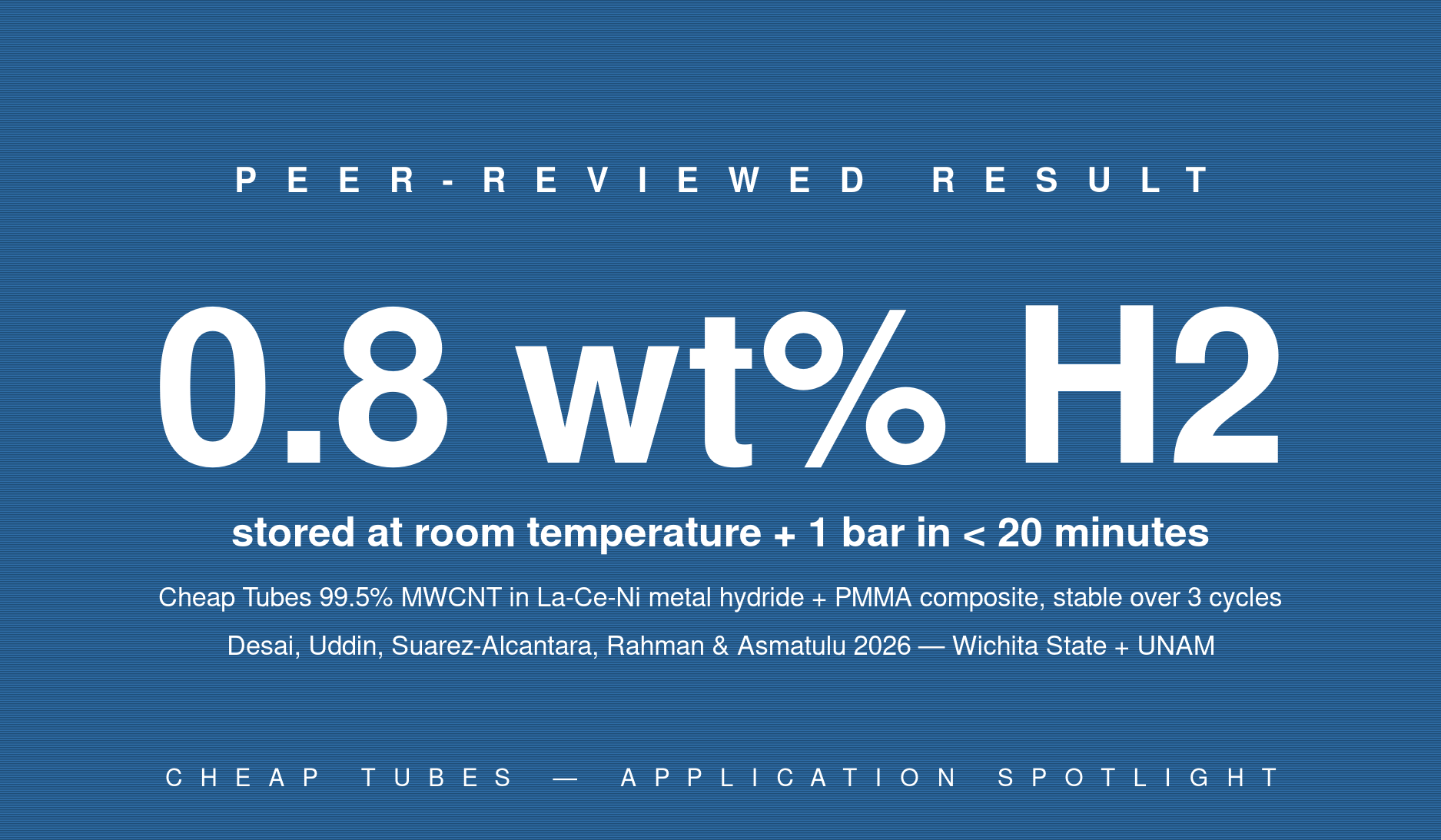
The hydrogen economy keeps hitting the same wall: storing hydrogen safely, densely, and reversibly under conditions a vehicle or stationary system can actually deliver. The textbook options all have problems. Compressed gas at 350-700 bar needs specialized tanks and energy-intensive compression. Liquid hydrogen needs cryogenic cooling to 20 K plus continuous boil-off management. Metal hydrides (LaNi5, MgH2, TiFe) store hydrogen at much lower pressures and densities high enough for mobility applications — but the storage kinetics are slow at room temperature, the materials oxidize in air, and capacity fades over hydrogenation cycles. A 2026 study from Wichita State University and the National Autonomous University of Mexico (UNAM), published in Materials for Renewable and Sustainable Energy, attacks all three of those problems with one composite architecture. La0.6Ce0.4Ni5 metal hydride is encapsulated in PMMA polymer to protect against oxidation; Cheap Tubes 99.5% purity MWCNTs (8-15 nm diameter, 10-50 μm length) are added to accelerate hydrogen transport into and out of the hydride. The result: 0.8 wt% H2 storage at room temperature and 1 bar ambient pressure, in under 20 minutes, with good stability over three cycles. Room-temperature ambient-pressure operation in under 20 minutes is the engineering breakthrough — the kind of condition a real vehicle or building actually has.
The Hydrogen Storage Problem
Hydrogen has the highest gravimetric energy density of any chemical fuel (142 MJ/kg, vs ~46 for gasoline). The catch is that under ambient conditions it's a low-density gas (89 g/m³), so volumetric energy density without compression or condensation is awful. Three practical storage routes have been developed for energy applications:
- High-pressure compressed gas (350-700 bar) — the current automotive standard. Type IV tanks are expensive, require multi-stage compression (energy-intensive), and present safety perception challenges.
- Cryogenic liquid hydrogen (20 K) — aerospace and bulk transport. Continuous boil-off makes stationary storage impractical.
- Solid-state metal hydrides + chemical hydrides — LaNi5, MgH2, TiFe, NaBH4. Store hydrogen as part of a metal lattice or chemical compound. Lower pressures, higher volumetric density. The challenges are slow uptake/release kinetics at room temperature, sensitivity to air and water (the metal surfaces passivate), and capacity decay over hydrogenation cycles.
Metal hydrides are the most promising route for distributed and stationary hydrogen storage if the kinetics and stability problems can be solved. The Desai paper attacks both simultaneously with a composite architecture that brings carbon nanotubes to the kinetics problem and polymer encapsulation to the stability problem.
The Composite Architecture — Three Layers of Engineering
The team built a three-component composite where each material solves a different problem:
- La0.6Ce0.4Ni5 metal hydride core — the actual hydrogen storage material. Substituting 40% of the lanthanum with cerium maintains the LaNi5 AB5 crystal structure while improving hydrogenation kinetics and lowering plateau pressure. 15 μm average particle size.
- PMMA or PVDF polymer encapsulation — protects the metal hydride from oxidation in air, water, and humidity. PMMA is permeable enough to hydrogen at room temperature to support fast uptake/release while blocking O2 and H2O. PVDF gives different gas-permeability and mechanical compliance for comparison.
- Cheap Tubes 99.5% MWCNTs + graphene — the kinetics accelerator. MWCNTs at 8-15 nm OD provide high surface area + high-aspect-ratio thermal-management paths that handle the exothermic hydrogenation heat release. They also crack the H2 molecule at sidewall defect sites and shuttle atomic hydrogen to the metal hydride surface (the rate-limiting step in conventional metal hydride kinetics).
Materials and Methods
Cheap Tubes MWCNTs — cited in the materials section
From the paper's materials section (verbatim): “MWCNTs (99.5 wt% purity) were purchased from Cheaptubes.com, with dimensions of 8-15 nm in diameter and 10-50 μm in length. The MWCNTs were synthesized via catalytic chemical vapor deposition (CCVD) and purified…”
Product clarification: the 99.5% purity grade cited in the paper corresponds to the Cheap Tubes Graphitized MWCNT 8-15 nm product line, not the standard MWCNT 8-15 nm SKU. The graphitization post-treatment at high temperature removes residual catalyst metals and improves crystalline quality, which is what produces the 99.5% purity spec and the H2-dissociation catalytic behavior the team relied on. For researchers reproducing this work, the matching product is the Graphitized Multi Walled Carbon Nanotubes category, not the standard MWCNT category.
99.5% purity is the high-purity research grade. For hydrogen storage applications, catalyst-residue metals matter — Ni or Fe residues left over from CCVD synthesis would compete with the LaNi5-based hydride for hydrogen binding sites and would alter the measured storage capacity. The high-purity grade ensures the measured kinetics reflect the engineered metal hydride performance, not residual-metal artifacts. The 8-15 nm OD + 10-50 μm length spec gives the right surface-area-to-mass ratio for both H2 dissociation and thermal-management heat transport.
Composite fabrication
- La0.6Ce0.4Ni5 synthesis: partial substitution of La with Ce in LaNi5 precursor; ball-milled to ~15 μm particle size.
- Polymer dissolution: PMMA or PVDF dissolved in dimethylformamide (DMF) solvent.
- Mixing: metal hydride + carbon (graphene + Cheap Tubes MWCNTs) + polymer / DMF solution combined; speed-homogenized at 1,500 rpm for 4 hours.
- Pellet formation: heat-cast in oven at 150 °C for 24 hours.
- Composition variations: the ratio of La0.6Ce0.4Ni5 to polymer and carbon was varied to find the optimal kinetics + capacity + stability combination.
Characterization battery
- Differential scanning calorimetry (DSC) — thermal stability of the polymer-metal-carbon composite.
- X-ray diffraction (XRD) — structural phase composition of the La0.6Ce0.4Ni5 + composite.
- FTIR + XPS — surface functional groups, oxidation state, polymer-metal bonding.
- Sieverts-type apparatus + temperature-programmed desorption (TPD) — hydrogen storage capacity, kinetics, and cyclic stability over 3 hydrogenation-dehydrogenation cycles.
Key Results
< 20 minutes uptake
cryo-temp benchmark
hydrogenation / dehydrogenation
in optimized composite
The room-temperature breakthrough
The 0.8 wt% H2 uptake at room temperature and 1 bar pressure in under 20 minutes is the headline number that matters. Most metal hydrides need 5-10 bar hydrogenation pressure (requiring compression) or cryogenic temperatures (requiring refrigeration) to achieve practical storage capacity. The Desai composite delivers practical storage capacity at the conditions that actually exist in real vehicles, real buildings, and real stationary applications.
Why the MWCNT matters — kinetics and thermal management
Hydrogen uptake in a metal hydride is a multi-step process: H2 dissociation at the surface, atomic H diffusion into the metal lattice, hydride phase formation. The rate-limiting step at room temperature is usually H2 dissociation — the energy barrier to cracking the H-H bond is too high for fast kinetics at 25 °C. MWCNT sidewall defects are known to dissociate H2 catalytically. Adding 8% MWCNT to the composite gives the metal hydride a continuous source of atomic H rather than molecular H2, bypassing the dissociation step and accelerating uptake. The MWCNT also acts as a thermal-management backbone, conducting heat out of the composite during the exothermic hydrogenation (and into it during the endothermic dehydrogenation) so the local temperature doesn't swing in ways that would block continued uptake.
The polymer encapsulation solves the oxidation problem
Bare LaNi5 and similar AB5 metal hydrides passivate rapidly in air — surface oxide layers form within minutes of exposure and block hydrogen ingress. The PMMA polymer encapsulation is selectively permeable: H2 passes through readily at room temperature, but O2 and H2O are blocked. This decouples the metal hydride's storage performance from its environmental sensitivity — cells can be assembled, handled, and operated in ordinary air conditions without specialized inert-atmosphere infrastructure.
Why Cheap Tubes Graphitized MWCNT 8-15 nm at 99.5% Purity Works for This Composite
- 99.5% purity is essential — residual catalyst metals (Fe, Co, Ni) from CCVD synthesis would compete with the engineered LaNi5-based hydride for H2 binding sites, distorting the measured storage capacity. High-purity grade ensures clean attribution of storage performance to the engineered hydride composition.
- 8-15 nm outer diameter — high surface-area-to-mass ratio for efficient H2 dissociation; small enough to integrate into the LaCeNi particle-size architecture (15 μm hydride particles) without phase separation in the polymer matrix.
- 10-50 μm length aspect ratio — long enough for thermal-percolation pathways through the composite that conduct hydrogenation reaction heat away from local hot spots. Short, fragmented CNTs would not establish the heat-transport network.
- Solvent-compatible dispersion in DMF — the composite preparation uses dimethylformamide as the polymer solvent. Cheap Tubes MWCNTs disperse in DMF cleanly at the high-speed homogenization conditions (1,500 rpm, 4 hours) without surfactant overload that would interfere with H2 diffusion.
Application Areas
- Hydrogen fuel cell vehicle storage — the direct industrial target. Solid-state metal hydride storage at room temperature reduces tank pressure, eliminates compression energy, and lowers thermal-management complexity vs 700 bar compressed gas.
- Stationary hydrogen energy storage — grid-scale buffering of renewable hydrogen (electrolysis from solar / wind), distributed industrial hydrogen storage, and back-up power systems.
- Portable fuel cell power — soldier-portable, drone, and remote-sensor power that needs higher energy density than batteries can deliver but can't carry high-pressure tanks.
- Hydrogen pipeline storage buffers — the polymer-encapsulated composite tolerates ambient air during installation and maintenance, removing inert-atmosphere infrastructure requirements.
- Adjacent metal-hydride R&D — MgH2, TiFe, and Mg-Ni intermetallic systems all face the same H2 dissociation kinetics + air-sensitivity problems and can adopt the same MWCNT + polymer encapsulation architecture.
- Hydrogen sensor + safety monitoring — reversible hydride uptake with fast room-temperature kinetics is the basis for solid-state H2 leak sensors with no compressed-gas reference.
Order the Cheap Tubes MWCNTs Used in This Study
The multi-walled carbon nanotubes used by the Wichita State and UNAM team are available directly from Cheap Tubes. Order the matching SKU: Graphitized Multi Walled Carbon Nanotubes 8-15 nm — 99.5% purity grade, 10-50 μm length, CCVD-synthesized and purified to research-grade spec. Other MWCNT diameter grades (8 nm, 10-20 nm, 20-30 nm, 30-50 nm, 50 nm) are available in the Multi Walled Carbon Nanotubes product category. Research and production volumes, SDS / TDS / CoA included, custom dispersions on request.
Graphitized MWCNT 8-15 nm (99.5% Purity) for Hydrogen Storage, Catalysis, and Thermal-Management R&D
High-purity multi-walled carbon nanotubes for hydrogen storage composites, metal hydride encapsulation, catalysis (H2 dissociation, electrocatalysis, hydrogen evolution), thermal-management composites, polymer-metal hybrid materials, and fuel-cell electrode R&D. 8-15 nm outer diameter, 10-50 μm length, 99.5 wt% purity from CCVD synthesis; consistent surface chemistry for reproducible catalytic and kinetic measurements.
Order Graphitized MWCNT 8-15 nm → Browse all MWCNT gradesFrequently Asked Questions
Why is room-temperature ambient-pressure hydrogen storage important?
Most metal hydride hydrogen storage systems require either elevated pressures (5-50 bar) or low temperatures (77 K cryogenic) to achieve meaningful storage capacity in practical time. Real-world applications (vehicles, buildings, distributed power) operate at ambient temperature and modest pressures. A storage material that works at room temperature and 1 bar in under 20 minutes eliminates the need for compression equipment, cryogenic refrigeration, and the energy overhead those add to the hydrogen value chain.
What does MWCNT do for hydrogen storage that the metal hydride alone cannot?
Two things. First, MWCNT sidewall defects catalyze the dissociation of molecular H2 into atomic H, bypassing the rate-limiting energy barrier in pure metal hydride uptake at room temperature. Second, the high thermal conductivity of MWCNT networks distributes the exothermic hydrogenation heat (and provides heat for endothermic dehydrogenation) so local temperature swings don’t block continued storage. The result is faster kinetics with stable performance across cycles.
Why use 99.5% purity MWCNT specifically?
Lower-purity MWCNT contains residual CCVD catalyst metals (Fe, Co, Ni). Those residues would themselves bind hydrogen and compete with the engineered LaNi5-based metal hydride for H2 storage sites, distorting the measured capacity attribution. High-purity grade ensures the measured kinetics and storage capacity reflect the engineered composite performance, not residual catalyst artifacts. Reproducibility across labs depends on starting from clean, purity-specified material.
How does the polymer encapsulation protect the hydride?
Bare LaNi5 and related AB5 metal hydrides oxidize rapidly in air, forming surface oxide layers that block H2 ingress within minutes. PMMA polymer encapsulation is selectively gas-permeable: H2 diffuses through readily at room temperature, but O2 and H2O are blocked at room conditions. This decouples storage performance from environmental sensitivity, enabling fabrication, handling, and operation in ordinary atmospheric conditions without specialized inert-atmosphere infrastructure.
How does the 0.8 wt% storage capacity compare to other hydrogen storage technologies?
0.8 wt% at room temperature and 1 bar is competitive for solid-state ambient-condition storage. By comparison: 700 bar compressed gas in Type IV tanks stores about 5-6 wt% but requires energy-intensive compression; liquid hydrogen stores about 13 wt% but needs 20 K cryogenic conditions; MgH2 has a theoretical capacity of 7.6 wt% but requires 300-400 degree C operation. The 5.4 wt% capacity at 77 K shown by this same composite system demonstrates the theoretical headroom; the engineering goal is bringing more of that capacity to ambient operation.
Where do I order high-purity MWCNT for hydrogen storage or catalysis R&D?
Order the matching SKU used in this study: Graphitized Multi Walled Carbon Nanotubes 8-15 nm at 99.5% purity from Cheap Tubes. The paper materials section cites this product directly. Other MWCNT diameters and functionalization grades are available for adjacent hydrogen-storage, catalysis, and thermal-management applications.