
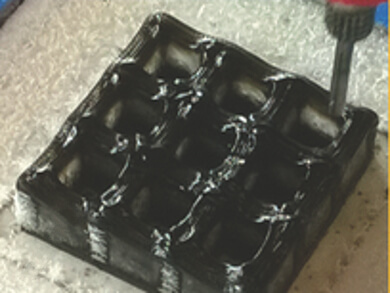
We love what we do. Especially when reviewing cutting edge research and find that the Scientists Create World’s Lightest 3D Printed Materials – Graphene Aerogel are our long time customers!
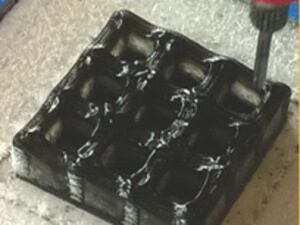
‘We developed a novel 3D printing technique, as illustrated in Figure 1 , by integrating 3D printing ice and freeze casting to print GA. Different from other 3D printing processes where the materials are heated up or extruded out at room temperature, our 3D printing technique, illustrated in Figure 1 a, rapidly freezes the water based GO suspension and selectively solidifi es the aqueous droplets into ice crystal on a cold sink (−25 °C), well below water’s freezing point. Therefore, the water, shown in Figure 1 b, and low viscous Newtonian GO suspension, shown in Figure 1 c, can be printed by drop-on-demand mode, where the material is ejected drop by drop only if needed. The dilute pure aqueous GO suspension, with low GO density (1 mg mL −1 ), offers lower density and larger surface area for printed GA when compared with the-state-of-the-art printing technique for GA. In traditional continuous deposition based 3D printing, physical properties of printed parts are negatively influenced by insufficient bonding at the interface driven by intermolecular diffusion and the undesirable voids between the adjacent filaments.
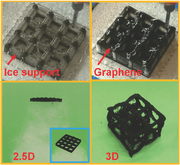
In our printing process, when liquid solution is deposited on top of previously frozen material, the not-yet-frozen material melts the already frozen surface. These two materials are mixed and refrozen together under low temperature (−25 °C). Because the remelted aqueous material possesses low viscosity, the voids between layers are instantly filled by the liquid material under surface tension and gravity. Since the deposited materials freeze and firmly bond together with the previous layer via hydrogen bond, high structural integrity of the final assembled GA can be achieved, as further confirmed in the mechanical test section. The pure water serves as a supporting structure to build complex architecture with overhang features. As shown in Figure 1 d–f, the post processing includes immersion of 3D printed architectures in liquid nitrogen, freeze drying to remove the water, and thermal annealing to achieve a 3D printed ultralight GA truss. As shown in Figure 1 g, 2.5 D (left) and truly 3D truss (right), GO aerogel structure can be printed. We also printed grid GO aerogel structures with various wall thicknesses, decreasing from left to right in Figure 1 h, in order to demonstrate the printing ability. Figure S1a–c (Supporting Information) illustrates more 3D printed GO aerogels on catkin and Figure S1d–f (Supporting Information) shows various design and structures with different wall thicknesses. Compared to the continuous printing mode, the drop-on-demand technique achieves higher precision and is easier to extend for printing multiple materials with multinozzles, paving the way for fabrication of multifunctional aerogel materials in myriad applications.”
The full journal article can be purchased at the link http://onlinelibrary.wiley.com/doi/10.1002/smll.201503524/abstract
Why Graphene Aerogel Holds the Density Record
Graphene aerogel consistently claims the title of world’s lightest solid material, with reported densities as low as 0.16 mg/cm³ — roughly five times lighter than air and hundreds of times lighter than aluminium. This extraordinary figure is possible because graphene aerogels are more than 99% empty space. The solid phase is a continuous three-dimensional network of graphene sheets just one to a few atoms thick, held together by van der Waals forces and, in reduced graphene oxide aerogels, by covalent carbon–carbon bonds formed during thermal annealing.
What sets graphene aerogels apart from silica aerogels — the previous record-holders — is that the graphene network is both electrically conductive and mechanically resilient. Silica aerogels are brittle and insulating. Graphene aerogels can be compressed to a fraction of their original volume and spring back completely, while simultaneously conducting electricity and heat throughout the structure.
The Freeze-Casting 3D Printing Method Explained
The technique described in this research combines two well-established processes — inkjet printing and freeze casting — to achieve architectural control over the aerogel structure that neither method achieves alone.
In conventional freeze casting, a GO suspension is poured into a mould and directionally frozen. Ice crystals nucleate and grow, expelling the GO flakes into the spaces between crystals. When freeze-dried, the ice sublimes and leaves behind a porous GO scaffold whose pore structure mirrors the ice crystal geometry. This gives excellent alignment in one direction but limited three-dimensional control.
The innovation in this work is depositing GO droplets layer by layer on a cold substrate (−25°C), where each droplet freezes almost instantly on contact. Because the substrate is below the freezing point, previously frozen layers partially melt at the surface when new droplets land, allowing the materials to mix and refreeze with strong interlayer bonding via hydrogen bonds. The pure water droplets serve as a sacrificial support structure — they freeze in place, support overhanging features during printing, then sublime during freeze drying. This allows fully three-dimensional truss architectures that are impossible with bulk freeze casting.
From Graphene Oxide to Graphene Aerogel: The Reduction Step
The printed scaffold after freeze drying is still graphene oxide — electrically insulating due to the oxygen functional groups disrupting the sp² carbon lattice. Thermal annealing at temperatures between 200°C and 1000°C progressively removes these groups, converting GO to reduced graphene oxide (rGO) and restoring electrical conductivity.
At 200–400°C, most carboxyl and epoxide groups are removed and conductivity increases by several orders of magnitude. Above 800°C in an inert atmosphere, the rGO approaches the conductivity of pristine graphene. The degree of reduction is tunable, allowing researchers to balance conductivity against the structural integrity of the aerogel — higher temperatures give better conductivity but also cause some shrinkage as the scaffolding densifies.
The dilute GO concentration used in this technique (1 mg/mL) produces aerogels with exceptionally low densities precisely because there is so little solid material relative to volume. More concentrated suspensions produce denser, stiffer aerogels — useful for load-bearing applications but heavier. This concentration dial gives researchers control over the density-stiffness trade-off depending on the intended application.
Mechanical Properties: Strong Despite Being Mostly Air
One of the counterintuitive properties of graphene aerogels is their mechanical resilience relative to their density. The 3D-printed truss architectures described in this research showed compressive strength values comparable to or better than bulk graphene aerogels made by conventional methods, despite being produced from a far more dilute ink.
This strength comes from the periodic truss geometry, which distributes mechanical loads through triangulated strut networks rather than through the random pore walls of a bulk aerogel. The same architectural principle that makes steel space frames stronger than solid slabs applies at the microscale. The interlayer hydrogen bonding formed during the freeze-printing process also contributes — interfaces between printed layers are not weak planes but continuous frozen junctions.
Compressive stiffness of graphene aerogels scales with density roughly as ρ², consistent with open-cell foam mechanics. This means that small increases in GO concentration during printing produce disproportionately stiffer aerogels, giving researchers fine control over the mechanical response.
Applications Enabled by Ultralight Graphene Aerogel
The unique combination of ultralow density, high surface area, electrical conductivity, and mechanical resilience opens applications across several industries:
- Energy storage electrodes — the high surface area and conductivity make graphene aerogels exceptional supercapacitor electrodes, as demonstrated in the companion research discussed on this site
- Thermal insulation — the aerogel’s mostly-air structure gives thermal conductivity values below 0.015 W/m·K, outperforming silica aerogels while being far more mechanically robust
- EMI shielding — the continuous conductive graphene network reflects and absorbs electromagnetic radiation efficiently at thicknesses below 1 mm, enabling ultrathin shielding for aerospace and consumer electronics
- Oil spill remediation — the hydrophobic graphene surface absorbs oils and organic solvents selectively from water at capacities exceeding 100–200× the aerogel’s own weight, and the absorbed material can be recovered by squeezing and the aerogel reused
- Pressure and strain sensing — the predictable resistance change under compression enables sensitive piezoresistive sensors for wearable health monitoring and structural health sensing
- Catalyst support — the high surface area and chemical inertness of the graphene network provides an ideal scaffold for nanoparticle catalysts in fuel cells and chemical reactors
Graphene Oxide for Aerogel Fabrication
The quality of the starting graphene oxide is the single most important variable in aerogel fabrication. Flake size distribution determines the gel strength and printability of the ink. Oxidation level controls the aqueous dispersibility and the reduction behaviour during annealing. Defect density in the original graphite feedstock sets a ceiling on the conductivity achievable after full reduction.
Cheap Tubes supplies graphene oxide in powder and aqueous dispersion form, with multiple grades spanning oxidation levels from mild to highly oxidised. Our material is characterised by XPS, Raman spectroscopy, and AFM for each production lot, and a full certificate of analysis is provided with every order. We have supplied graphene oxide to aerogel research groups at universities and national laboratories across North America, Europe, and Asia since 2005.
For groups developing aerogel inks for freeze-printing or other additive manufacturing approaches, we can provide technical guidance on selecting the appropriate GO grade for your ink concentration and nozzle geometry. Contact our technical team to discuss your specific requirements.
Graphene Nanoplatelets for Advanced Composites & Aerogels
Our GNP grades (H-series and M-series) are used in aerogel synthesis, composite reinforcement, and thermal management R&D. Spec sheets, bulk pricing, and technical support available from a team that has shipped graphene since 2005.