
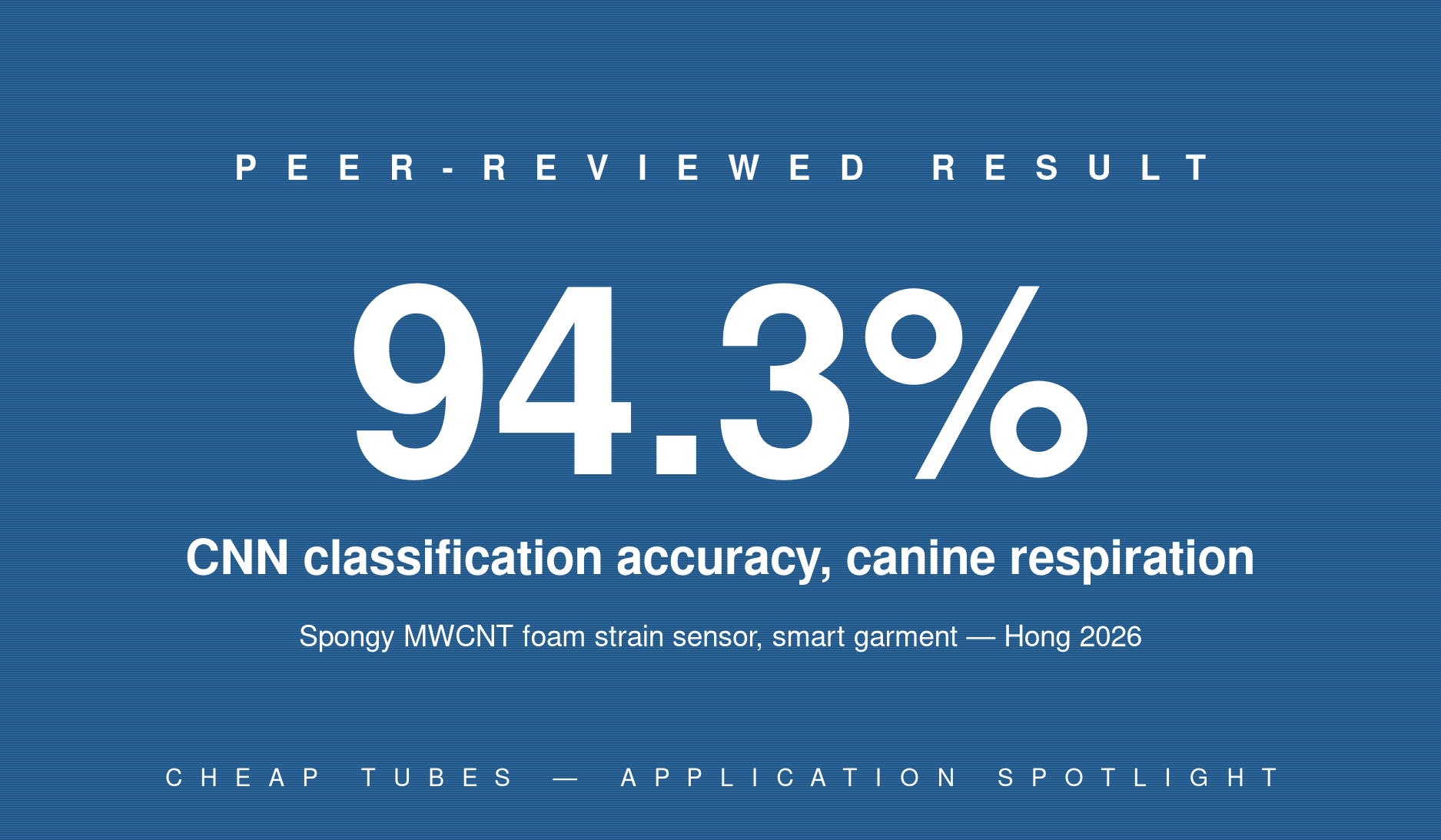
Continuous, at-home monitoring of a dog's breathing is a growing veterinary need. Dogs face elevated respiratory risk from breed-specific anatomy (especially brachycephalic breeds like pugs, bulldogs, and boxers), high activity exposure, and the simple fact that dogs cannot describe discomfort — clinical signs often appear only after substantial decline. Current options are imperfect: capnography during anesthesia and arterial blood-gas analysis are accurate but invasive and clinic-bound; harnesses and chest straps are non-invasive but uncomfortable and frequently mis-fitted (one survey reported 82% of 1,567 dog owners did not adjust the harness). A 2026 study from the Chi Hwan Lee group at Purdue University, published in ACS Sensors, introduces a smart garment that integrates a spongy multi-walled carbon nanotube (MWCNT) foam strain sensor — built with Cheap Tubes MWCNT — into commercially available canine apparel, enabling continuous, non-invasive monitoring of respiration, body temperature, and physical activity. The CNN-assisted machine-learning pipeline classified respiratory patterns across two breeds (Labrador and Boxer) and multiple activity levels with 94.3% accuracy.
The Research Question
The clinical reality: respiration is a powerful early biomarker in dogs — respiratory rate, depth, and panting behavior correlate with stress, cardiac function, and systemic illness — but existing measurement tools force a hard trade-off. Anesthesia-room capnography is accurate but episodic. Manual auscultation depends on practitioner experience. Wearable harnesses and collars are non-invasive but often poorly tolerated and prone to mis-fit. The Purdue team set out to design a garment-integrated sensor that would be: (1) continuous, (2) non-invasive, (3) tolerant of natural dog behavior (eating, grooming, running, sleeping), and (4) capable of distinguishing breed- and activity-specific breathing signatures rather than just counting breaths.
Materials and Methods
Strain sensor — spongy MWCNT foam (Cheap Tubes MWCNT)
From the paper's Experimental Section, Materials subsection (verbatim): "The average diameter and length of the MWCNTs (Cheap Tubes, Inc.; purity >95 wt %) were measured as 10-20 nm and 10-30 μm."
- MWCNT specs: 10-20 nm outer diameter, 10-30 μm length, >95 wt% purity.
- Sensor architecture: a highly perforated, micropore-dominated "spongy" MWCNT/polymer foam — the high internal porosity enables large reversible strain and stable percolation under cyclic deformation.
- Format: 2 cm by 7.5 cm sensor element, integrated into a textile neckband stitched into commercially available canine apparel.
- Electrical readout: resistance change versus strain measured with a Keithley 2400 source meter; gauge factor (GF) and hysteresis characterized over 2,000 cycles.
- Imaging / verification: spongy foam morphology and percolation network confirmed by high-resolution SEM (Hitachi S-4800).
Data acquisition and signal pipeline
- Compact DAQ module: integrated into the garment near the sensor, sampling resistance change and on-board accelerometer / temperature.
- Signal processing: custom amplification + filtering, designed to preserve breathing-frequency content while rejecting locomotion artifacts.
- Machine-learning classifier: a convolutional neural network (CNN) trained on labeled time-series snippets of resistance change versus time, classifying breathing patterns across breeds and activity levels.
- Validation set: two breeds (Labrador and Boxer) instrumented across at-rest, walking, and running activity levels.
Key Results
across breed and activity
retained >90% performance
Labrador and Boxer
respiration, temp, activity
Classification accuracy
The headline result is the 94.3% classification accuracy of the CNN-assisted ML pipeline across both breeds and multiple activity levels (at-rest, walking, running). This is the metric that distinguishes a useful clinical tool from a simple breath counter: it tells you the system is identifying the character of the breathing pattern, not just the rate.
Breed- and activity-specific patterns
The Labrador and Boxer breeds were chosen as a deliberate contrast: Labradors are mesocephalic with longer muzzles and deeper, slower at-rest breathing; Boxers are brachycephalic with shorter muzzles and characteristically more rapid, shallower at-rest breathing. The smart garment captured these breed-specific differences in breathing rate, amplitude, and panting behavior, validating that the spongy MWCNT strain sensor and the CNN classifier together recover signatures that depend on breed anatomy, not just average rate.
Cyclic stability
The spongy MWCNT foam strain sensor maintained over 90% performance through 2,000 stretch-and-release cycles — the durability threshold that separates a research demo from a wearable product. The micropore-dominated foam architecture allows large reversible strain without permanent damage to the MWCNT percolation network, and the highly perforated structure both lowers the modulus (more comfortable for the dog) and enlarges the dynamic range of the resistance signal.
Why MWCNT (and Why "Spongy")
Two material properties of the Cheap Tubes MWCNT used in this study align directly with what a wearable strain sensor needs:
- High aspect ratio (10-30 μm length, 10-20 nm diameter) — long, thin tubes form stable percolation networks at low loading. The conductive path survives the mechanical strain cycles that destroy networks built with shorter, lower-aspect-ratio carbon additives.
- >95% purity — amorphous carbon and metal-catalyst residue degrade resistance stability and increase noise. High-purity MWCNT delivers cleaner baseline resistance and lower drift over thousands of cycles, which is what a CNN classifier needs to maintain accuracy in deployment.
The "spongy" architecture is the second design choice. By dispersing the MWCNT in a highly perforated polymer foam, the sensor gains compliance (it stretches and recovers with the dog's chest wall rather than fighting it), preserves the percolation network through deformation, and produces a strain-to-resistance response large enough to read with a simple compact circuit. The result is a sensor that's comfortable enough for a dog to wear continuously and electrically clean enough to feed reliable signals to a CNN.
Application Areas
- Veterinary telehealth and home monitoring — continuous out-of-clinic tracking for animals with chronic respiratory disease, brachycephalic obstructive airway syndrome (BOAS), or post-operative recovery.
- Working and service dog health — military, police, search-and-rescue, and assistance dogs operating in stressful environments where early respiratory distress is operationally critical.
- Companion-animal wearables beyond canines — the paper authors note the platform may adapt to cats and other companion animals, expanding the addressable market for veterinary-grade wearable sensors.
- Human wearable strain sensors and electronic textiles — the same spongy MWCNT/polymer architecture transfers directly to human respiration belts, smart garments for sleep apnea screening, and large-strain wearable motion sensors.
- Soft robotics and prosthetics feedback — high-cycle, compliant strain sensors are core to next-generation soft actuators and prosthetic limb control.
Order the Cheap Tubes MWCNT Used in This Study
The MWCNT material used by the Purdue team is available from Cheap Tubes at research and production volumes. Spec card: 10-20 nm outer diameter, 10-30 μm length, >95% purity, low ash content, supplied with Technical Data Sheet, Safety Data Sheet, and Certificate of Analysis on request. Production-scale supply, custom dispersions, and functionalized variants (COOH, NH₂, OH) available on request.
Multi-Walled Carbon Nanotubes for Strain Sensors and Wearable Electronics
High-aspect-ratio MWCNT for wearable strain sensors, spongy foam architectures, conductive textiles, electronic skin, and soft-robotics feedback. Pristine and functionalized grades, with SDS, TDS, and CoA included. Production-scale supply and custom dispersions on request.
Order MWCNT 10-20 nm → MWCNT Buying GuideFrequently Asked Questions
What is a smart garment for canine respiration monitoring?
A smart garment is wearable apparel with an integrated sensor and electronics that monitor physiological signals continuously. In the Purdue study, the team integrated a spongy MWCNT foam strain sensor into a textile neckband stitched into commercial canine apparel, so the dog wears it like a normal vest or harness while the sensor tracks chest-wall motion (respiration) and accelerometer / temperature data.
How does a spongy MWCNT foam strain sensor work?
Multi-walled carbon nanotubes are dispersed in a highly perforated polymer foam. The MWCNTs form a conductive percolation network through the foam. When the foam is stretched (by chest expansion during inhalation), the network deforms and electrical resistance changes measurably. The output is a continuous resistance-vs-time signal that mirrors the breathing waveform.
Why use MWCNT instead of conductive metal traces?
Metal traces fatigue and crack under repeated large strain — the kind of strain a dog's chest wall imposes on a wearable. MWCNT percolation networks are mechanically compliant and recover their conductivity after stretching, so they sustain thousands of cycles without permanent damage. High aspect ratio MWCNT (long, thin tubes) extends this further by maintaining percolation at lower volume fraction.
What MWCNT specifications did the paper report?
The authors used Cheap Tubes MWCNT with measured outer diameter 10-20 nm, length 10-30 μm, and purity greater than 95 wt%. High purity matters because amorphous carbon and metal-catalyst residue increase baseline noise and drift, which would degrade CNN classifier accuracy in deployment.
Why is the 94.3% classification accuracy significant?
A simple breath counter only needs to detect rate. The 94.3% number is for full classification of breathing patterns across two breeds and multiple activity levels — identifying the character of the breathing signal (rate, amplitude, panting behavior) and attributing it to breed anatomy and activity context. That level of classification is what enables clinical decisions, not just bookkeeping.
Where do I order MWCNT for strain-sensor R&D?
Order the matching SKU directly: MWCNT 10-20 nm — or browse all grades., available in pristine and functionalized grades at research and production volumes. Contact us with target loading, polymer matrix, and the strain / cycle requirements of your application for grade and dispersion-protocol recommendations.