
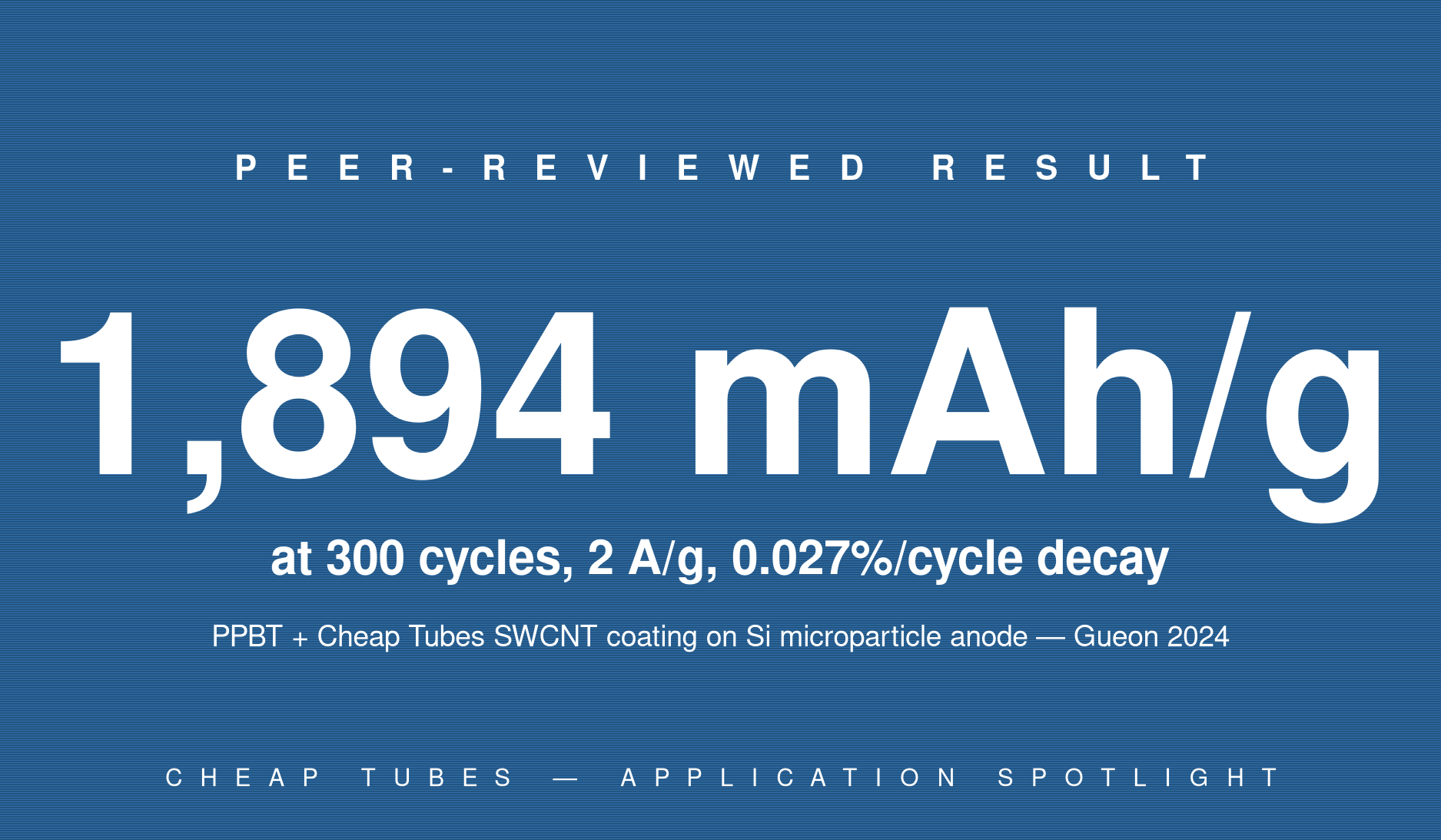
Silicon microparticle (Si MP) anodes promise a step change in lithium-ion battery energy density — theoretical capacity ~4,200 mAh/g, roughly an order of magnitude above graphite — but the practical problem has been the same for fifteen years: silicon swells ~300% during lithiation, the active particles fracture, the solid-electrolyte interphase keeps re-forming on the fresh surfaces, and capacity decays within tens of cycles. Strategies that protect the particles tend to add manufacturing complexity (yolk-shell architectures, ALD coatings, nano-engineered morphologies). A 2024 study from the Reichmanis group at Lehigh University — with collaborators at Brookhaven National Laboratory and Stony Brook University, funded by the U.S. Department of Energy — published in ACS Applied Energy Materials, takes a different route: a thin, water-processable composite coating of carboxylated polythiophene (PPBT) and Cheap Tubes single-walled carbon nanotubes (SWCNT) applied to commercial Si microparticles. The coated Si MP anodes delivered a reversible capacity of 1,894 mAh/g after 300 cycles at 2 A/g, a 0.027% per-cycle decay rate, an 85% initial Coulombic efficiency, and 3.3× higher capacity than pristine Si MP anodes. In situ Raman quantification showed the PPBT/SWCNT layer reduced tensile-stress variation by 45% compared with SWCNT-only coatings.
The Research Question
Silicon's 300%-volume-change problem is well-understood. The harder question the Reichmanis group set out to answer: can a single thin coating simultaneously deliver four jobs that Si anode developers usually have to split across multiple layers? Specifically — (1) provide an elastic stress-relieving cap that lets the Si particle expand and contract without pulverizing, (2) maintain electrical conductivity through the cycling-induced volume change, (3) limit the continuous SEI regrowth that bleeds capacity, and (4) be water-processable for industrial-scale slurry processing. A carboxylated polythiophene (PPBT) had been shown previously to do (3) and (4) in the same group's earlier work on SWCNT/PPBT networks. The new question was whether adding a high-aspect-ratio SWCNT conductive backbone to the PPBT layer would also solve (1) and (2) — without the engineering overhead of a yolk-shell architecture or vacuum-deposited coating.
Materials and Methods
SWCNT — Cheap Tubes Inc.
From the paper's Experimental Section (verbatim): "SWNTs (15 mg; Cheap Tubes Inc.) were added to 10 mL of DI water and sonicated in a water bath for 1 h. PPBT/SWNT dispersions were then added dropwise to the PDDA@Si MP aqueous dispersion and sonicated in a water bath for 1 h."
Coating chemistry — PPBT + SWCNT in water
- Polymer: poly[3-(potassium-4-butanoate)thiophene] (PPBT) — a water-soluble carboxylated polythiophene with 89% regioregularity (Rieke Metals, Inc.). The carboxylate side chains anchor to the Si particle surface and bridge to the SWCNT network.
- Si microparticles: commercial silicon microparticles, pre-functionalized with PDDA (poly(diallyldimethylammonium chloride)) to create a positively charged surface for electrostatic assembly.
- Dispersion route: sonicated SWCNT in DI water, then PPBT/SWNT dispersion added dropwise to the PDDA@Si MP suspension, sonicated 1 h. Washed and isolated.
- Coating thickness: a thin conformal capping layer on the Si MP surface — SEM and TEM verified by the authors.
- Why water-processable matters: the entire coating step uses DI water with no organic solvents — compatible with existing aqueous slurry processing lines used in commercial Li-ion battery manufacturing.
Cell architecture and testing
- Anode: PPBT/SWNT-coated Si MPs in a standard slurry with carbon black + binder, cast on copper current collector.
- Testing: half-cell vs Li metal counter electrode, standard carbonate electrolyte with FEC additive, 0.01-1.5 V cycling window.
- Cycling protocol: formation at low current density, then 300 cycles at 2 A/g (a fast-charge-relevant rate, ~1C for the silicon).
- Characterization: in situ Raman spectroscopy during cycling to quantify SWCNT tensile-stress evolution; SEM and XPS to assess SEI morphology and chemistry.
Key Results
at 300 cycles, 2 A/g
capacity at cycle 300
over 300 cycles
formation cycle
Capacity and cycle life
1,894 mAh/g at cycle 300 with 0.027%/cycle decay is the kind of number Si-anode developers track because it puts the material in the range that justifies the silicon premium in cell design. For comparison, the pristine Si MP control in the same study faded to roughly one-third of that capacity in 300 cycles. The 3.3× improvement isn't a marginal stability gain — it's the difference between a Si anode that's a research curiosity and one that survives the cycle counts a battery integrator needs to consider.
Initial Coulombic efficiency
85% ICE on a Si MP anode is meaningful. Industrial silicon anodes typically run 50-80% ICE; the gap above 85% is what separates research-grade material from cells that can be paired with limited-Li-inventory cathodes (NMC, LFP) without parasitic capacity loss on the first cycle. The PPBT capping layer reduces the parasitic SEI side-reactions on the first lithiation, recovering that inventory.
Stress relaxation — the mechanism
The novel piece of this paper is the in situ Raman quantification of SWCNT tensile stress during cycling. The G-band Raman shift of SWCNT bundles is sensitive to mechanical strain, so the authors used the SWCNT in the coating as a built-in strain gauge. The PPBT/SWCNT@Si MP anode showed 45% less tensile-stress variation than a SWCNT-only @Si MP coating — demonstrating that the PPBT polymer isn't passive: it acts as a mechanical buffer that distributes the silicon's 300%-volume swing across the SWCNT network rather than concentrating it at single anchor points where the network would tear apart. That's the "stress relaxation via a protective capping layer" in the paper's title.
Why Cheap Tubes SWCNT works in this coating
Three material properties of Cheap Tubes SWCNT align with what this Si-anode coating needs:
- High aspect ratio — long, thin tubes form percolating conductive networks at low loading. The conductive path survives the cycling-induced volume changes that break shorter, lower-aspect-ratio carbon additives. In the Reichmanis coating, 15 mg of SWCNT is sufficient to bridge the Si microparticles into a robust electrical network.
- Water dispersibility with PPBT — the carboxylated polythiophene wraps the SWCNT and stabilizes the dispersion without surfactants, so the whole coating step runs in DI water. This matters for industrial slurry processing where NMP solvents are being phased out.
- Built-in strain-gauge function — SWCNT Raman G-band shifts under strain, letting the authors quantify stress evolution non-destructively. This is a free side effect of using SWCNT vs amorphous conductive carbon: the same material that conducts electrons also serves as an in situ mechanical sensor.
Application Areas
- Silicon and silicon-graphite composite anodes — the obvious primary application. PPBT/SWCNT coatings on Si or Si-graphite blends extend cycle life at high silicon fraction.
- Silicon oxide (SiOx) anodes — the same Reichmanis group previously demonstrated SWCNT/PPBT coatings on SiO electrodes (Kwon 2018, ACS Applied Energy Materials). The 2024 paper extends the methodology to bare Si microparticles.
- Lithium-ion fast-charge cells — the 2 A/g cycling rate in this study is fast-charge-relevant. Si anodes with stable coatings survive higher current densities without dendrite formation.
- Aqueous slurry battery manufacturing — the water-processable coating step fits existing battery production lines moving away from organic NMP solvents.
- Other large-volume-change anode chemistries — tin, germanium, and metal sulfide conversion anodes share silicon's volume-expansion problem and can borrow the same stress-relieving coating strategy.
Order the Cheap Tubes SWCNT Used in This Study
The single-walled carbon nanotubes used by the Reichmanis group are available from Cheap Tubes at research and production volumes. Spec card varies by grade: outer diameter 1-2 nm (pristine grades), length 5-30 μm, >90% to >99.5% purity options, with COOH, NH₂, OH functionalization variants for buyers needing surface-chemistry-matched material. SDS and TDS included with every shipment. Representative data provided; a representative Certificate of Analysis is available on request.
Single-Walled Carbon Nanotubes for Battery Anode Coatings
SWCNT for silicon anode coatings, conductive polymer composites, Li-ion conductive additives, and high-aspect-ratio percolation networks. Pristine and functionalized grades, with SDS and TDS included. A representative Certificate of Analysis is available on request. Production-scale supply and custom dispersions on request.
Order Single-Walled CNT 99 → Silicon-CNT Anode HubFrequently Asked Questions
Why use SWCNT instead of cheaper conductive carbon for silicon anode coatings?
Silicon's 300%-volume change during lithiation tears apart conductive networks built from amorphous carbon black or short-aspect-ratio carbon. SWCNT has a long, flexible, high-aspect-ratio morphology that survives the volume change — the percolation network stays intact through cycling. The Reichmanis group's coating uses SWCNT specifically because the conductive backbone has to flex with the silicon, not crack.
What does the PPBT carboxylated polythiophene do?
PPBT serves three roles in this coating. It wraps and disperses the SWCNT in water (replacing organic solvents and surfactants); it carboxylate-bonds to the Si particle surface, anchoring the SWCNT network; and it acts as a mechanical buffer that distributes the silicon's volume strain across the SWCNT network rather than concentrating it at single anchor points. The result is a 45% reduction in cycling-induced tensile stress vs SWCNT alone.
How is the SWCNT acting as a strain gauge?
The G-band Raman peak of SWCNT bundles shifts measurably under tensile stress. The authors took in situ Raman spectra during electrochemical cycling and used the SWCNT G-band shift to quantify mechanical stress evolution in the coating layer. This is a side benefit of using SWCNT — the same material that carries electrons also reports its own mechanical state.
Is this coating compatible with industrial battery manufacturing?
The coating step uses DI water with no organic solvents — compatible with the aqueous slurry processing lines that commercial Li-ion manufacturing is moving toward. The chemistry uses commercially available components (PPBT polymer, PDDA surface modifier, SWCNT) and standard sonication-based dispersion. The scale-up path is straightforward.
Does this work on silicon-graphite blends, not just pure silicon microparticles?
The same Reichmanis group previously published SWCNT/PPBT coatings on silicon monoxide (SiO) electrodes (Kwon et al. 2018, ACS Applied Energy Materials). The coating chemistry transfers to silicon-graphite composite anodes — the binding chemistry is selective for silicon surfaces, so it preferentially protects the high-strain silicon component of the blend.
Where do I order SWCNT for Si-anode R&D?
Order the matching SKU directly: Single-Walled CNT 99 — or browse all grades., available in pristine and functionalized grades at research and production volumes. Contact us with target silicon morphology (Si MP vs Si NP vs Si-graphite blend), coating chemistry, and the cycle / current-density requirements of your application for grade and dispersion-protocol recommendations.