
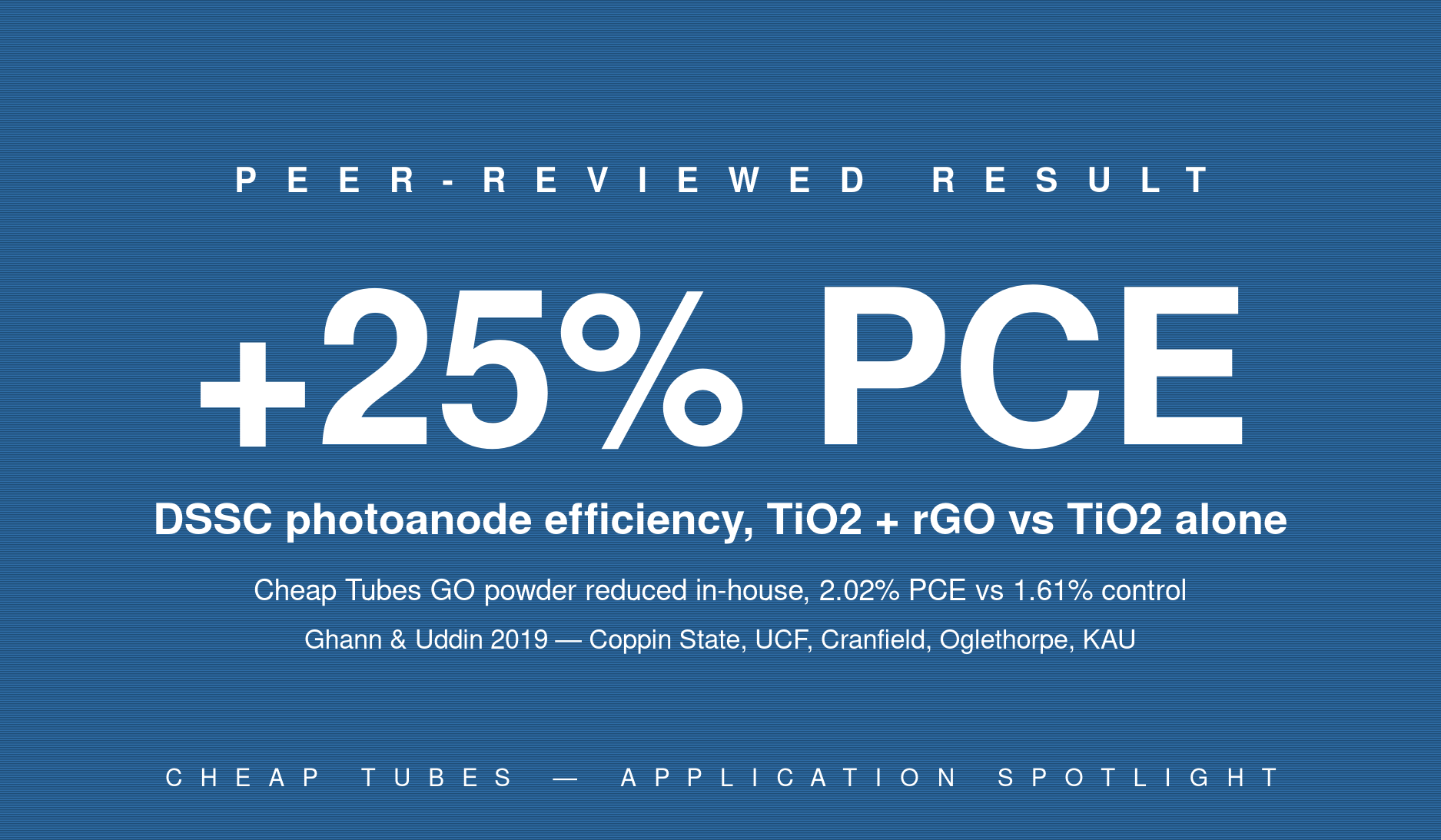
Dye-sensitized solar cells (DSSCs) lost the absolute-efficiency race to silicon and perovskite PV years ago, but they keep finding niches that the dominant chemistries can't serve: indoor-light harvesting for IoT and BLE devices, semi-transparent building-integrated glazing, low-light agricultural sensors, and flexible substrates that thin-film silicon can't match. The chemistry is also low-cost, room-temperature, and uses earth-abundant materials — meaningful for distributed manufacturing and university research labs. The remaining challenge is incremental efficiency. A 2019 paper from Coppin State University's Center for Nanotechnology (with collaborators at UCF, Cranfield, Oglethorpe, and King Abdulaziz), published in ChemEngineering, shows one clean lever: incorporating reduced graphene oxide (rGO) into the TiO2 photoanode lifts the cell's power conversion efficiency from 1.61% to 2.02% — a relative improvement of ~25% at otherwise matched architecture. The rGO is synthesized in-house by chemical reduction of Cheap Tubes graphene oxide powder, cited explicitly in the synthesis section.
Why rGO in the TiO2 Photoanode?
The DSSC photoanode does three jobs at once: it absorbs sunlight via the dye sensitizer (N719), injects the photo-excited electrons into a wide-bandgap semiconductor (TiO2), and transports those electrons through a mesoporous network out to the external circuit. Each step has its own losses. The headline limitation of pure TiO2 is electron transport: the nanoparticle network has many grain boundaries, and a meaningful fraction of injected electrons recombine with the oxidized dye (or the iodide-triiodide redox couple) before they make it to the FTO collector. Reduced graphene oxide solves this by providing a high-mobility, conductive pathway that bypasses the TiO2 grain-boundary maze. The rGO sheets also extend the visible-light absorption window slightly (the graphene-oxide-to-rGO chemistry leaves residual oxygen functionalities that interact with the dye), and improve the dye adsorption density via increased effective surface area.
The Material Choice — Why Cheap Tubes GO Powder
From the paper's synthesis section (verbatim): “The individual GO sheets in powdered form were obtained from Cheap Tubes Inc., Cambridgeport, VT. Thirty milligrams of GO powder was added to a 30 mL of deionized (DI) water in a vial. The GO solution was then stirred with a Teflon-coated magnetic stirring bar in a water bath for 24 h to obtain well dispersion.”
The team then chemically reduced the GO in-house using ammonia + hydrazine hydrate, producing the rGO used in the TiO2 photoanode amalgam. The choice of GO powder as the starting material (rather than buying pre-reduced rGO) gave the team complete control over the oxygen content, sheet morphology, and dispersion uniformity of the final rGO — all of which directly influence the photoanode performance. Buying GO powder and reducing it in-house is the standard workflow for any solar-cell group that needs to tune rGO chemistry for a specific device architecture.
Materials and Methods
rGO synthesis from Cheap Tubes GO powder
- Starting material: 30 mg Cheap Tubes graphene oxide powder dispersed in 30 mL DI water (1 mg/mL).
- Dispersion: 24 hours of Teflon-magnetic-stirring in a water bath to fully disperse the sheets.
- Reduction: 200 μL of 5% ammonia aqueous solution + 30 μL hydrazine hydrate (Sigma-Aldrich), then heat-treatment to drive the reduction reaction.
- Product: reduced graphene oxide (rGO) dispersion, ready for blending with TiO2 nanoparticle paste.
DSSC fabrication
- Photoanode (control): TiO2 nanoparticle paste doctor-bladed on FTO glass, sintered, then sensitized with N719 dye.
- Photoanode (rGO-modified): same TiO2 paste, but with the in-house rGO blended in to form a TiO2/rGO amalgam, then sintered and N719-sensitized.
- Counter electrode: Pt-coated FTO.
- Electrolyte: iodide-triiodide (I−/I3−) redox couple.
- Sealing: sandwich cell architecture.
Characterization battery
- UV-vis spectrometry — absorption shift comparing GO vs rGO and TiO2 vs TiO2/rGO photoanode.
- FTIR + Raman — confirmation of reduction (loss of C=O, C-O signatures; D-band / G-band ratio shift).
- AFM, FESEM, TEM, EDS — morphology and elemental composition of the rGO and the composite photoanode.
- I-V curves under simulated AM 1.5G illumination — JSC, VOC, fill factor, and power conversion efficiency.
- Electrochemical impedance spectroscopy (EIS) — charge transfer resistance at the TiO2/dye interface and the electron transport resistance through the photoanode.
Key Results
TiO2 + rGO amalgam photoanode
TiO2 only, no rGO
matched cell architecture
30 mg in 30 mL DI water
The headline efficiency lift
The DSSC with the TiO2/rGO amalgam photoanode delivered a solar-to-electric power conversion efficiency of 2.02%. The matched-architecture control with pure TiO2 (same dye, same electrolyte, same Pt counter electrode, same cell sealing) delivered 1.61%. The relative improvement of ~25% is meaningful for two reasons: it's at the same loading, the same dye, the same architecture — the only difference is the rGO — and it's reproducible from inexpensive starting materials (GO powder + standard reduction chemistry).
What the EIS data shows
The electrochemical impedance spectroscopy data shows that the rGO incorporation primarily reduces the charge transfer resistance at the TiO2/dye interface and the electron transport resistance through the photoanode network. This is consistent with the proposed mechanism: rGO provides a conductive high-mobility shortcut that helps photo-injected electrons reach the FTO collector before they can recombine with the oxidized dye or the iodide-triiodide redox couple. Both JSC (short-circuit photocurrent density) and the fill factor improve; VOC is roughly unchanged.
Where DSSC + rGO matters
DSSC absolute PCE in this paper is well below commercial silicon (~20%) and lab perovskite (>25%), but DSSC keeps a niche in indoor-light harvesting (IoT, BLE beacons, RFID-style energy harvesters), semi-transparent BIPV (building-integrated photovoltaic glazing where the cell needs to be visually transparent), and flexible / agricultural sensors. The rGO route shown here transfers cleanly to all three: a +25% efficiency lever on a low-cost room-temperature chemistry is meaningful regardless of where the absolute number lands.
Why Cheap Tubes GO Powder Works for This Solar Cell Application
- Powder format for stoichiometric weighing — the synthesis section calls out a precise 30 mg starting mass. Powder format allows reproducible weighing on a standard analytical balance, vs liquid GO dispersions where concentration drift, sedimentation, and aliquot volume introduce variability.
- Single-layer sheets in powder form — the paper specifically notes “individual GO sheets in powdered form,” meaning a true monolayer-dispersible powder rather than a poorly-exfoliated bulk GO product. This is critical: poorly-exfoliated GO produces non-uniform rGO with inconsistent oxygen content, and the photoanode performance scatters.
- Dispersible in DI water within 24 hours — the synthesis protocol uses only DI water and standard Teflon-magnetic stirring at room temperature in a water bath. Cheap Tubes GO powder fully disperses in this mild protocol, which is what made the in-house reduction route possible without specialty equipment.
- Consistent oxygen functional group distribution — the chemical reduction route (ammonia + hydrazine) needs a starting GO with predictable oxygen chemistry. Lot-to-lot GO consistency from a single commercial supplier is what made the resulting rGO reproducible across the multi-institution study.
Application Areas
- Dye-sensitized solar cells (DSSCs) — the direct target, including DSSC R&D using ruthenium-based and metal-free organic dyes, alternative redox couples, and quasi-solid-state electrolytes.
- Indoor light harvesting for IoT — DSSCs are particularly competitive under low-light indoor conditions (300-1000 lux), where they outperform amorphous silicon. The rGO route transfers directly.
- Perovskite solar cell electron transport layers — the same rGO-in-TiO2 architecture is used as an electron transport layer in n-i-p perovskite cells, where it serves the same charge-extraction function.
- Quantum-dot sensitized solar cells (QDSSCs) — the same TiO2/rGO photoanode architecture is used with CdS, CdSe, PbS, and CIS quantum dots in place of N719 dye.
- Photoelectrochemical water splitting — the rGO + TiO2 photoanode chemistry directly transfers to PEC hydrogen evolution applications, where the same charge extraction limits apply.
- Photocatalysts for environmental remediation — rGO + TiO2 composites are widely used in photocatalytic dye degradation and water purification, sharing the same charge-separation chemistry.
Order the Cheap Tubes GO Used in This Study
The graphene oxide powder used by the Coppin State team is available directly from Cheap Tubes. Order the matching SKU: Single Layer Graphene Oxide. Other GO formats (reduced GO, GO gel, GO dispersions, larger and smaller lateral grades) are available in the Graphene Oxide product category. Research and production volumes, SDS / TDS / CoA included, custom dispersion concentrations and pre-reduced rGO grades on request.
Graphene Oxide Powder for Solar Cell, Photoanode, and Photocatalyst R&D
Single-layer graphene oxide powder for dye-sensitized solar cell photoanodes, perovskite solar cell electron transport layers, quantum-dot sensitized solar cells, photoelectrochemical water splitting, photocatalytic environmental remediation, and TiO2/rGO composite R&D. Powder format for stoichiometric weighing; water-dispersible without surfactants; lot-to-lot oxygen content consistency for reproducible in-house reduction.
Order Single Layer Graphene Oxide → Browse all GO gradesFrequently Asked Questions
Why use reduced graphene oxide in a DSSC photoanode at all?
Pure TiO2 nanoparticle photoanodes have an electron transport bottleneck: the mesoporous network has many grain boundaries, and a meaningful fraction of photo-injected electrons recombine with the oxidized dye or the iodide-triiodide redox couple before reaching the FTO collector. Reduced graphene oxide provides a high-mobility, conductive shortcut that helps electrons bypass the TiO2 grain-boundary maze. The result is reduced charge transfer resistance, improved short-circuit photocurrent density, improved fill factor, and a measurable lift in power conversion efficiency.
Why buy GO powder and reduce it in-house rather than buy pre-reduced rGO?
Two reasons. First, the in-house reduction lets the team tune the oxygen content of the resulting rGO to match the application; commercial rGO has a fixed reduction degree that may not be optimal. Second, freshly-reduced rGO has a controllable surface chemistry and dispersion state that translates directly to consistent photoanode performance; commercial rGO that has been sitting in inventory may have surface oxidation or agglomeration that produces device-to-device variability. The standard workflow is to start with high-quality GO powder, reduce it in-house under conditions optimized for the application, and use it immediately.
How much PCE improvement did the rGO add?
The DSSC with TiO2/rGO photoanode delivered 2.02 percent power conversion efficiency. The matched-architecture control with pure TiO2 delivered 1.61 percent. The relative improvement is approximately 25 percent at matched dye (N719), matched electrolyte (iodide-triiodide), matched counter electrode (Pt-FTO), and matched cell architecture. The only difference between the two devices was the rGO incorporation in the photoanode.
How was the GO actually reduced to rGO in this study?
30 milligrams of Cheap Tubes graphene oxide powder was dispersed in 30 mL of DI water by Teflon-magnetic-stirring for 24 hours. Then 200 microliters of 5 percent ammonia aqueous solution plus 30 microliters of hydrazine hydrate (Sigma-Aldrich) were added, and the mixture was heat-treated to drive the reduction. The resulting rGO dispersion was characterized by UV-vis, FTIR, Raman, AFM, FESEM, TEM, and EDS before being incorporated into the TiO2 photoanode amalgam.
Does the rGO approach transfer to perovskite or quantum-dot solar cells?
Yes. The TiO2/rGO architecture used here is also a standard electron transport layer (ETL) configuration in n-i-p perovskite solar cells, where the rGO serves the same charge-extraction function for the photo-generated electrons coming out of the perovskite absorber. The same architecture is also used in quantum-dot sensitized solar cells with CdS, CdSe, PbS, and CIS quantum dots replacing N719. The charge transport physics is shared across all three cell families.
Where do I order GO powder for solar cell R&D?
Order the matching SKU used in this study: Single Layer Graphene Oxide from Cheap Tubes. The paper's synthesis section cites this product directly. Other GO formats and pre-reduced rGO are available for adjacent applications. Contact us with your application (DSSC photoanode, perovskite ETL, quantum-dot solar cell, photocatalyst) and target reduction degree for grade recommendations.