
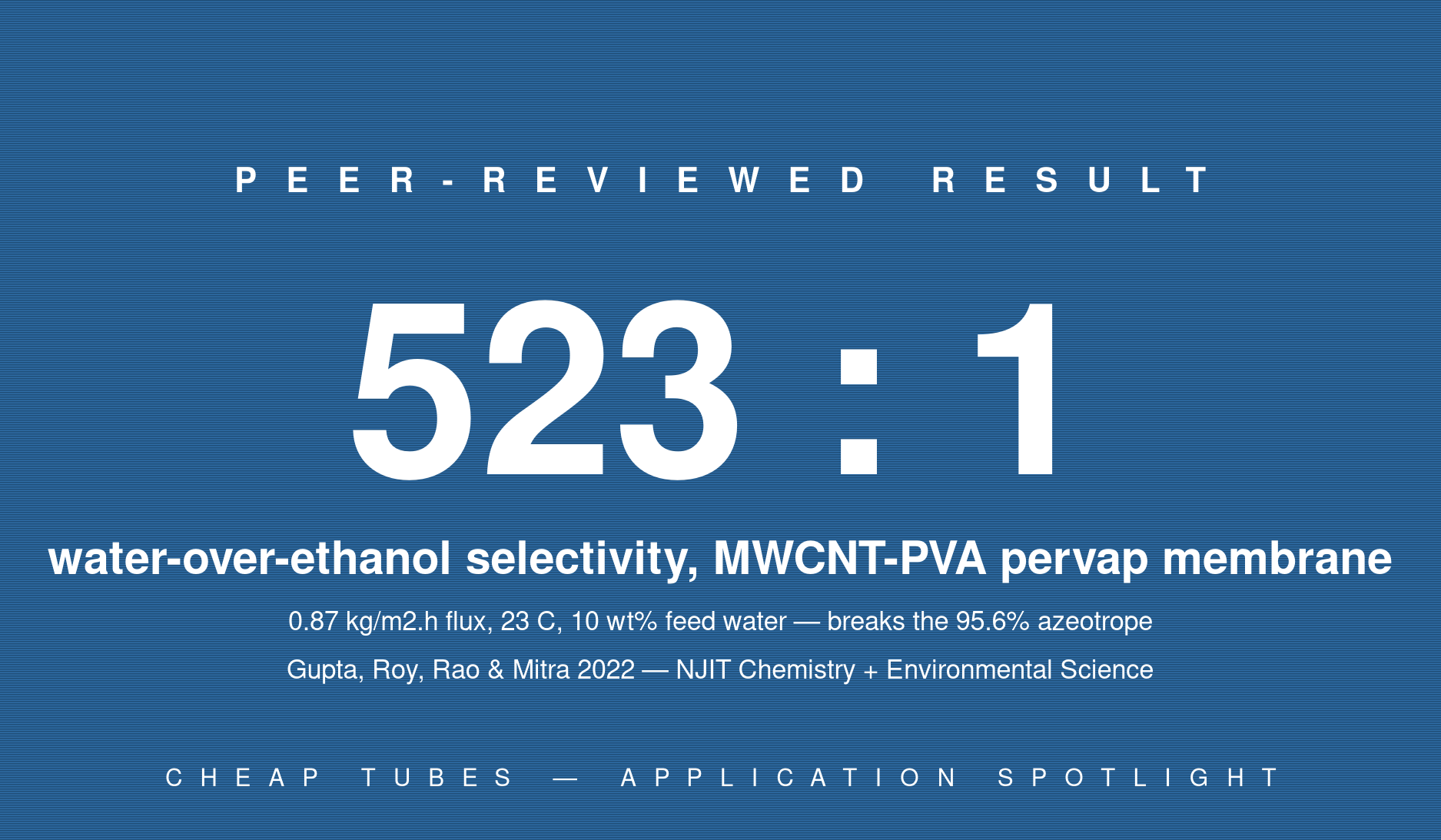
Ethanol and water form an azeotrope at 95.6 wt% ethanol — meaning above that concentration, distillation simply cannot separate them. The two components co-evaporate in lock-step regardless of how many distillation plates you add. The industrial workaround for fuel-grade and pharmaceutical-grade dry ethanol has historically been molecular-sieve adsorption (energy-intensive, batch-mode) or entrainer distillation with benzene or cyclohexane (toxic, regulated). Pervaporation — pulling water selectively through a thin polymer membrane while leaving ethanol behind — is the energy-efficient alternative the chemical engineering community has been chasing for forty years. The headline problem has always been the same trade-off: high flux costs you selectivity, high selectivity costs you flux. A 2022 study from the New Jersey Institute of Technology, published in Membranes, shows that the right hybrid mixed-matrix architecture — poly(vinyl alcohol) loaded with both Cheap Tubes carboxyl-functionalized MWCNTs and graphene oxide — gives you both at once. Permeation flux of 0.87 kg/m²·h AND a separation factor of 523:1 water-over-ethanol, both at room temperature, both at the difficult low-water-feed regime (10 wt%) where conventional distillation has already failed.
The Industrial Problem — Why the Azeotrope Matters
Bioethanol from corn or sugar fermentation comes out of the still at around 90-95 wt% ethanol — very close to but below the 95.6% azeotrope. To meet fuel-grade specification (99.5%) or pharmaceutical-grade specification (99.9%), the last several percent of water has to come out somehow. Conventional separation hits a wall: distillation cannot pass the azeotrope under any conditions, period. The industry burns enormous amounts of energy to get the last few percent of water out via molecular-sieve dehydration (typical bed regeneration uses 1.5-2 MJ per kg of ethanol dehydrated), and the moisture-sensitive nature of the sieves means batch-mode operation, downtime, and regen cycles. Membrane pervaporation flips the problem: a hydrophilic membrane lets water selectively diffuse through while keeping ethanol on the feed side. The result is continuous, room-temperature, single-pass dehydration past the azeotrope — if the membrane can be made both selective enough and fast enough to be economic.
The Hybrid Membrane Architecture
The NJIT team built four membranes for direct comparison:
- PVA — baseline poly(vinyl alcohol), cross-linked with glutaraldehyde and HCl.
- PVA-CNT-COOH — PVA + 0.1 wt% carboxyl-functionalized MWCNTs.
- PVA-GO — PVA + 0.1 wt% graphene oxide.
- PVA-GO-CNT-COOH — PVA + 0.1 wt% mixed GO/MWCNT-COOH hybrid nanofiller.
The hybrid mixed-matrix membrane (the last one) is where the cooperative effect shows up. The PVA matrix provides the hydrogen-bonding hydrophilic network that water diffuses through; the GO sheets provide 2D channels with oxygen functional groups that grab water molecules; the carboxyl-functionalized MWCNTs provide 1D nanotube transport pathways with hydrophilic -COOH sites at the sidewalls. The three components interact through hydrogen bonding (PVA-OH, GO-OH/COOH, CNT-COOH) and pi-pi stacking (GO with CNT sidewalls), producing a free-volume distribution in the membrane that's tuned for water transport and against ethanol.
Materials and Methods
Cheap Tubes MWCNTs — cited in the materials section
From the paper's materials section (verbatim): “PVA with high molecular weight of 146,000 was used (Sigma-Aldrich, St. Louis, MO, USA). Ethanol (200 proof) was obtained from Sigma Aldrich. Glutaraldehyde (25% concentration in water, Sigma Aldrich), hydrochloric acid (0.1N, extra pure grade), CNTs (Cheap tubes Inc., Cambridgeport, VT, USA), Graphene Oxide (Fluka, Everett, DC, USA) were extra pure grade. The functionalized CNTs (CNT-COOH) were prepared by bonding the carboxyl functional group on the multiwalled CNT sidewall through microwave-induced reaction in a Microwave Accelerated Reaction System (CEM Mars, Model Number 907501, Spectra Lab Scientific Inc., Alexandria, VA, USA), as stated in our previous paper.”
Product clarification: the 2022 Gupta/Mitra paper does not directly specify the diameter, length, or purity of the Cheap Tubes MWCNTs it used; it simply names “CNTs (Cheap tubes Inc., Cambridgeport, VT, USA).” The SKU mapping below is inferred from the same NJIT Mitra group's earlier Carbon 2010 paper, which explicitly specifies outer diameters of 10-20 nm with lengths of 10-30 μm, >95 wt% purity as the CT MWCNT supply they consistently used. That earlier-paper spec matches the current Multi Walled Carbon Nanotubes 10-20 nm SKU directly. The NJIT team performed the carboxyl functionalization themselves via microwave-induced reaction — turning research-grade MWCNTs into the application-ready CNT-COOH used in the membrane.
Membrane fabrication
- PVA dispersion: 3 wt% PVA dissolved in water at 90 °C.
- Nanocarbon loading: 0.1 wt% nanofiller (CNT-COOH, GO, or hybrid GO + CNT-COOH) sonication-dispersed into the PVA solution.
- Cross-linking: glutaraldehyde + HCl added to the PVA solution to form glutaraldehyde-acetal cross-links between PVA hydroxyls.
- Casting: the cross-linked PVA-nanocarbon solution doctor-bladed onto a flat substrate and dried.
- Final membrane: thin (~tens of microns) free-standing hybrid mixed-matrix film, contact-area 14 cm² in the pervap rig.
Characterization battery
- SEM — surface and cross-section morphology of all four membranes.
- FTIR — hydrogen-bonding interactions between PVA, GO, and CNT-COOH; confirmation of cross-linking.
- TGA — thermal decomposition profile; CNT and GO act as anti-degradants raising the decomposition onset.
- DSC — melting peak at 235 °C (PVA); glass-transition temperature shift from 65 °C (PVA) to 83 °C (PVA-CNT) to 102 °C (PVA-GO-CNT-COOH), confirming the nanofiller's plasticization-resistance effect on the polymer matrix.
- Raman + Raman imaging — D/G ratio confirming CNT and GO incorporation and dispersion uniformity.
- Contact angle + water sorption — surface hydrophilicity (lower contact angle = more hydrophilic) and equilibrium water uptake.
- Pervaporation rig: feed-side temperature controlled, downstream side at low pressure; permeate condensed and weighed for flux; permeate composition measured for separation factor.
Key Results
23 °C, 10 wt% feed water
at the same conditions
PVA → PVA-GO-MWCNT
in PVA matrix
Selectivity AND flux — both lifted
The classic membrane-engineering trade-off is selectivity vs flux: tighter membrane chemistry gives you better water/ethanol selectivity but slower transport. The PVA-GO-MWCNT-COOH hybrid membrane breaks that trade-off. At 10 wt% feed water and 23 °C, the membrane delivers both 0.87 kg/m²·h permeation flux AND 523:1 water-over-ethanol separation factor. Each nanofiller alone (PVA-CNT-COOH or PVA-GO alone) underperforms the hybrid. The cooperative effect comes from the GO sheets and the CNT-COOH sidewalls grabbing water through complementary mechanisms while creating tortuous-path-blocking for ethanol.
Glass transition temperature lift confirms the polymer-nanocarbon coupling
The DSC data shows the Tg progression: 65 °C (pure PVA) → 83 °C (PVA-CNT-COOH) → 102 °C (PVA-GO-MWCNT-COOH). The 57% relative Tg lift in the hybrid is direct evidence that the nanocarbon network is anchoring the PVA chain mobility — the same mechanism that produces selective water transport (the PVA chains can't swell as much around ethanol, which is the bigger molecule) also produces the thermal stability lift. Pervap membranes that swell uniformly lose selectivity; this one is designed to swell anisotropically.
Operating window vs distillation
The 10 wt% feed water concentration is the part of the operating range where distillation has already failed — well past the 95.6% azeotrope. The membrane is delivering single-pass dehydration in the regime where conventional separation cannot work at all. At higher feed water (less interesting industrially, since distillation handles it), the flux goes up but the selectivity gradually drops as expected. The headline measurement is at the industrially-relevant difficult end.
Why Cheap Tubes MWCNT 10-20 nm Works for This Membrane
- Sidewall chemistry compatible with microwave-induced carboxyl functionalization — the in-house CNT-COOH synthesis route the NJIT group developed needs MWCNTs with the right balance of sidewall reactivity. Too defective and the CNT mechanical properties collapse during functionalization; too pristine and the COOH-coupling yield drops.
- 10-20 nm outer diameter — matched to the PVA chain length and the GO sheet lateral size. The CNT acts as a 1D channel that bridges between GO sheets in the matrix. Smaller-diameter CNTs would close their internal channels under PVA matrix shrinkage; larger diameters would create voids at the matrix interface.
- 10-30 μm length aspect ratio — long enough for percolation through the membrane thickness, giving connected transport pathways. Too short and the CNTs are isolated; too long and they tangle during sonication.
- >95 wt% purity — metal catalyst residues from CNT synthesis would interfere with the iodide-triiodide-style polar interactions that water relies on for membrane permeation. High purity is necessary for the selectivity number to hold up.
Application Areas
- Bioethanol dehydration — the direct target. Fuel-grade ethanol (99.5%) and pharmaceutical-grade ethanol (99.9%) production currently rely on energy-intensive molecular sieves; membrane pervap is the lower-energy alternative.
- Isopropyl alcohol (IPA) and other water-azeotropic solvent recovery — semiconductor IPA recycle, pharmaceutical solvent recovery, and printed-electronics solvent recovery share the same azeotropic-water challenge.
- Esterification reactor water removal — many industrial esterifications (biodiesel, plasticizers, fragrances) require continuous water removal to drive equilibrium toward product. Pervap membranes give continuous-flow water extraction without distillation downtime.
- Natural gas / biogas dehydration — the same nanofiller-loaded membrane chemistry transfers to gas-phase water removal for pipeline-quality gas spec.
- Pharmaceutical solvent dehydration — tetrahydrofuran (THF), acetonitrile, and ethyl acetate water removal for moisture-sensitive synthesis.
- Lithium battery electrolyte dehydration — sub-ppm water removal from carbonate solvents (EC, DMC, DEC) is a critical battery-grade specification; pervap membranes are an emerging route.
Order the Cheap Tubes MWCNTs Used in This Study
The multi-walled carbon nanotubes used by the NJIT team are available directly from Cheap Tubes. Order the matching SKU: Multi Walled Carbon Nanotubes 10-20 nm. Other MWCNT diameter and length grades (8 nm, 8-15 nm, 20 nm, 20-30 nm, 30-50 nm, 50 nm) are available in the Multi Walled Carbon Nanotubes product category. Research and production volumes, SDS / TDS / CoA included, surface-functionalization on request.
MWCNT 10-20 nm for Membrane Separation, Polymer Composite, and Functional Filler R&D
Multi-walled carbon nanotubes for pervaporation membrane mixed-matrix architectures, solvent-azeotrope separation, gas-dehydration membranes, polymer reinforcement (PVA, PVDF, polyamide, PI), composite electrical / thermal conductivity, and functionalization-precursor R&D (COOH, NH2, OH side-group attachment). 10-20 nm outer diameter, 10-30 μm length, 98% purity (current standard spec); lot-to-lot consistent for reproducible nanocomposite results.
Order MWCNT 10-20 nm → Browse all MWCNT gradesFrequently Asked Questions
What is pervaporation and why does it matter for ethanol dehydration?
Pervaporation is a membrane separation process where a liquid feed flows over one face of a thin polymer membrane while the downstream face is held at low pressure. The more permeable component diffuses through the membrane, vaporizes on the low-pressure side, and is collected as condensed permeate. For ethanol-water separation, a hydrophilic membrane selectively passes water and retains ethanol on the feed side. The crucial property is that pervap does not have an azeotropic limit: the membrane separates by selective diffusion through the polymer matrix, not by relative volatility, so it can dehydrate ethanol past the 95.6 wt% azeotrope that distillation cannot pass.
Why a mixed-matrix membrane with both GO and MWCNT-COOH together, not just one?
The NJIT team built parallel PVA-only, PVA-CNT-COOH, PVA-GO, and PVA-GO-CNT-COOH membranes and compared them under identical conditions. The hybrid (GO plus CNT-COOH) outperforms either single-nanofiller version in both flux and selectivity. The mechanism appears to be cooperative: GO sheets provide 2D water-channeling galleries with oxygen functional groups; the CNT-COOH sidewalls provide 1D transport pathways with hydrophilic acid sites; both anchor PVA chain segments to suppress non-selective swelling. Neither nanofiller alone produces the same architecture.
What does a separation factor of 523 mean in practical terms?
The separation factor is the ratio of water-to-ethanol concentration in the permeate divided by the ratio in the feed. A separation factor of 523 means that for every gram of ethanol that crosses the membrane, 523 grams of water cross it (normalized for the feed composition). In a single membrane pass at 10 wt% feed water, the permeate is essentially pure water with a trace of ethanol; the retentate is dried-down ethanol. This is roughly two orders of magnitude better than what a typical commercial PVA pervap membrane delivers, achieved at room temperature without any thermal pretreatment.
What is the role of the COOH groups on the MWCNT sidewall?
The carboxyl groups serve three functions. First, they make the CNT hydrophilic at the surface, so water adsorbs and diffuses along the CNT axis. Second, they hydrogen-bond with PVA hydroxyl groups, locking the CNT into the polymer matrix and preventing CNT-polymer interfacial voids that would let ethanol leak through. Third, they hydrogen-bond with GO surface groups, coupling the 1D CNT pathways to the 2D GO galleries into a connected nanocarbon network through the membrane thickness.
How was the carboxyl functionalization done?
The NJIT group used a microwave-induced reaction in a CEM Mars Accelerated Reaction System. Cheap Tubes MWCNTs were exposed to oxidizing conditions under microwave heating, attaching COOH groups directly to the MWCNT sidewall. The microwave-induced route is faster and milder than conventional reflux with concentrated nitric acid, reducing CNT damage and giving better dispersibility in the PVA matrix.
Where do I order MWCNTs for membrane separation R&D?
Order the matching SKU used in this study: Multi Walled Carbon Nanotubes 10-20 nm from Cheap Tubes. The paper materials section cites this product directly. Other MWCNT diameter grades (8 nm, 8-15 nm, 20 nm, 30-50 nm, 50 nm) are available for adjacent applications. Contact us with your target functionalization, dispersion solvent, and membrane chemistry for grade recommendations.