
How Much Do Carbon Nanotubes Cost?
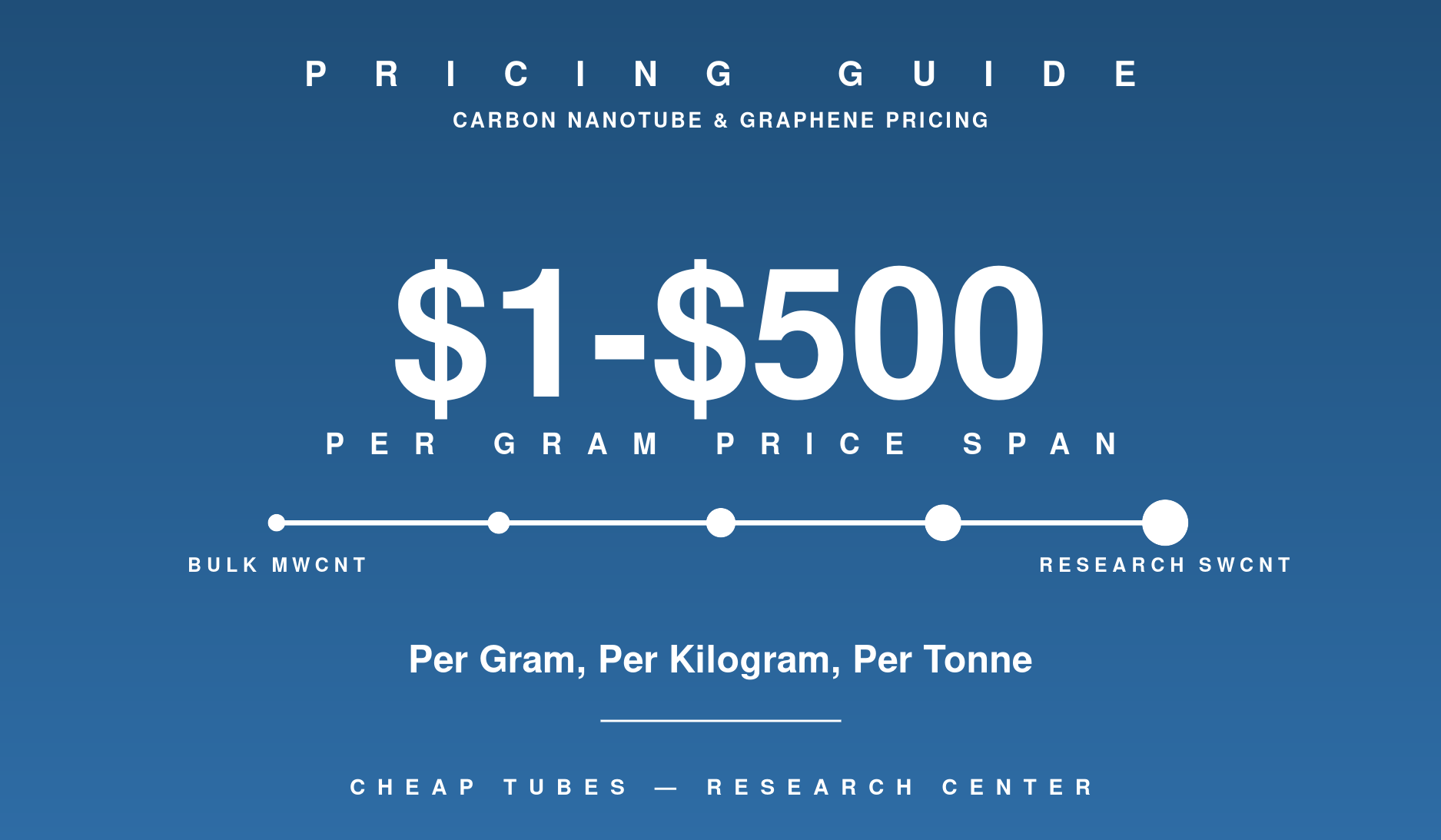
Carbon nanotubes cost anywhere from under $1 per gram to over $500 per gram, and the honest answer to “how much” is that the type, purity, and order size you specify move the number by roughly three orders of magnitude. A gram of bulk industrial-grade multi-walled carbon nanotubes (MWCNT) purchased at the kilogram tier can run under a dollar per gram equivalent. A gram of research-grade single-walled carbon nanotubes (SWCNT) at 99%+ purity can run into the hundreds. This guide breaks down what actually drives the spread, shows current Cheap Tubes pricing across every product family, and answers the specific per-gram, per-kilogram, and per-tonne questions researchers and buyers ask most. If you need the basics on what carbon nanotubes are and how the wall structures differ before pricing them, see our carbon nanotube primer first.
Prices below are pulled from live Cheap Tubes product pages as of August 2026. Material pricing changes with raw feedstock, synthesis capacity, and order volume, so treat the numbers here as a snapshot and check the relevant product page for current pricing before you quote a budget.
Quick answer by tier:
- Under $1/g: standard-grade GNP and standard MWCNT at bulk gram quantities
- $1-10/g: graphitized MWCNT and functionalized GNP at bulk quantities
- $10-100/g: most gram-to-25-gram research orders of MWCNT, GO, and fullerenes
- $100-250/g: SWCNT and high-purity SW-DWCNT at small order sizes
- Priced per kg, not per gram: industrial-grade MWCNT, industrial-grade GNP, CNT masterbatches
What Drives Carbon Nanotube and Graphene Price?
Six variables explain almost all of the price spread between two products that both say “carbon nanotubes” or “graphene oxide” on the label.
- Wall structure (SW vs DW vs MW). Single-wall synthesis needs more expensive catalysts, typically cobalt-based, and runs at much lower yield than multi-wall synthesis. MWCNTs are generally grown as MWCNTs from the start rather than separated out of a mixed-wall batch, so that catalyst cost and yield gap is the single biggest reason SWCNT costs more per gram than MWCNT.
- Purity grade. Higher stated purity means more post-synthesis purification (acid reflux, thermal annealing, filtration passes), each of which loses yield and adds processing time. A 95% industrial-grade MWCNT and a 99.5% graphitized MWCNT come off related but different production lines with very different cost structures.
- Functionalization. COOH, OH, and NH2 surface groups are added in a separate wet-chemistry step after the base material is made. Functionalized material is consistently priced above its pristine counterpart across every product line.
- Length and aspect ratio. Longer, higher-aspect-ratio tubes are harder to keep intact through synthesis and purification without breaking, and short CNTs are made by mechanically shortening standard-length tubes, an additional processing step that adds cost. That is part of why specialty long or short variants carry different pricing than standard-length material.
- Dispersion state. Dry powder, a pre-dispersed suspension, or a finished polymer masterbatch are three different products with three different cost bases. A masterbatch already has the dispersion work, the compounding, and the pelletizing done for you, which is why it is priced per kilogram of finished pellet, not per gram of nanotube.
- Order volume. Every product line on this page drops price per unit as quantity increases, sometimes by an order of magnitude between a 1-gram order and a 5-kilogram order. Volume is the single biggest lever a buyer controls directly.
Typical Starting Price by Product Family
| Product family | Typical Cheap Tubes starting price | What moves it |
|---|---|---|
| Industrial Grade MWCNT (95% purity) | from ~$199/kg at volume (kg-tier pricing) | diameter grade, functionalization, kg quantity break |
| Standard MWCNT (98% purity) | from ~$0.90/g at bulk gram tiers | diameter, functionalization, gram quantity break |
| Graphitized MWCNT (99.5%+ purity) | from ~$3.65/g at bulk gram tiers | graphitization post-treatment (raises crystallinity and conductivity, cuts specific surface area by about 50%), diameter, quantity |
| SWCNT / SW-DWCNT | from ~$90/g (90% blend) to $250/g (95-99% grades) | purity grade, single-wall vs blend, order size |
| Graphene Oxide (single-layer) | from ~$140/g at bulk gram tiers | layer count, lateral size, reduction (rGO costs more) |
| Graphene Nanoplatelets (standard) | from ~$0.45/g at bulk gram tiers | functionalization, thickness/layer count, quantity |
| GNP Industrial Grade, 6-10 Layer | $200/kg (1 kg) down to $100/kg (100+ kg) | kilogram order volume only, no functionalization tiers |
| CNT Masterbatches (PP, ABS, PC, PA6) | $250/kg (1-9 kg) down to $190/kg (101-500 kg) | polymer carrier, loading %, kilogram order volume |
| Fullerenes (C60 / C70 guide) | from ~$95-225/g depending on grade | C60 vs C70, purity (99% vs 99.9%), quantity |
| Flexiphene (SWCNT paper) | $300 per sheet (32mm diameter) | sold as a finished sheet, not by weight |
See our CNT masterbatch guide for how to pick a carrier resin and loading percentage, and our guide on bundled vs. individually dispersed carbon nanotubes for how dispersion state changes both price and performance before you commit to a powder, a suspension, or a masterbatch.
Price Per Gram vs. Per Kilogram vs. Per Tonne
Researchers searching “carbon nanotubes price per kg” or “per gram” are usually comparing two very different purchase sizes, and the per-unit price does not scale linearly between them. Cheap Tubes prices standard and graphitized MWCNT, SWCNT, graphene oxide, and standard GNP by the gram, with declining per-gram rates as order size increases from single grams up through multi-kilogram bulk tiers. Industrial-grade MWCNT, the new industrial-grade GNP line, and CNT masterbatches are priced directly by the kilogram instead, because those product lines exist specifically for volume, cost-sensitive applications rather than gram-scale bench work.
Per-tonne pricing is a different market entirely from per-gram research pricing. Production-scale battery-grade CNT paste sells for roughly tens of dollars per kilogram on a dry-basis at qualification volumes, but that market requires production audits, multi-ton annual commitments, and supplier qualification cycles that research buyers do not go through. It is not a tier a gram-to-kilogram research order can access, and it is not what Cheap Tubes’ published catalog pricing is built for.
What decides which tier applies to your order:
- Gram-to-kilogram, published catalog tiers: formulation work, percolation screening, pilot batches, most academic and startup R&D
- Kilogram-tier volume programs (up to 500 kg on some lines): larger pilot runs and cost-sensitive composite or masterbatch production
- Ton-scale production supply: qualified production lines with audited suppliers and multi-ton annual commitments, a different market than this catalog serves
If your project needs ton-scale material for a qualified production line, contact us directly to discuss volume programs above the published kilogram tiers; if your project needs gram-to-kilogram material for formulation, percolation screening, or pilot work, the published per-gram and per-kilogram tiers on each product page apply as-is.
Why Do Supplier Prices Differ So Much for the “Same” Material?
Two suppliers can both list “MWCNT, 95% purity, 10-20nm” and quote prices that differ by 5-10x. That gap is almost never a scam on one end. It usually comes down to three things buyers should check before comparing numbers directly.
- How purity is measured. TGA-based purity, elemental analysis purity, and visual/TEM-estimated purity are not the same measurement, and suppliers do not always disclose which method produced the number on the spec sheet.
- Agglomerate vs. dispersed state. A powder that arrives as tightly bundled agglomerates and a powder that has been pre-treated for easier dispersion can carry the same nominal spec and a very different real-world usable yield in your formulation.
- QC documentation. A published Technical Data Sheet and Safety Data Sheet with a lot-specific COA costs the supplier real QC time per batch. A listing with no documentation is cheaper to produce and cheaper to sell, and buyers pay for the difference either way, either up front or in failed formulations later.
Our MWCNT buying guide and SWCNT buying guide go deeper on matching a spec to an application rather than shopping purity number alone.
Sample and Evaluation Policy
We run paid evaluation samples rather than free samples for most research orders. Free-sample programs at scale end up prioritizing whoever asks first rather than whoever has the highest-value project, and a small team can only run so many evaluation orders in parallel. A paid evaluation, even at a modest gram-scale price, filters for buyers who have already scoped their material need and are ready to run a real test. It also means your evaluation order ships from the same QC’d lot and documentation pipeline as a full order, rather than a separate “sample-only” batch, so what you test is what you would actually buy. For volume programs, contact us to discuss an evaluation quantity ahead of a full kilogram-tier order.
Frequently Asked Questions
How much does 1 gram of carbon nanotubes cost?
One gram of carbon nanotubes costs anywhere from roughly $10-15 for standard MWCNT at the 1-9 gram tier up to $250 for high-purity SWCNT, with the exact number set by wall structure, purity grade, and functionalization. Standard MWCNT at 8-15nm starts at $15/g for small orders; 99%+ SW-DWCNT starts at $250/g for orders under 25 grams.
Why are SWCNTs more expensive than MWCNTs?
SWCNTs cost more because single-wall synthesis needs more expensive catalysts, typically cobalt-based, and runs at much lower yield than multi-wall synthesis. On our catalog, standard MWCNT starts under $1/g at bulk gram quantities while SWCNT and SW-DWCNT blends start at $90-250/g depending on purity, a gap that reflects catalyst cost and synthesis yield rather than arbitrary pricing.
How much does graphene oxide cost?
Single-layer graphene oxide starts at $150/g for orders of 1-20 grams and drops to $140/g at bulk gram quantities. Reduced graphene oxide (rGO) runs higher, starting at $200/g for small orders and settling at $190/g in bulk, because the reduction step adds processing on top of the base oxidation. Specialty size-controlled GO (sub-450nm or 1-20µm lateral size) starts at $190-200/g. Our graphene oxide buying guide covers how to choose between single-layer, few-layer, and reduced grades for your application.
What does a CNT masterbatch cost per kg?
Cheap Tubes CNT masterbatches (PP, ABS, PC, and PA6 carrier resins) start at $250/kg for orders of 1-9 kg and drop to $190/kg at the 101-500 kg tier. A masterbatch price covers the carrier resin, the dispersion work, and the pelletizing, so it is not directly comparable to a raw nanotube powder price per gram; you are buying a ready-to-compound pellet, not a powder you disperse yourself. See our CNT masterbatch guide for loading percentage and carrier resin selection.
Can I buy carbon nanotubes by the ton?
No, not through the standard catalog tiers. Our published pricing runs from single grams up through kilogram-scale volume tiers (up to 500 kg on some functionalized industrial-grade lines), which covers bench research through pilot-scale formulation work. Ton-scale supply is a production-market category that involves supplier qualification audits and multi-ton annual commitments, the kind of relationship built around a qualified production line rather than a catalog order. If that describes your program, contact us to talk about what a volume program above the listed kilogram tiers would require.
How much does industrial-grade material cost compared to research-grade?
Industrial-grade lines are priced by the kilogram specifically because they serve cost-sensitive, higher-volume applications rather than gram-scale bench work. Industrial Grade MWCNT (95% purity) runs roughly $199-450/kg depending on diameter, functionalization, and quantity break. The new Industrial Grade GNP, 6-10 Layer line runs $200/kg at 1 kg down to $150/kg at 50 kg and $100/kg above 100 kg. Both are priced well below their research-grade, gram-priced counterparts once you convert to an equivalent per-gram basis, which is the tradeoff: lower purity specification and coarser QC in exchange for volume pricing. Our graphene nanoplatelets buying guide covers how to pick between the industrial-grade and research-grade GNP lines by application.
Do prices include shipping?
No. Published catalog prices are for material only; shipping is calculated separately at checkout based on order weight, packaging, and destination. International orders should also expect duties and import fees to apply on the buyer’s side, which are not included in the quoted material price.
Why do prices drop so much at higher quantities?
Per-unit synthesis, purification, and QC cost less per gram or per kilogram as batch size increases, and that efficiency gets passed through in the tiered pricing on every product page. The size of the drop varies by product: standard MWCNT can drop from $15/g at 1-9 grams to under $1/g at 5,000+ grams, roughly a 15x spread, while industrial-grade kilogram-tier products see a more moderate 2x spread across their published tiers. If your project has a known volume, checking the specific tier on the product page before ordering usually saves more than negotiating.
Get a Quote
Every product page linked in this guide has current pricing and an add-to-cart flow for standard quantities. For volume programs, custom specifications, functionalization not shown in the catalog, or evaluation quantities ahead of a full order, request a quote and we’ll get back to you with current lead time and pricing for your specific spec.
Include these details in a quote request so we can turn it around fast:
- Material family (MWCNT, SWCNT, GO, GNP, fullerene, masterbatch) and grade if known
- Target quantity in grams or kilograms
- Functionalization, if any (COOH, OH, NH2)
- Application area, so we can flag a better-fit grade if one exists
- Timeline, especially if you need an evaluation quantity before a full order