
What Is the Difference Between Bundled and Individually Dispersed Carbon Nanotubes?
Bundled carbon nanotubes are still held together in ropes or tangled agglomerates by van der Waals attraction, while individually dispersed carbon nanotubes are separated tube by tube and stabilized so each one can act on its own.
Every carbon nanotube leaves the reactor as part of a bundle. Individual tube diameters run roughly 0.7-2 nm for single-walled material and 5-80 nm across the multi-walled grades in our catalog, and raw powder always arrives as clusters of tubes stuck together, not as loose single strands. Whether that powder ends up performing as discrete, high-aspect-ratio filler or as small chunks of bundled carbon depends on what happens to it after it leaves the bottle. That gap between as-supplied and dispersed material is what this page covers.
- Starting bundle structure: SWCNT rope vs. MWCNT tangle
- Dispersion method and energy applied during processing
- Stabilization approach used to keep tubes apart afterward
Why Carbon Nanotubes Bundle Together
Carbon nanotubes bundle because the same graphitic surface that makes them useful also makes them attractive to their neighbors. Two adjacent tubes lying side by side are pulled together along their full length of contact, strongly enough to resist ordinary mixing. That attraction also explains why some CNT powders are harder to break apart than others.
Van der Waals Attraction Between Adjacent Tubes
Two adjacent carbon nanotubes attract each other through van der Waals forces acting across their entire length of contact. Reported binding strength for this tube-to-tube interaction falls in the range of roughly 0.5 to 0.9 eV per nanometer of contact length. That number looks small in isolation, but a micron-long tube lying alongside a neighbor accumulates this attraction over a thousand nanometers of contact, adding up to a bond that plain stirring does not break. This is why as-received nanotube powder does not spontaneously separate once it hits a solvent, resin, or water.
SWCNT Ropes vs. MWCNT Agglomerates
Single-walled tubes are thin (about 0.7-2 nm in diameter), straight, and rigid enough to pack side by side into ordered hexagonal ropes, similar to a bundle of pencils. Wall-to-wall spacing inside these ropes sits close to 0.34 nm, the same scale as the interlayer spacing in graphite. A single rope can contain anywhere from a few tens to several hundred individual tubes locked into that ordered lattice, and the straight, uniform geometry maximizes contact area between neighbors, which is exactly what strengthens the van der Waals bond.
Our single-walled carbon nanotubes ship as this kind of bundled rope material before any dispersion work is done. Tube length commonly runs from around 1 micron up to several tens of microns for standard grades, and up to roughly 100 microns for our longer specialty grades, giving single tubes aspect ratios that can exceed 1,000:1 once separated.
Multi-walled tubes are larger in diameter (commonly 5-80 nm across our Standard MWCNT, Industrial Grade MWCNT, and Graphitized MWCNT lines) and carry more waviness along their length, with aspect ratios that typically run 100:1 to 1,000:1 once individualized, lower than the longest SWCNT grades mainly because MWCNT diameters start out larger. Rather than packing into an ordered rope, MWCNTs tend toward tangled agglomeration, closer to a ball of wire than a bundle of straws. That curvature reduces the contact area between any two tubes compared with a straight SWCNT rope, so bulk MWCNT agglomerates generally take less energy to break apart than densely packed SWCNT ropes, even though both still require active dispersion work.
What Bundling Costs You in Application Performance
Bundling changes the effective size and shape of a filler, and that shows up directly in electrical, thermal, mechanical, and rheological performance. Composites, conductive coatings, elastomers, thermal interface materials, EMI shielding, energy storage electrodes, and biosensors all depend on the same principle: a network of individual high-aspect-ratio tubes behaves very differently from the same weight of bundled carbon.
Percolation Threshold and Aspect Ratio
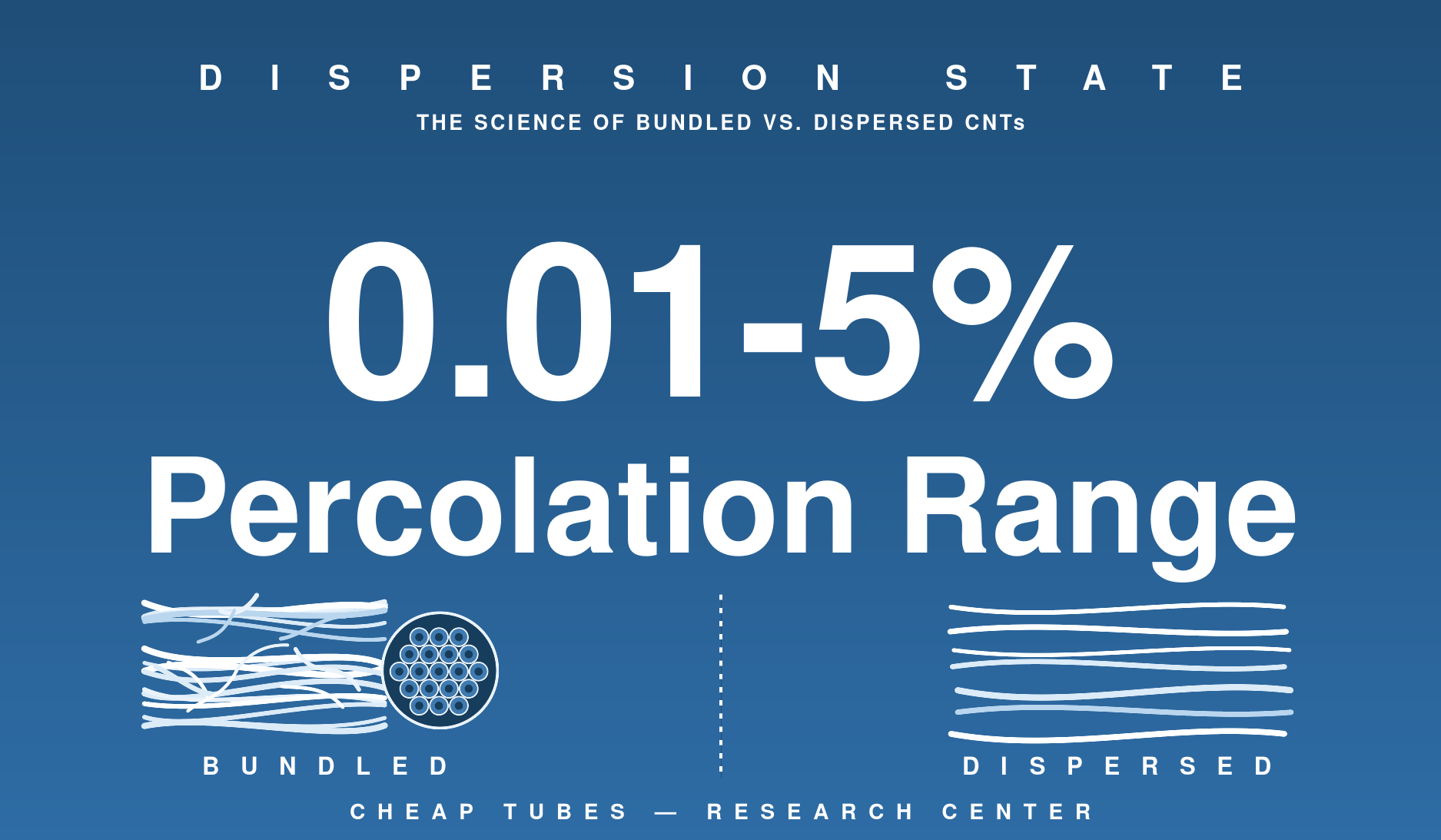
Percolation threshold is the minimum loading of conductive filler needed to form a continuous conductive network through a matrix. It depends heavily on aspect ratio (tube length divided by diameter) and on how much of that filler is actually acting as individual, high-aspect-ratio tubes rather than as bundles. A bundle of fifty tubes behaves electrically and geometrically like one thicker, shorter particle, not fifty separate high-aspect-ratio ones, so bundling quietly lowers the effective aspect ratio of a filler even when the individual tubes are unchanged.
| Dispersion State | Typical Aspect Ratio | Percolation Threshold |
|---|---|---|
| Well-dispersed, high-aspect-ratio CNTs | >100:1, often >1,000:1 for long SWCNT | 0.01-0.5 wt% |
| Poorly dispersed / bundled CNTs | Effective ratio reduced by bundling | 1-5 wt% |
Conductivity, Mechanical Reinforcement, and Viscosity Effects
The same aspect-ratio penalty that raises percolation threshold also shows up in several other properties, all pointing back to the same root cause.
- Electrical conductivity: fewer continuous conductive pathways form at a given loading
- Thermal conductivity: the same network-formation dependence as electrical conductivity
- Tensile modulus and strength: a bundle transfers stress as one thick unit rather than distributing it across many thin tubes
- UV-Vis-NIR absorbance: bundling broadens or flattens the sharp electronic transitions used to verify individualization
- Processing viscosity: bundled and dispersed material build viscosity differently at the same weight loading
How Liberation Is Achieved
Separating bundles into individual, stabilized tubes takes two things: enough energy to break the van der Waals contacts, and a stabilization step that keeps tubes apart afterward.
- Mechanical shear (high-shear mixing, three-roll milling, ball milling)
- Bath or probe sonication
- Surfactant-assisted stabilization
- Polymer-assisted stabilization
- Graphene-family dispersants (graphene or graphene oxide)
- Covalent functionalization (COOH, OH, NH2)
Mechanical Shear and Sonication
Mechanical shear applies bulk force to break bundles apart and often precedes any chemical stabilization step. Sonication layers acoustic cavitation on top of, or instead of, shear, but bath and probe units are not interchangeable. Bath sonicators spread energy across an entire tank, commonly rated 40-300 W total, so the energy reaching any one tube is diluted and unfocused. Probe (tip) sonicators concentrate output, commonly rated 100-750 W, into a small immersed volume, focusing enough energy to debundle tubes efficiently.
Probe sonication is the right choice for debundling single-walled tubes; a bath sonicator will not reliably debundle SWCNTs, since its energy spreads across the whole tank instead of focusing into the sample. Bath sonication works well for graphene oxide and can still disperse CNTs, but it takes far longer to deliver the same energy. Bath units run near 40 kHz, probe units run lower, near 20 kHz, at much higher amplitude, and batch size and acceptable tube shortening still shape the setup.
Surfactant-Assisted, Polymer-Assisted, and Graphene-Family Dispersion
Once bundles are mechanically broken apart, something has to keep the tubes from re-aggregating. Surfactant molecules adsorb onto the tube surface and provide steric or electrostatic stabilization, a common route for aqueous dispersions. Polymer-assisted dispersion works on a similar principle: a polymer wraps or adsorbs onto the tube sidewall, useful when the end application already calls for that polymer as the matrix. Neither approach is inherently the right answer for every job; the choice depends on solvent, matrix, and whether the adsorbed layer needs to stay in the final part or be removed later.
Cheap Tubes offers our patented Flexiphene line, using graphenes and functionalized graphenes as the dispersant.
Validated Performance | Published Data
Functionalization Routes
Covalent functionalization attaches chemical groups, commonly carboxyl (COOH), hydroxyl (OH), or amine (NH2), directly to the tube sidewalls or ends. This breaks up the smooth graphitic surface and adds polar groups that weaken tube-to-tube stacking while improving wetting in polar solvents and resins. All three MWCNT lines and our SWCNT line ship in both pristine and pre-functionalized variants, so functionalization does not have to be a separate in-house step.
Functionalized tubes often still need a surfactant, polymer, or other dispersant alongside the functional groups, since pushing functionalization to a high weight percent damages the underlying CNT structure. Functionalization alone is usually not the whole answer to a dispersion problem.
Sonication Energy vs. Tube Scission
Sonication energy and tube length work against each other past a certain point. More time and power separate bundles more completely, but the same cavitation energy that breaks tube-to-tube van der Waals contacts can also fracture tube walls once a bundle is mostly broken apart, cutting tube length and lowering aspect ratio. Because percolation threshold and reinforcement both depend on high aspect ratio, over-sonicating to chase full individualization can quietly erase the benefit dispersion was meant to deliver. The practical target is the minimum energy that hits a verified dispersion state, not the maximum time on the clock.
How Dispersion State Is Verified
Dispersion is not something to assume from a product label. It is a measurable state, and there are several standard ways to check it before committing material to a full batch.
UV-Vis-NIR Absorbance
Individually dispersed single-walled tubes show sharp, well-resolved absorbance peaks in the UV-Vis-NIR range, corresponding to van Hove singularity transitions (commonly labeled S11, S22, and M11) specific to each tube’s diameter and chirality. When tubes are still bundled, electronic coupling between neighbors broadens or flattens these peaks. Sharp, distinct peaks signal individualized tubes; a flat, featureless curve points to bundling. Carbon nanotubes also absorb strongly in the infrared, worth noting when interpreting IR-based characterization of a CNT sample or its dispersion.
AFM Height Statistics
Atomic force microscopy measures the physical height of tubes deposited on a flat surface such as mica or silicon. An individual single-walled tube measures roughly 1-2 nm in height, matching its actual diameter. A height distribution clustered at multiples of that value, around 5 nm, 10 nm, or 20 nm and higher, indicates tubes stacked into small bundles rather than lying singly. Running height statistics across enough deposited tubes, typically dozens to a few hundred, gives a quantitative individualization fraction rather than a single spot check.
Dynamic Light Scattering and Zeta Potential
Dynamic light scattering (DLS) reports particle size based on diffusion speed, but the underlying model assumes spherical particles. Since CNTs are high-aspect-ratio rods, DLS results for a CNT dispersion are relative comparisons between batches, not true sizes. Zeta potential measures surface charge, and its magnitude indicates colloidal stability: a value further from zero generally means better resistance to re-aggregation, while a value near zero suggests faster settling or re-bundling.
Optical Microscopy and Viscosity Behavior
Standard optical microscopy will not resolve an individual nanotube, but it will show agglomerates and clumps above roughly 1 micron, exactly the material a good dispersion should not contain. A well-dispersed sample looks optically clean under magnification; visible dark clumps or fibers mean bundled material is still present. Viscosity and rheology add a bulk-scale check: well-dispersed, high-aspect-ratio tubes raise viscosity and show shear-thinning behavior at lower loadings than bundled material, and resist sedimentation over time.
- Sharp, resolved van Hove peaks in UV-Vis-NIR absorbance
- AFM height statistics clustered near the tube’s true diameter
- Zeta potential magnitude well away from zero
- DLS trending toward smaller relative size after processing
- No visible clumps under optical microscopy
- Shear-thinning viscosity buildup consistent with high aspect ratio
- Resistance to sedimentation over days to weeks
- Flat, featureless UV-Vis-NIR absorbance
- AFM heights clustered at multiples of the tube diameter
- Zeta potential magnitude near zero
- Visible dark clumps or fibers under optical microscopy
- Lower-than-expected viscosity buildup at a given loading
- Fast settling or a visible sediment layer
Choosing Carbon Nanotube Material With Dispersion in Mind
Diameter, length, purity, and functionalization all influence how a batch of tubes will disperse and perform once dispersed. Treat this page as the dispersion-science companion to our product guides, not a replacement for them.
Matching Product Line to Your Application
Our SWCNT Buying Guide and MWCNT Buying Guide walk through how diameter, purity, and functionalization specs map onto specific product lines. For a low-loading percolation target, aspect ratio and starting dispersibility matter as much as the dispersion method applied afterward. As a reference point, our Standard MWCNT line runs 98% purity across seven diameter SKUs from 8 nm to 50 nm, Industrial Grade MWCNT runs 90% purity in 10-30 nm and 20-40 nm diameters, and Graphitized MWCNT runs 99.5%+ purity across five diameter bands from 8-15 nm to 50 nm; diameter and purity together identify the right line for a given target.
Specifying Diameter, Length, and Functionalization Together
When requesting a quote, specify these together rather than one at a time, since they interact.
- Target application and matrix (aqueous, solvent-based, resin, elastomer, and so on)
- Target loading or percolation threshold, if known
- Preferred diameter range and tube type (SWCNT vs. MWCNT)
- Pristine material or a specific functional group (COOH, OH, NH2)
- Purity requirement and any downstream processing constraints
Frequently Asked Questions About Bundled and Dispersed Carbon Nanotubes
How Do I Know If My Carbon Nanotubes Are Dispersed?
Check for sharp UV-Vis-NIR absorbance peaks, AFM heights close to the tube’s true diameter, zeta potential magnitude and DLS trends (relative comparisons, not true sizes, given the tubes’ shape), no visible clumps under optical microscopy, and viscosity or settling behavior consistent with individualized tubes. No single method is definitive on its own; combining at least two of these checks gives a more reliable read than any one of them alone.
Do SWCNTs or MWCNTs Disperse More Easily?
Neither disperses on its own, but MWCNT agglomerates generally take less energy to break apart than tightly packed SWCNT ropes, because tube curvature lowers the contact area between neighbors. That does not make one line better for a given job; it changes how much processing energy to budget for.
What Percolation Threshold Should I Expect?
Well-dispersed, high-aspect-ratio carbon nanotubes typically reach percolation in the 0.01-0.5 wt% range, while poorly dispersed material can require 1-5 wt% or more to form the same conductive network. The exact number for a given system depends on matrix, aspect ratio, and dispersion quality, so treat this range as a planning figure rather than a guarantee.
Can Over-Sonication Damage My Carbon Nanotubes?
Yes. Sonication energy that fully separates bundles can also fracture tube walls and shorten tube length once most of a bundle is already broken apart, which lowers the aspect ratio the dispersion process was meant to preserve. Checking dispersion state as you go, rather than sonicating to a fixed time regardless of result, avoids this tradeoff.
Should I Buy Pristine or Functionalized Material for Easier Dispersion?
Functionalized material with COOH, OH, or NH2 surface groups generally wets and disperses more readily in polar solvents and water than pristine tubes. The choice should still be driven by what the application’s chemistry needs downstream, not dispersion ease alone, since the functional group also affects bonding and compatibility with the matrix.
Does Higher Purity Mean Easier Dispersion?
Not directly. Purity mainly describes how much amorphous carbon and residual catalyst are mixed in with the tubes, a separate issue from whether the tubes themselves are bundled. Our MWCNT lines run from 90% purity (Industrial Grade) up to 99.5%+ purity (Graphitized), and purity alone does not predict bundling; a high-purity sample can still be tightly bundled, and a lower-purity sample can disperse well once processed correctly.
What Carrier or Solvent Should I Use?
It depends on the application. Aqueous systems commonly use a surfactant carrier, organic-solvent systems commonly use NMP or DMF, and resin or elastomer systems often disperse tubes directly into the matrix during compounding. Match the carrier to how the material will be used downstream, not to whichever is easiest to source.
How Long Does a Dispersion Stay Stable Before Tubes Re-Bundle?
It depends heavily on stabilization method and concentration. Unstabilized dispersions can begin settling within hours to days, while a properly stabilized dispersion can hold up considerably longer, so check stability for your own system rather than assume a general figure.
Request a Paid Evaluation of Your Carbon Nanotube Dispersion
If you need to confirm dispersion behavior before committing to a formulation, we offer paid evaluation quantities of our SWCNT and MWCNT lines sized for bench-scale testing in your own solvent, resin, or matrix. Send us your target application, loading, and matrix, and we will quote material and, where useful, dispersion guidance built on twenty years of supplying research-grade nanotubes worldwide. We do not run open-ended free sample programs; a paid evaluation keeps the work prioritized on both sides and gives you a real data point to formulate against.