
Conductive Nanotubes Composite Additive
Quick Summary: Conductive Nanotubes Composite Additive
- What it is — engineered blend of carbon nanotubes and conductive carbon black, formulated for Li-ion battery cathode and anode applications
- Why it matters — combines the percolation efficiency of CNTs with the surface coverage of carbon black, achieving target conductivity at lower total additive loading
- Compared to CNT-only or CB-only — better rate capability and cycle life at lower additive %, plus reduced cell impedance under high C-rate operation
- Key applications — Li-ion battery cathodes (LFP, NMC, LCO), graphite and silicon anodes, supercapacitor electrodes
- Available forms — pre-blended powder; bulk and custom CNT/CB ratios on request
We supply a Conductive Nanotubes Composite Additive!
Our Conductive Nanotubes Composite Additive for Li-Ion battery electrodes is a blend of carbon nanotubes and carbon black. It can increase the tap density and the number of charge/discharge cycles in the battery lifetime. Prices are per kilogram. To know the price for a specific product and quantity, please click thru to the individual product page and enter the quantity you need. Our website will display the price for that specific quantity. Quotes are available online thru our cart. Simply add the products and quantities you need into the cart and then you can print or download a quote.
Showing the single result
What is a Conductive Nanotubes Composite Additive?
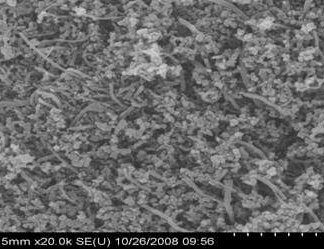
Cheap Tubes’ Conductive Nanotubes Composite Additive is an engineered blend of multi-walled carbon nanotubes (MWCNTs) and conductive carbon black, formulated specifically for use in lithium-ion battery cathode and anode slurries. The blend takes advantage of two complementary conductive mechanisms — long-range percolation from the high-aspect-ratio nanotubes, and short-range surface coverage from the carbon black particles — to achieve target electrical conductivity at significantly lower total additive loading than either material can deliver alone.
How the CNT-Carbon Black Synergy Works
Carbon nanotubes form a percolating conductive network at very low weight percentages (typically 0.5 to 2 wt%) because their micron-scale length lets each tube bridge dozens of active-material particles. However, CNTs alone leave gaps where individual particles aren’t directly contacted, and CNT dispersion can be challenging in cathode slurries.
Conductive carbon black, by contrast, provides excellent local surface coverage on every active particle but requires 5 to 10 wt% loading to span the longer distances needed for full electrode connectivity. By combining the two, the CNT framework provides backbone connectivity while the carbon black ensures every particle is locally connected to the framework. The result: target conductivity is achieved at 1 to 3 wt% total additive loading, leaving more room in the formulation for active material.
Performance Benefits
- Higher energy density — lower additive % means more space for active material per unit cell volume, directly increasing volumetric and gravimetric capacity
- Improved rate capability — better-developed conductive network supports higher C-rates without ohmic loss
- Longer cycle life — reduced cell impedance reduces local heating and mechanical stress on the active material during cycling
- Easier processing — pre-blended ratio eliminates the need to optimize CNT-to-CB ratio in your slurry development
Typical Applications
Our customers use this composite additive for:
- Lithium-ion battery cathodes — LFP (LiFePO4), NMC (LiNiMnCoO2), and LCO (LiCoO2) chemistries
- Graphite and graphite/silicon-composite anodes where additional conductivity helps offset silicon’s volume expansion
- Supercapacitor electrodes using activated carbon or graphene-based active materials
- Solid-state battery research where additive interaction with the solid electrolyte interface (SEI) is critical
Specifications
The standard composite is supplied as a free-flowing powder with a CNT-to-carbon-black ratio optimized for typical Li-ion cathode formulations. Custom ratios are available for research customers developing application-specific blends. Each batch ships with a Technical Data Sheet documenting the carbon nanotube source, average outer diameter, and tested electrical resistivity at standard loadings, plus a current Safety Data Sheet.
Ordering and Custom Formulations
Standard pricing covers research-quantity orders (10 g to 5 kg). For pilot-scale and production quantities, contact us for volume pricing — we ship from Vermont and most orders go out within 5 business days. Custom CNT/CB ratios, custom CNT diameter selections, and pre-dispersion in NMP or PVDF binder solutions are available on request for development projects with specific formulation requirements.
Frequently Asked Questions
How does the CNT/carbon black ratio affect performance?
Higher CNT content (closer to 1:1 with carbon black) improves rate capability and cycle life because the percolation network is denser. Higher carbon black content (e.g., 1:3 CNT:CB) is lower cost and easier to disperse but requires slightly higher total loading. The standard blend is optimized for the most common balance of cost, processability, and performance in commercial Li-ion cathodes.
What loading should I use in my electrode?
For NMC and LFP cathodes, start at 1.5 to 2 wt% of the composite additive in the dry electrode formulation and adjust based on rate capability and impedance testing. Anodes typically use 0.5 to 1.5 wt%. Optimal loading depends on active material particle size, electrode thickness, and target C-rate.
Can I disperse this in NMP for a typical cathode slurry?
Yes. Use 30 to 60 minutes of bath sonication or 5 to 15 minutes of probe sonication in NMP with PVDF binder. The carbon black portion disperses readily; the CNT portion benefits from longer or more energetic sonication. For high-shear mixers (planetary or twin-screw), follow your standard cathode slurry mixing schedule.
Is this composite the same as buying CNTs and carbon black separately?
The end ratio is similar to what you would achieve mixing the two yourself, but the pre-blended composite eliminates the inconsistency that comes from variations in dry-blending or partial mixing. The ratio is calibrated for our specific CNT and carbon black grades, so you skip the optimization step. For high-volume production where formulation discipline is already in place, buying separately may be more cost-effective.
What documentation comes with each order?
Every order ships with a Technical Data Sheet documenting the CNT source, outer diameter range, carbon black grade, blend ratio, and electrical resistivity at standard loadings, plus a current Safety Data Sheet. Certificate of Analysis is available on request. For research projects, we can also provide Raman, TGA, and SEM characterization for the specific batch.
Showing the single result