
What Is a Carbon Nanotube Masterbatch?
A carbon nanotube masterbatch is a pre-dispersed concentrate of carbon nanotubes in a carrier polymer, supplied as pellets, that a processor melts and blends into virgin resin to reach a target CNT loading in the finished part. The dispersion work is already done at the pellet stage, so the masterbatch feeds directly into standard compounding equipment.
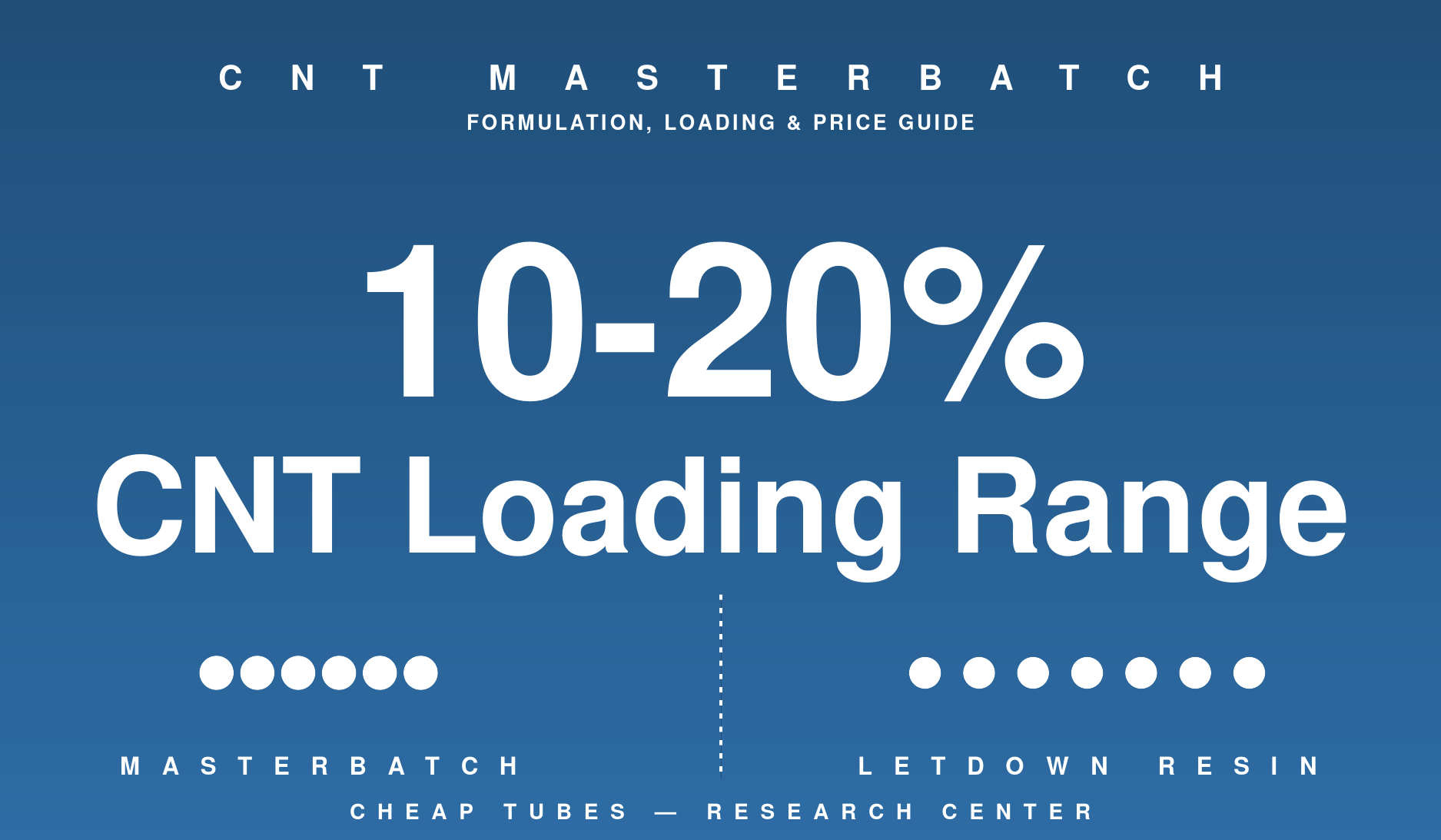
Most CNT masterbatches run 10-20 wt% CNT loading in the pellet, with the carrier resin making up the remaining 80-90% of the mass. A compatibilizer or dispersion aid is often blended in alongside the CNTs to keep them from re-agglomerating during pellet cooling and storage. The finished pellet looks and handles like any other engineering-plastic pellet, not like a powder.
- CNT loading: typically 10-20 wt% of the pellet
- Carrier resin: 80-90 wt% of the pellet, chosen to match the final application
- Form: extruded and pelletized, feeds hoppers on standard extrusion or injection molding equipment
- Dispersion state: set at the pellet manufacturing stage, not left to the end user
Typical Applications for CNT Masterbatch
Processors specify CNT masterbatch pellets across thermoplastic parts where the letdown resin and equipment already exist in-house.
- ESD and EMI shielding for electronics housings and packaging
- Automotive fuel lines, fuel system components, and static-dissipative parts
- Structural composites needing electrical or thermal conductivity alongside mechanical reinforcement
- Conductive coatings and films compounded from a masterbatch-modified resin
- Battery electrode and cell-component materials, alongside conventional conductive additives
Masterbatch vs. Raw Powder vs. Aqueous Dispersion
A masterbatch, raw powder, and an aqueous dispersion all deliver carbon nanotubes to a formulation, but they differ in carrier, form, and which processing step each one skips. Choosing between them comes down to what equipment you run and how much dispersion work you want to do in-house.
- Dry powder: undispersed, lowest cost per kilogram of CNT, requires in-house dispersion
- Masterbatch pellet: pre-dispersed in a carrier resin, melt-processed on standard equipment
- Aqueous dispersion: pre-dispersed in a liquid, water-based carrier for coatings or aqueous processing
Masterbatch vs. Dry CNT Powder
Dry CNT powder arrives undispersed, as bundled agglomerates that the end user must break apart using shear, sonication, or a dispersion aid before the tubes behave as individual high-aspect-ratio filler. A masterbatch skips that step: the dispersion work happens once, at the compounding stage, and the CNTs stay in that dispersed state inside the solid pellet until the next melt-processing step re-distributes them into the final resin.
Masterbatch (Melt Route) vs. Aqueous Dispersion (Flexiphene)
Masterbatch and aqueous dispersion both start from pre-dispersed material, but they enter a formulation through different routes. Masterbatch is a melt-processed solid: it feeds an extruder or injection molder alongside virgin resin, and the carrier only makes sense in a thermoplastic system. Our Flexiphene line takes the liquid route instead, delivering CNTs/Graphenes material dispersed in water for coatings, aqueous processing, or applications where a solvent-free liquid carrier fits the workflow better than a melt-compounded pellet. Pick the route that matches your processing equipment, not the other way around.
Typical CNT Masterbatch Concentrations and Carrier Resins
CNT masterbatch concentrates typically run 10-20 wt% CNT loading, and most formulations trend toward the top of that range: 20 wt% is the workhorse loading, and our CNT/PP 20 masterbatch is Cheap Tubes’ most popular masterbatch product. Higher-loading masterbatches let a processor use less masterbatch pellet per batch, but they also get harder to melt-process as CNT content climbs, since the nanotube network raises viscosity at the pellet stage the same way it does in the final part.
Common Carrier Polymers
Carrier resin selection matters as much as CNT loading, since the carrier has to be compatible with, or identical to, the resin used in the final part.
- PA6 (nylon 6): common for automotive and industrial molded parts
- PA66 (nylon 66): higher heat and chemical resistance than PA6
- PP (polypropylene): widely used, lower-cost carrier for commodity applications
- PE (polyethylene): used where PP is not compatible with the final resin
- PC (polycarbonate): optical and impact-resistant applications
- Epoxy systems: supplied as a liquid concentrate rather than a pellet, mixed directly into resin during formulation instead of letdown through an extruder
A carrier does not always have to match the final resin exactly, since some masterbatches are formulated to be compatible across a small family of resins. A carrier chemically identical to the letdown resin still gives the most predictable melt behavior and avoids introducing a second, mismatched polymer into the part.
Maximum practical loading also depends on the carrier polymer itself, not just the CNT grade. That is why ABS and PA6 masterbatches typically run lower loadings than PP masterbatches: the carrier’s own melt viscosity and processing window set a ceiling on how much CNT content the pellet can carry before it stops melt-processing cleanly.
Calculating Final CNT Loading From a Masterbatch Letdown Ratio
Final CNT loading equals the masterbatch’s CNT concentration divided by the letdown ratio, where a letdown ratio of X:1 means 1 part masterbatch is blended into a total of X parts (1 part masterbatch plus X-1 parts virgin resin).
As a worked example, a 20% CNT masterbatch, our most popular masterbatch loading, let down at a 10:1 ratio (1 part masterbatch blended into 10 total parts) gives a final loading of 20% divided by 10, or 2.0% CNT in the finished part. Run the same formula at other loadings and ratios to hit a target percolation or reinforcement level.
| Masterbatch Loading | Letdown Ratio | Final CNT Loading |
|---|---|---|
| 10% | 5:1 | 2.0% |
| 20% | 10:1 | 2.0% |
| 20% | 8:1 | 2.5% |
| 20% | 20:1 | 1.0% |
Weigh masterbatch and virgin resin by mass, not by pellet count, since pellet size and density can differ between the two materials. Most compounding lines meter by weight feeder anyway, so this maps directly onto standard production setup.
Masterbatch Advantages Over Dry CNT Powder
Masterbatch trades some formulation flexibility for a simpler, safer path to a finished part. For processors running standard thermoplastic equipment, that trade usually pays off.
- Dispersion is already done: no in-house shear, sonication, or dispersion-aid step required before the material can be melt-processed
- No powder handling: pellets avoid the dust exposure, static, and housekeeping concerns that come with fine carbon nanopowder
- Lower EHS burden: less need for engineering controls, such as local exhaust and PPE protocols, built around loose nanoparticle powder
- Drop-in compatibility: feeds standard extrusion and injection molding hoppers alongside virgin resin, with no dedicated dispersion equipment needed
- Consistent starting dispersion state: batch-to-batch pellet quality is set by the masterbatch producer, not re-created by every end user
When Dry Powder Is Still the Right Choice
Masterbatch is not the right answer for every job. Dry powder still wins in a few specific situations.
- Custom carrier resin: your target matrix is not offered as a masterbatch carrier, or is a specialty resin outside common carrier families
- Maximum formulation flexibility: you need to fine-tune loading, additive packages, or a non-standard blend that a fixed-concentration pellet cannot deliver
- Cost at scale: high-volume in-house compounding with existing dispersion capability can run cheaper per kilogram of final resin than buying pre-compounded pellets, once volume is large enough to amortize the dispersion step
- Non-thermoplastic systems: applications outside melt processing, such as certain coatings or elastomer compounds, where powder or a liquid dispersion fits the process better than a pellet
Weigh formulation control and volume economics against the labor and EHS cost of running your own dispersion step before defaulting to either format.
Percolation and Loading Guidance for CNT Masterbatch
The final CNT loading you need depends on percolation threshold, the minimum filler content required to form a continuous conductive network through the resin. Our dispersion-state guide covers this in depth: well-dispersed, high-aspect-ratio CNTs typically reach percolation in the 0.01-0.5 wt% range, while poorly dispersed material can require 1-5 wt% or more to build the same network.
Masterbatch starts from an already-dispersed state, which helps hold effective loading toward the lower end of that range, but the letdown step itself still applies shear during extrusion, and too little mixing at letdown can leave CNT-rich and CNT-poor zones in the final part. Confirm actual network formation with a conductivity or mechanical test on a molded sample rather than assuming the nameplate loading alone guarantees percolation.
CNT Masterbatch Pricing: What Drives Cost Per Kg
CNT masterbatch pricing per kilogram depends on several stacked factors, not a single number that holds across suppliers or specs.
- CNT type: SWCNT-based masterbatches cost more than MWCNT-based masterbatches at the same wt% loading, since raw SWCNT material itself carries a higher per-kilogram cost
- CNT loading: a 20 wt% masterbatch costs more per kilogram of pellet than a 10 wt% masterbatch made with the same carrier and CNT grade
- Carrier resin: engineering resins like PA66 or PC cost more as a base than commodity PP or PE, and that carrier cost carries through into the masterbatch price
- Dispersion quality and verification: a masterbatch with documented dispersion testing, such as microscopy and conductivity data on a molded plaque, costs more to produce than one shipped without that verification
- Order volume and pack size: development packs under 1 kg run higher per kilogram than production drums of 200 kg or more, the same pattern seen across the compounding industry
Because most of a masterbatch pellet’s mass is carrier resin rather than CNT, the finished pellet costs less per kilogram than the equivalent weight of raw nanotube material would on its own. China, Europe, and US-based sources differ on all five factors above, on top of freight and duty. Get a quote against your specific loading, carrier, and volume rather than comparing a generic per-kilogram figure across suppliers.
Evaluating a CNT Masterbatch Before You Buy
A masterbatch’s data sheet tells you the nominal loading and carrier, but three checks confirm whether the pellet actually performs the way the spec sheet implies.
- Melt flow index (MFI, g/10 min): compare the masterbatch’s melt flow against the carrier resin’s unfilled baseline; a large drop signals a heavily networked, high-viscosity CNT structure, while an unexpectedly small change can signal poor dispersion or a lower actual loading than claimed
- Dispersion quality via microtomed sections and optical microscopy: a thin section cut from a molded or extruded sample, examined under optical microscopy at roughly 100-500x magnification, should show few or no agglomerates larger than roughly 1 micron, the same optical-microscopy threshold described in our dispersion-state guide
- Conductivity of molded test plaques: mold a standard test plaque at your target letdown ratio and measure surface or volume resistivity, then compare the result against the expected percolation curve for that CNT type and loading
Run these checks on a development quantity before committing to a production-volume order. A masterbatch that looks right on paper can still under-perform if dispersion quality or actual loading drifts from the data sheet.
Available CNT Masterbatches From Cheap Tubes
Our CNT/PP 20 masterbatch is our most popular masterbatch product, and it, along with the rest of our current lineup, is listed in the CNT Masterbatches category. Beyond the standard lineup, we also build masterbatch products to the application rather than stocking a fixed catalog of every possible carrier and loading combination, and that category page is where new SKUs land as they come online, alongside graphene nanoplatelet masterbatches, including a PA66 masterbatch line, that are in active development now.
The current path to a CNT masterbatch built for your carrier, loading, and application is a paid development evaluation and quote. We do not run open-ended free sample programs; a paid evaluation keeps development work prioritized and gives you real test material to qualify against, not a promise.
- Target application and final part or process
- Carrier resin and letdown equipment already in use
- Target final CNT loading or percolation threshold, if known
- Preferred CNT type: MWCNT for cost-driven volume work, SWCNT where junction resistance or lower loading justifies the premium
- Development quantity needed to run your own qualification before scaling
Frequently Asked Questions About CNT Masterbatches
How Much Does a CNT Masterbatch Cost Per Kg?
There is no single number: price per kilogram depends on CNT type (SWCNT vs. MWCNT), loading (commonly 10-20 wt%), carrier resin, dispersion verification, and order volume, all stacked together. Ask for a quote against your specific loading, carrier, and volume rather than comparing a generic figure across suppliers, since two masterbatches quoted at the same headline price can differ substantially in actual CNT content and dispersion quality.
What Is a Typical CNT Masterbatch Concentration?
Most CNT masterbatches run 10-20 wt% CNT loading in the pellet, and 20 wt% is the workhorse loading, the point most formulations trend toward. Our CNT/PP 20 masterbatch is Cheap Tubes’ most popular masterbatch product. Higher loadings reduce how much masterbatch pellet you need per batch but raise processing viscosity, and the maximum practical loading also depends on the carrier polymer, which is why ABS and PA6 masterbatches typically run lower than PP.
How Do I Calculate My Final Loading From a Masterbatch?
Divide the masterbatch’s CNT concentration by the letdown ratio. A 20% masterbatch let down 10:1 (1 part masterbatch in 10 total parts) gives 2.0% final CNT loading; the same 20% masterbatch let down 8:1 gives 2.5%.
What Carrier Resin Should I Use?
Match the carrier to your final application resin when possible: PA6 or PA66 for automotive and industrial parts, PP or PE for commodity applications, PC for optical or impact-resistant parts, and liquid epoxy concentrates for thermoset systems. A carrier identical to the letdown resin gives the most predictable melt behavior.
Is Masterbatch Better Than Powder for Compounding?
For most processors running standard extrusion or injection molding equipment, yes: masterbatch arrives already dispersed, avoids powder handling and EHS exposure, and feeds standard hoppers directly. Dry powder still wins for custom carriers outside common masterbatch families, maximum formulation flexibility, or high-volume in-house compounding where the dispersion cost is already amortized.
Can I Buy CNT Masterbatch in Small Quantities for R&D?
Development-quantity packs are available through a paid evaluation and quote, sized for bench-scale and pilot-line testing before a production-volume commitment. We do not run free sample programs; a paid evaluation keeps your project prioritized and gives you real material to qualify against.
Does Cheap Tubes Sell CNT Masterbatch Pellets?
Yes. Our CNT/PP 20 masterbatch is our most popular masterbatch product, listed with the rest of our current lineup in the CNT Masterbatches category, where new SKUs, including a graphene nanoplatelet PA66 masterbatch, land as they come online. For a formulation built to your carrier and loading now, request a paid development evaluation and quote.
What Is the Difference Between CNT Masterbatch and Flexiphene?
Masterbatch is a melt-compounded pellet for thermoplastic processing on standard extrusion or injection molding equipment. Flexiphene is our aqueous dispersion line, delivering CNTs/Graphenes material in a liquid, water-based carrier for coatings and other aqueous-processing applications. Pick the format that matches your equipment and process, not the other way around.
Request a Paid CNT Masterbatch Development Evaluation
If you are formulating with MWCNT, SWCNT, or graphene nanoplatelet material and need a masterbatch built to your carrier resin and target loading, send us your application, letdown equipment, and target final loading. Review our MWCNT Buying Guide and GNP Buying Guide to choose the right base material before you scope a masterbatch formulation. We will quote a paid development evaluation sized for your process, built on twenty years of supplying research-grade nanomaterials worldwide.