
Research Watch tracks papers and conference abstracts researchers are chasing right now on carbon nanotube and graphene applications, regardless of whose material was used. This entry covers a 2026 paper in the American Society of Civil Engineers’ Journal of Materials in Civil Engineering from a team at Guangxi University and Huazhong University of Science and Technology on chemically modifying three-dimensional porous graphene (3DG) so it stays dispersed in cement paste. The paper is peer-reviewed and ahead-of-print (accepted for the November 2026 print issue); the publisher’s full text, figures, and detailed data tables sit behind ASCE’s paywall. This coverage draws on the paper’s own published abstract, which reports real numeric results. We’ve quoted those, and we say plainly where the abstract’s detail ends and the paywalled full text begins. Cheap Tubes did not supply material for this study. We’re covering it because graphene dispersion stability in alkaline, cementitious environments is a live problem for anyone working with our graphene oxide or graphene nanoplatelet materials in construction or composite research.
The Problem: Graphene Agglomerates in Cement’s Alkaline Pore Solution
Graphene is one of the most-studied nanoscale reinforcements for cement-based materials. Its two-dimensional structure, high aspect ratio, and mechanical properties make it attractive for densifying microstructure, accelerating hydration, and improving strength and durability. The catch, well known in the cement-nanomaterials literature, is that graphene’s own van der Waals attraction pulls individual sheets back into stacked, agglomerated clumps almost as soon as they’re mixed into an aqueous system, and cement pore solution is an especially hostile environment for staying dispersed. Once cement starts hydrating, the pore solution rapidly becomes strongly alkaline (the literature typically cites pH in the 12.5–13.5 range, driven by dissolved calcium, sodium, and potassium hydroxides), and that high ionic strength compresses the electrostatic double layer that would otherwise keep charged graphene sheets apart. Agglomerated graphene doesn’t reinforce anything. It behaves like a coarse, poorly bonded inclusion, and the strength and durability gains the material is supposed to deliver don’t show up. High-quality graphene is also expensive relative to bulk cement, so agglomeration wastes a costly input on top of costing performance. Solving alkaline dispersion stability is the gatekeeping problem for graphene-cement research generally, not a detail specific to any one study.
What the Team Did
The Guangxi University-led team (Jingwei Ying, Hao Wang, Haijie Yan, Feiming Su, and Caishou Wei) started from three-dimensional porous graphene (3DG), a graphene architecture built as an interconnected porous network rather than flat, discrete platelets, and covalently modified it with polycarboxylate (PC), the same class of chemistry used in PC superplasticizers that concrete producers already use to control workability. The resulting material, which they call PC-modified 3DG (PG), was designed specifically to improve dispersion stability in cement’s alkaline environment rather than to change the graphene’s intrinsic mechanical properties. They tested PG at an extremely low dosage: 0.03% by mass of cement, which works out to only about 0.01% graphene content within the modified material, and evaluated dispersion behavior in solution and in cement paste directly, alongside rheology, hydration heat analysis, X-ray diffraction (XRD), scanning electron microscopy (SEM), and mercury intrusion porosimetry (MIP) to see whether better dispersion actually changed the hardened microstructure.
According to the paper’s own abstract, PG showed superior dispersibility and stability compared with unmodified 3DG, both in solution systems and within cement paste. The covalent polycarboxylate coating did what it was designed to do. Incorporating PG also slightly reduced the yield stress and plastic viscosity of the cement paste (a workability benefit alongside the strength benefit), and the hydration-heat, XRD, and SEM data indicated PG accelerated the hydration reaction and densified the resulting microstructure. MIP analysis showed the more homogeneous PG dispersion inhibited the formation of large pores and reduced total porosity, which the authors link to improved resistance to chloride ion diffusion, a durability property relevant to reinforced concrete service life.
Key Results (as Reported in the Abstract)
at 3 / 7 / 28 days
at 3 / 7 / 28 days
≈0.01% graphene content within PG
Why alkaline dispersion stability is the whole ballgame
Cement pore solution is not a mild aqueous environment. It is one of the more aggressive dispersion conditions a nanomaterial can be asked to survive. As cement hydrates, calcium hydroxide, sodium hydroxide, and potassium hydroxide dissolve into the mix water, driving pore-solution pH into the 12.5–13.5 range and pushing ionic strength well above what most dispersion strategies developed for neutral water or organic solvents were designed to handle. Two mechanisms usually keep nanosheets like graphene or graphene oxide apart in a liquid: electrostatic repulsion (charged surface groups pushing sheets away from each other) and steric hindrance (physical bulk, like an attached polymer chain, getting in the way of re-stacking). High ionic strength compresses the electrostatic double layer and screens surface charge, which is why electrostatic-only stabilization tends to fail in cement pore solution even when it works fine in plain water. That’s the specific reason a covalent, polymer-based modification, like the polycarboxylate coating in this paper, is a sensible design choice: steric stabilization from a bulky, covalently attached polymer chain is far less sensitive to ionic strength than charge-based stabilization alone. Getting this right at a very low dosage (0.03% by cement mass here) also matters economically. Graphene is expensive enough that dispersion strategies requiring high loadings to overcome agglomeration erode the cost case for using it at all.
The mechanism: covalent polycarboxylate modification of a 3D porous network
Two design choices stand out. First, starting from a three-dimensional porous graphene architecture rather than flat platelets: a porous, interconnected network changes how the material distributes through the paste and how it interacts with hydration products, compared with discrete 2D sheets. Second, using polycarboxylate specifically as the modifying chemistry: PC superplasticizers are already a known, cement-compatible chemistry (they’re the workhorse dispersant for cement particles themselves), so grafting PC onto the graphene surface borrows a chemistry the cement system already tolerates well, rather than introducing an unfamiliar surfactant or polymer that might interfere with hydration. The reported combination (better dispersion, slightly reduced yield stress and plastic viscosity, and a denser, less porous hardened microstructure) is a coherent picture: if the graphene stays dispersed instead of clumping, it can actually participate in and influence hydration and pore structure development, instead of sitting inert as an agglomerated inclusion.
Replicating or Extending This Work
Product clarification: the abstract describes the starting material as “three-dimensional porous graphene” without stating a manufacturer, lateral flake size, layer count, or oxidation state, so there is no exact SKU match, and we’re not going to pretend otherwise. 3D porous graphene architectures (foams, aerogels, self-assembled networks) are most commonly built starting from a graphene oxide dispersion. GO’s oxygen-containing functional groups make it water-dispersible and let it self-assemble (hydrothermally or via freeze-drying) into a 3D network before reduction. Cost matters here: cement additions are dosed by mass of cement, so even a low weight percent means bulk quantities of graphene material, and the price gap between a premium research-grade GO and an affordable, QC’d GO adds up fast at that scale. Our Graphene Oxide Powder (id 30170) is the practical starting point for cement and composite dispersion work: spray-dried, QC’d to a tight carbon-to-oxygen specification on every lot, and priced for the quantities this kind of research actually consumes. If your process calls for a partially-reduced sheet instead, our Reduced Graphene Oxide Industrial Grade (id 30171) is the equivalent cost-appropriate option on the reduced side. Both sit in our Graphene Oxide category.
If instead your work calls for a ready-to-disperse graphene platelet material, adding bulk graphene content directly into a cement or composite mix without first building a self-assembled porous network, the more direct analog is our Graphene Nanoplatelets (GNP) line. Covalent polymer modification, as this paper used, is one route to alkaline-stable dispersion. Polymer-free aqueous dispersion approaches, such as our own Flexiphene emulsions, take a different path to the same stability problem. Which starting point makes sense depends on whether your process needs the graphene pre-dispersed and stable in water going in, or whether you’re building your own surface chemistry (like the PC grafting in this paper) as part of the research itself.
Graphene Oxide & GNP for Cement & Composite Dispersion R&D
Graphene Oxide Powder and Reduced Graphene Oxide Industrial Grade are priced and QC’d for pilot-scale cement and composite dispersion work, where additions are dosed by cement mass and material cost adds up fast. Graphene Nanoplatelets are the direct-dispersion option for bulk graphene content in cement, polymer, and composite formulations. Pre-dispersed aqueous Flexiphene emulsions are available where a polymer-free dispersion path is preferred.
Browse Graphene Oxide →Browse Graphene NanoplateletsFrequently Asked Questions
What did the Guangxi University team report?
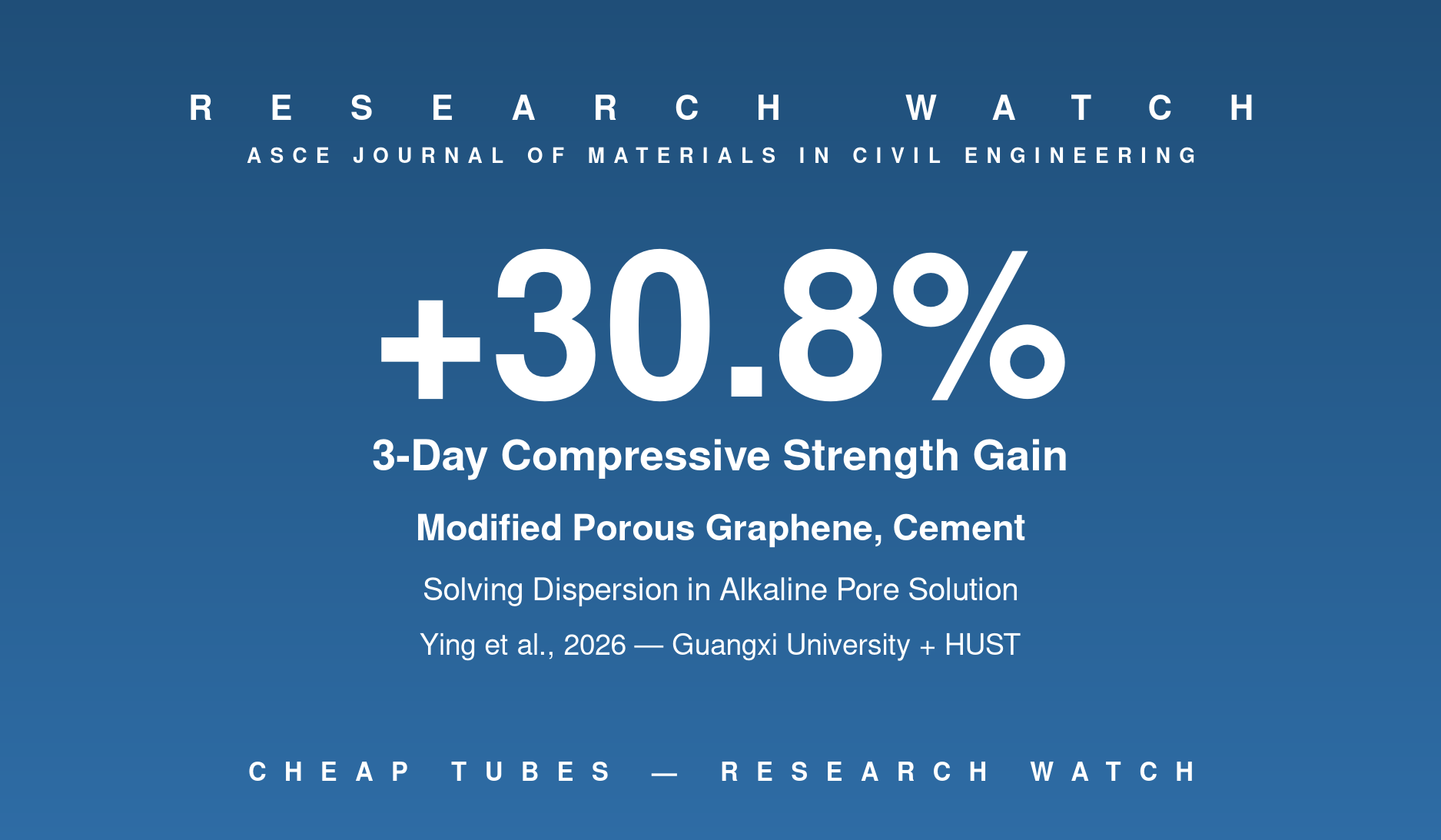
A peer-reviewed paper in ASCE’s Journal of Materials in Civil Engineering describing polycarboxylate-modified three-dimensional porous graphene (PG) engineered to resist agglomeration in cement’s strongly alkaline pore solution. At 0.03% cement mass dosage, the paper’s abstract reports compressive strength gains of 30.8%, 28.8%, and 26.4% at 3, 7, and 28 days versus plain cement paste, alongside reduced total porosity and improved resistance to chloride ion diffusion, which the authors attribute to better dispersion enabling accelerated hydration and a denser microstructure.
Is this a peer-reviewed paper or a preliminary abstract?
It’s a peer-reviewed journal article, accepted and ahead-of-print in ASCE’s Journal of Materials in Civil Engineering (assigned to the November 2026 print issue, volume 38, issue 11). The publisher’s full text, figures, mix-design tables, and detailed discussion are behind ASCE’s paywall. This coverage is based on the paper’s own published abstract, which does report real numeric results. We’ve quoted those and linked the paywalled paper for anyone who wants the full dataset.
Did Cheap Tubes supply the material used in this study?
No. Cheap Tubes did not supply material for this study. This is Research Watch coverage of a paper we found relevant to graphene dispersion research, not an Application Spotlight, and the paper does not name Cheap Tubes or reference our products. We cover items like this because alkaline dispersion stability is directly relevant to researchers using our graphene oxide and graphene nanoplatelet materials in cement or composite work.
What material would I need to replicate or extend this work?
The abstract doesn’t specify a graphene manufacturer, flake size, or oxidation state for the starting 3D porous graphene, so there’s no exact SKU match. If you’re building a similar self-assembled porous network from a solution-processable precursor, Graphene Oxide Powder is the cost-appropriate starting point for cement-scale dosing, with Reduced Graphene Oxide Industrial Grade as the equivalent option on the reduced side. If you want a ready-to-disperse platelet material for direct addition to a cement or composite mix, Graphene Nanoplatelets are the more direct analog. The polycarboxylate surface modification itself is not a Cheap Tubes product and would need to be developed or sourced separately.